Box squat: technique, box height and programming
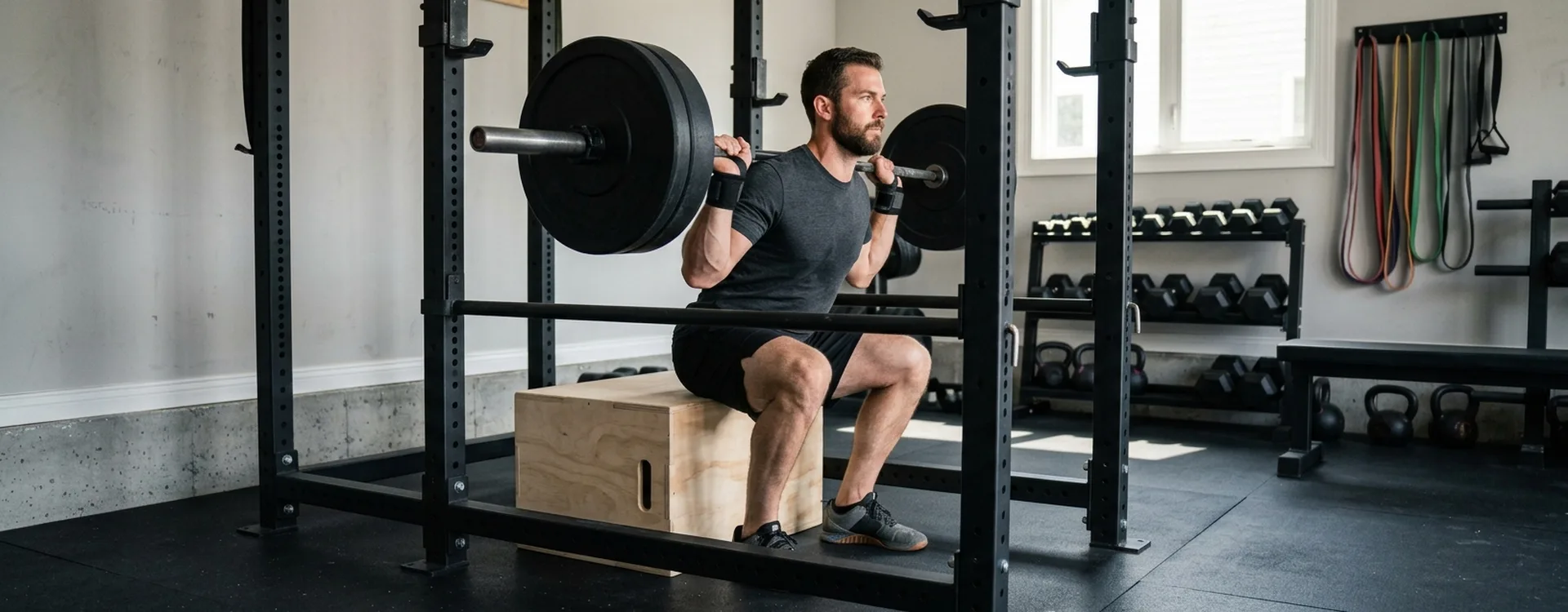
The box squat consists of sitting down on a box placed behind you, staying still for one second without losing your brace, then standing back up from the dead stop. Set at parallel, the box imposes the same depth on every rep and forces you to sit your hips back, which works the glutes, hamstrings and lower back more than the quads. It is done in a rack, with the safeties set just below seat height, as a complement to the regular squat and not as a replacement for it.
Setting up the station in your home gym
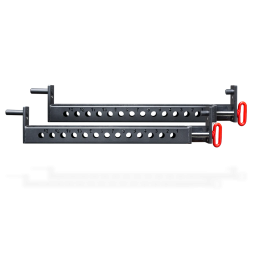
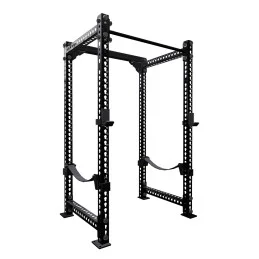
You are squatting down under a loaded bar, so the box squat is done in a rack. Set the safeties just below seat height. If you fail at the bottom, the bar then rests on the safety arms instead of crushing you against the box. The CS-1 power rack (75 × 75 mm uprights, 800 kg) and the CS-Basic (50 × 50 mm, 350 kg) can both be set up this way, and our guide to power rack exercises covers the other movements you can do in the cage.
For the seat, use a support that doesn't move: a plyo box, a sturdy flat bench or stacked tiles. Set it at parallel first: once you are seated, the top of your thigh is level with your knee. You will then adjust it 2 to 3 cm up or down depending on what you want to work on.
Why sitting down changes the squat
- The hips move first. To reach a support located behind you, you have to push your pelvis back. The shin stays more vertical and the work shifts from the quads to the glutes, hamstrings and lower back. It is the most direct fix for lifters who start the descent by pushing their knees forward.
- Depth that doesn't cheat. As the weights go up, the squat often gets shorter without anyone noticing. The box, on the other hand, stays at the same height from one set to the next and from one week to the next. If you train alone, it is the objective reference you are missing.
- A start with no momentum. In the regular squat, the stretch of the muscles at the bottom of the movement (the stretch reflex) helps you drive back up. The pause on the box removes that help: you have to produce force from a motionless position. This builds starting strength, the kind that is lacking when a heavy bar stalls at the bottom.
- Fatigue that is easier to absorb. You recover better from a box squat than from a heavy regular squat, which lets you put the squat pattern into your week more often.
A clean rep in five steps
- Brace. Lock your abs and upper back before leaving the standing position.
- Descent. Send your hips back and control the bar all the way down to contact with the box, including the last few centimeters.
- Sit. Really sit down. Only the hip flexors relax; abs, back and upper back stay contracted.
- Pause. One second of stillness, with no bounce.
- Drive up. Push explosively from the dead stop, torso stable, bar over the middle of your foot.
Five faults to watch for
| Fault | Consequence | Fix |
|---|---|---|
| Letting everything go once seated | Abs relaxed, upper back rounding, knees caving in: standing back up becomes risky | Relax only the hip flexors |
| Bouncing off the box | The pause disappears, and with it the dead start that makes the exercise worthwhile | Hold a real one-second pause |
| Dropping onto the box | The spine absorbs the impact | Control the speed all the way to contact |
| Tipping the torso forward to stand up | The bar moves in front of the middle of the foot, and the movement stops being a squat | Push into the floor while keeping your torso angle |
| Raising the box to load more weight | A bigger number with no real benefit | Only raise the box for a specific reason: overloading one portion of the movement, working around discomfort or targeting an identified weakness |
Programming the box squat for your goal
The lift is suited to speed work, with light weights moved fast, as well as to heavy work. Box height is the first variable, but you can also change your stance width, switch bars or choose the type of resistance: plates only, bands or chains.
| Goal | Box height | Load | Sets × reps |
|---|---|---|---|
| Learning to sit your hips back | Parallel (top of the thigh level with the knee) | Light to moderate | 4 to 5 × 5 |
| Speed and starting strength | Parallel or 2 cm below | 50 to 60% of max | 8 × 2, 60 s rest |
| Heavy strength | Parallel | 80 to 90% of max | 3 to 5 × 2 to 3 |
| Overloading one portion | Above parallel | Heavier than your regular squat max | 2 to 3 × 2 to 3 |
Bands and chains make the bar heavier as you stand up, which forces you to accelerate all the way to the top. How to attach them to the rack is explained in our band guide and our chain guide.
The limits of the exercise
It is an object that sets the depth, not your range of motion. As a result, some weaknesses stay hidden as long as you only do box squats:
- a competition depth you can't hold without support;
- hamstrings that are too weak, which the pause relieves instead of exposing;
- a lack of hip or ankle mobility.
Preparing for a competition, or has your regular squat stopped progressing? Keep some regular squats in your week and work on these points separately, with paused squats, front squats and stiff-legged deadlifts.
The Uni Strength equipment for the box squat
A rack with adjustable safeties to set the depth, bands and their anchor points for accommodating resistance: here is the equipment we offer for box squatting at home, shipped from our warehouse in France.
| Product | Key points | Price incl. VAT |
|---|---|---|
| CS-1 Power Rack 204 cm, 4 uprights, 76 cm depth | Complete bundle | 75 x 75 mm uprights, 800 kg capacity, holes every 5 cm, pull-up bar and J-cups included | 1 199,99 € |
| CS-1 Folding Safeties | 76 or 104 cm folding safeties, 3 mm steel, 500 kg, sold as a pair | from 249,99 € |
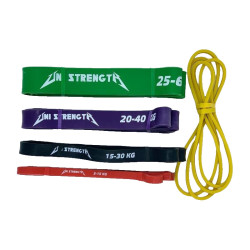
| Uni Strength 5-piece Resistance Band Kit | 5 resistance bands for strength, mobility and pull-up assistance | 64,99 € |
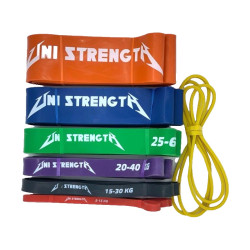
| Kit of 7 Uni Strength elastic bands - training band | 7 multilayer latex bands, smooth progressive elasticity | 129,99 € |
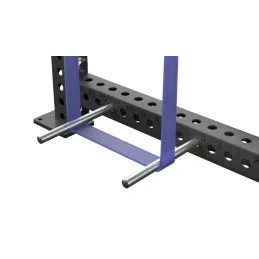
| CS-1 Band Pegs | Set of 4 band anchor points for the 75 x 75 mm uprights of the CS-1 rack | 59,99 € |
Prices incl. VAT as of 9 October 2026. Free delivery from €300 excl. VAT in mainland France, instalment payment available. For advice on your home gym setup, write to [email protected] or call +33 4 83 39 67 96.
Further on the shop: Rack CS-1 - Complete and Modular Rack, CS-1 Rack and Squat Cage Accessories, Strength Training Accessories, Power Racks & Squat Racks.
Your box squat questions
What box height should I choose to start with?
Parallel: when you are seated, the top of your thigh is level with your knee. Lower it by 2 to 3 cm to strengthen the bottom of the movement, and only raise it to overload a specific portion.
Do you really have to sit on the box?
Yes, fully, but without relaxing. During the one-second pause, the hip flexors are the only muscles that relax; the back, the abs and the upper back stay braced.
Is the box squat enough on its own?
No. It teaches you to sit your hips back and builds starting strength, but it can let a lack of mobility or hamstring strength go unnoticed. Alternate it with the regular squat.
Can a beginner do it?
Yes, with a light load. It is actually the simplest way to learn to sit your hips back and hold a consistent depth.
In summary
The box squat pays off as long as you stay braced, hold the pause and choose the box height for a specific reason. To set it up at home, a CS-1 rack or a CS-Basic rack is enough, and bands then let you work on acceleration. To fit the exercise into your preparation, read our SBD tips and our comparison belt squat or regular squat.
Also worth reading: Progressive range of motion: the same bar, an ever longer lift.