Our SBD Tips: Squat, Bench and Deadlift
SBD combines the three fundamental powerlifting exercises: squat, bench press and deadlift. These multi-joint movements develop raw strength, stability and functional power. In weight training, they form a solid basis for structured, measurable progress.
Squat
The squat is one of the most fundamental and effective exercises in strength training. This multi-joint movement mainly involves the quadriceps, hamstrings, glutes and lower back muscles. As well as developing the muscles, the squat strengthens the entire posterior chain and improves overall body stability. You can choose between the belt squat and the classic squat.
Optimum technical execution begins with solid foot placement, generally at shoulder width or slightly wider, with moderate external rotation. The bar should rest firmly on the trapezius muscles, creating a vertical line of force through the middle of the foot. On descent, the movement is initiated by pulling back the hips, keeping the torso as straight as possible and the knees in line with the toes. The ideal depth corresponds at least to a position where the thighs are parallel to the ground, or even lower, depending on your joint mobility.
Progressing in the squat requires a methodical approach, combining periods of moderate volume with phases of higher intensity. Beginners will benefit from a twice-weekly frequency, while more advanced athletes can vary the types of squats to target different aspects of their muscle and strength development. The kettlebell squat is an interesting variation, especially for beginners.
Bench Press

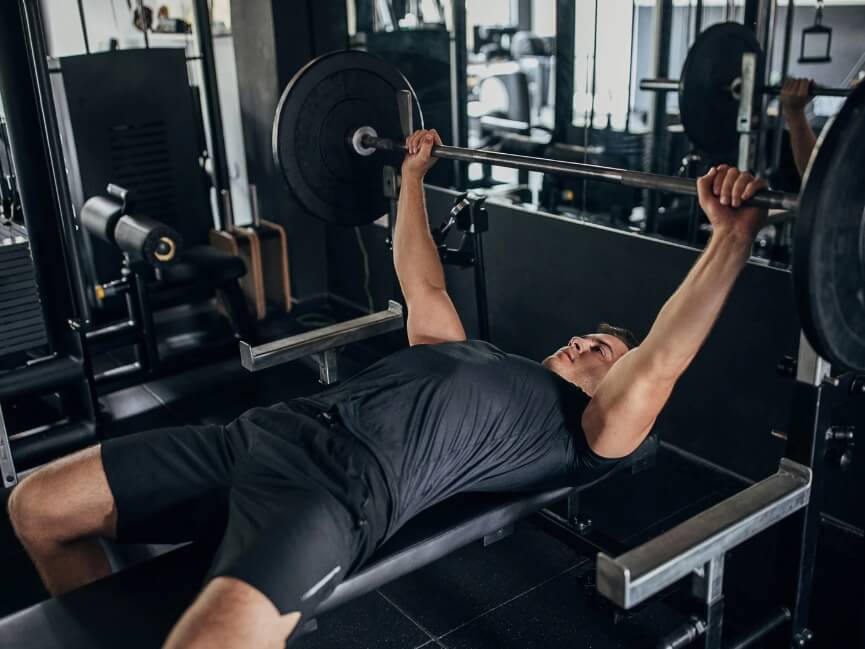
The bench press is the benchmark exercise for developing upper-body strength and muscle mass. It primarily targets the pectorals, anterior deltoids and triceps, while also calling on numerous stabilizing muscles. Its popularity is justified by its effectiveness in developing the entire upper thrust chain.
Optimal technique begins with a stable position on the bench: feet firmly planted on the ground, shoulder blades tight and a natural, slight lumbar arch. The grip on the bar, generally slightly wider than shoulder-width apart, should enable optimal alignment of wrists, elbows and shoulders during the movement. The descent is made in a controlled manner down towards the chest, followed by an explosive but controlled push, maintaining body contact points with the bench.
Effective bench press programming generally alternates between periods of pure strength (short sets, heavy loads) and volume phases (longer sets, moderate loads). The judicious integration of variations such as the incline or decline bench press, as well as accessory exercises targeting weak points, will ensure optimal long-term progress.
Deadlift
The deadlift is the ideal exercise for assessing and developing overall body strength. This movement simultaneously calls on almost all the major muscle groups: erector spinae, hamstrings, quadriceps, glutes, trapezius, forearms and abdominals. It reproduces one of the most fundamental motor patterns: lifting a weight off the ground.
Technical execution begins with precise positioning facing the bar, feet hip-width apart, toes pointing slightly outwards, with the bar centred above the mid-foot. Initial engagement involves bending the hips and knees to grip the bar, while keeping the back in neutral, the chest high and the shoulder blades slightly retracted. The concentric phase is initiated by a push to the floor with the legs, followed by a progressive extension of the hips, keeping the bar close to the body throughout the movement.
Unlike other SBD movements, the deadlift places a particularly heavy load on the central nervous system, requiring careful management of training volume and frequency. For most exercisers, a weekly high-intensity deadlift session, supplemented by more moderate-intensity variations or accessory exercises, represents the optimum approach to progress without the risk of overtraining.
Our Tips
Basic principles for a successful SBD
| Aspect | Recommendations |
|---|---|
| Technique | Systematically prioritize quality of execution over load. Film yourself regularly to analyze your movement. |
| Progression | Follow a linear progression at first (add 2.5-5 kg per week), then switch to a wavy periodization when it becomes too difficult. |
| Frequency | Beginners: 2-3x/week per movement. Intermediates: 1-2x/week directly, plus accessory work. |
| Volume | Start with 15-25 total reps per session and movement, gradually increasing according to your recovery capacity. |
Warm-up and cool-down
- General warm-up: 5-10 minutes of light cardio to raise body temperature
- Specific warm-up: Progressive sets at 40%, 60%, 80% of your workload
- Active recovery: Joint mobility between training sessions
- Passive recovery: 7-9 hours sleep daily, optimal hydration
Strategic nutrition for SBD
| Nutrient | Recommended intake | Role in performance |
|---|---|---|
| Protein | 1.6-2.2g/kg body weight | Muscle protein synthesis, tissue repair |
| Carbohydrates | 4-7g/kg body weight | Glycogen restoration, primary energy source |
| Lipids | 1-1.5g/kg body weight | Hormonal balance, vitamin absorption |
| Hydration | 35-45ml/kg body weight | Neuromuscular performance, thermoregulation |
Progression by experience level
- Beginner (0-1 year): Master basic technique, progress linearly, establish consistency
- Intermediate (1-3 years): Identify your weak points, integrate variations, begin periodization
- Advanced (3+ years): Micro-periodization, increased specificity, optimized fatigue management
Personalize according to your morphotype
- Ectomorph: Focus on medium loads, moderate volume and short recovery.
- Mesomorph: Balance volume and intensity according to your strengths
- Endomorph: Alternate pure strength sessions with metabolic circuits
By adopting these strategies and remaining consistent in your practice, you'll maximize your progress on the three fundamental SBD movements, creating a solid foundation for your overall physical development.
To go further in the shop: Olympic bars, Calibrated weights Powerlifting, Power racks, Flat Bench Weight Training.
The equipment for the squat, bench press and deadlift
| Lift | Equipment | Key figure |
|---|---|---|
| Squat | CS-1 power rack 204 cm, complete pack | 800 kg maximum load, safety straps and J-cups included |
| Bench press | UF Power Bench | 750 kg maximum load, 43 cm high, 30 or 35 cm pad |
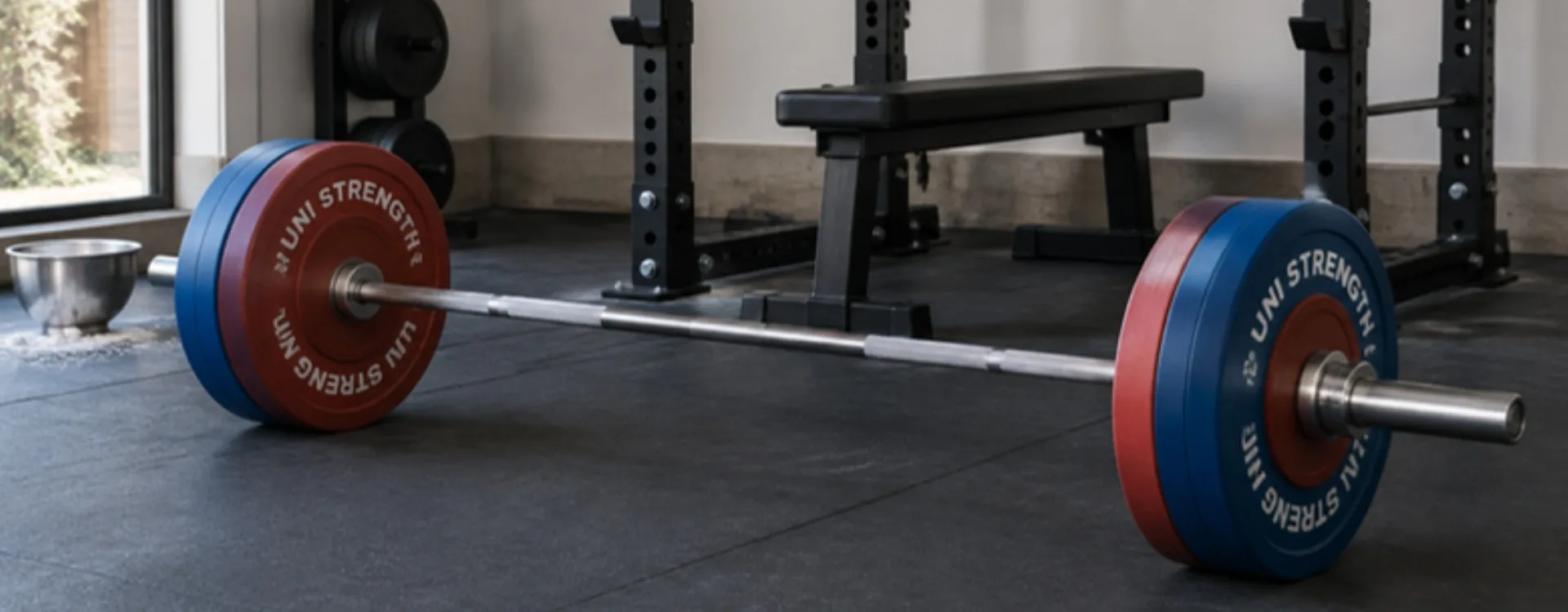
| All three lifts | UF-Power Zeus powerlifting bar | 20 kg, built to IPF specifications, 1,000 kg capacity |
| Exact loads | 159 kg calibrated plate set | 10 g tolerance per plate, IPF colours |
| Deadlift | Deadlift platform | 120 x 100 cm, rubber drop zones, 30 mm cushioning |
Specifications taken from the product pages on 9 October 2026.
Frequently asked questions
What does SBD mean in strength training?
Squat, Bench press and Deadlift: the three strength movements that work the whole body.
How do you warm up before an SBD session?
5 to 10 minutes of light cardio, then progressive sets at 40, 60 and 80 % of the working load.
Why does the deadlift need more recovery?
It places a particularly heavy load on the central nervous system and requires careful management of volume and frequency.
Also worth reading: to get your setup right, read how to keep your arch when you unrack the bar and, before your first meet, the guide to your first powerlifting meet, and for the squat, how to set up under the bar.
Also worth reading: Progressive range of motion: the same bar, an ever longer lift.