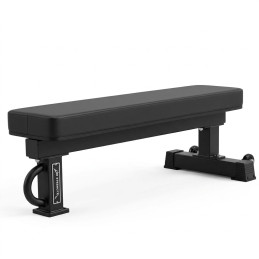
Flat Bench: Essential for Versatile and Safe Training
The flat weight bench is an essential element for any training space, whether dedicated to powerlifting, strength training or fitness. Designed to offer maximum stability, it guarantees optimal support for exercises requiring solid support, such as bench press, dumbbell rowing or bench dips.
Thanks to its robust and durable construction, this bench supports heavy loads while ensuring superior comfort with quality padding. It allows smooth and safe execution of movements, promoting better posture and optimal strength gains.
Whether you are an experienced athlete or a beginner, our flat bench integrates perfectly into your training space, offering reliable support to improve your performance.
Discover our selection and choose the ideal bench for your goals!
The advantages of a Quality Flat Bench
- Stability and safety: Designed to support heavy loads without unwanted movement, ensuring confident training.
- Enhanced comfort: High-density padding for optimal support and good pressure distribution during exercises.
- Maximum versatility: Ideal for a wide range of strength training exercises, from chest work to back and triceps movements.
- Exceptional durability: Made with resistant materials, designed to last even with intensive use.
- Suitable for all levels: Whether you are a beginner or experienced athlete, a quality flat bench accompanies you in your progression.
Exercises and Targeted Muscles with a Flat Bench
| Exercise |
Primary Muscles |
Secondary Muscles |
| Barbell bench press |
Chest |
Triceps, front deltoids |
| Dumbbell bench press |
Chest |
Triceps, stabilizers |
| Dumbbell fly |
Chest (isolation) |
Front deltoids |
| Pullover |
Chest, lats |
Triceps, serratus |
| Close-grip bench press |
Triceps |
Chest, shoulders |
| Lying triceps extension |
Triceps (isolation) |
- |
| Lying curl |
Biceps |
Forearms |
| Bench crunch |
Abs |
Hip flexors |
| Weighted sit-up |
Abs |
Hip flexors |
| Single-arm dumbbell row |
Lats |
Biceps, rhomboids |
How to choose a Flat Bench for strength training?
The choice of your weight training flat bench depends above all on your goals and your morphology.
First prioritize the load capacity: it must largely exceed your body weight added to the loads you handle. An 80 kg athlete using 100 kg on bench press should aim for a bench supporting minimum 250 kg for optimal safety.
Next, check the dimensions: the length must allow comfortable support from head to glutes, at least 120 cm for most builds. Width influences stability - 30 cm offers a good compromise between comfort and freedom of movement.
Concerning height, it should allow you to place your feet on the ground when lying down, generally between 42 and 48 cm. For budget, a quality cheap flat bench starts around €150, but investing €200-300 guarantees robustness and longevity for intensive use. Finally, consider available space: some models fold or stack to optimize storage in small home training spaces.
Frequently asked questions about flat benches
30 cm or 35 cm flat bench?
The 30 cm pad is the competition width: it leaves the shoulders free and follows powerlifting standards. The 35 cm pad gives more shoulder support for volume sessions and broad builds. Both UF Power Benches share the same frame: 11-gauge steel, 750 kg capacity, 32 kg, 122 cm long, 10 cm thick padding.
How high is the bench?
43 cm, the height used in competition: feet stay flat on the floor for most builds, which allows leg drive in the bench press.
Does the bench fit under a rack?
Yes: at 122 cm long, the UF Power Bench slides between the uprights of the CS-1 and Athena racks for bench pressing. Its handle and wheels make it easy to move.
Which exercises can I do on a flat bench?
Barbell or dumbbell bench press, dumbbell rows, bench dips, step-ups, hip thrusts, flyes and pull-overs. The 750 kg capacity (lifter plus bar) is suited to heavy pressing.
Which versions exist?
Four references: 30 cm or 35 cm pad, in black or red. Same height, same frame and same padding; only the pad width changes.
Our guides: the best weight bench in 2026, what are the types of weight benches?, building a bench press arch, why commercial gym benches hold back your progress