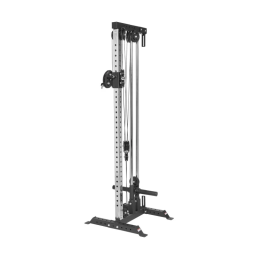
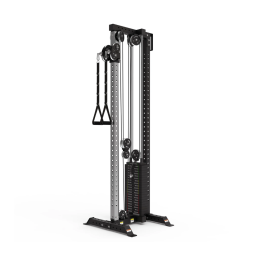
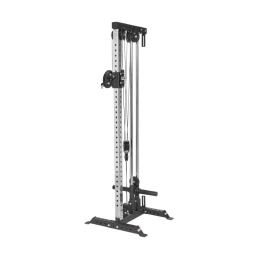
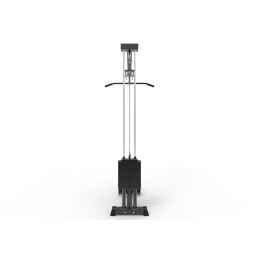
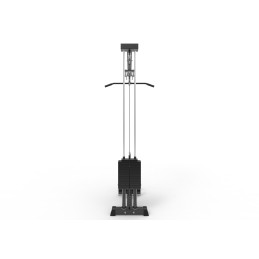
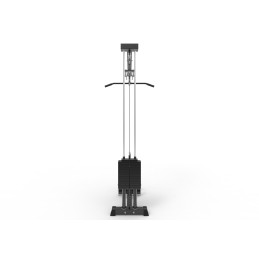
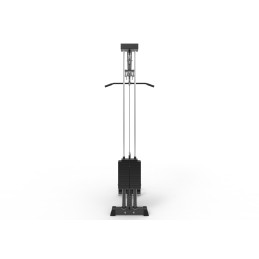
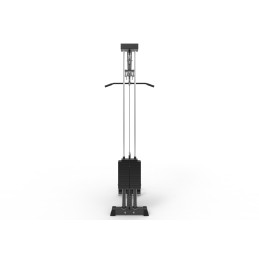
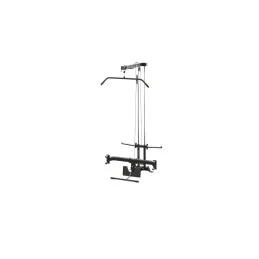
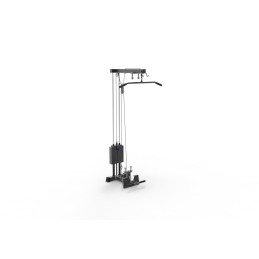
A cable pulley machine is one of the most versatile pieces of equipment for building strength, hypertrophy and mobility. Whether you are equipping a home gym or a commercial gym, adding a pulley system opens the door to dozens of targeted exercises, with constant muscle tension and a control of the movement that free weights alone cannot reproduce. At Uni Strength, we design sturdy, smooth and upgradeable pulleys to meet the demands of serious lifters.
What is a cable pulley machine?
A cable pulley machine is made of a cable, one or more guide wheels and a resistance system (Olympic plates or a weight stack). The principle is simple: the cable transmits the load through the pulleys to create continuous resistance over the full range of motion. Unlike dumbbells and barbells, where gravity imposes a single direction of resistance, the pulley lets you train at varied angles and keep constant muscle tension, including at the end of the movement.
This mechanism offers several biomechanical advantages. The resistance stays linear and predictable, which reduces joint stress and allows precise control of the eccentric phase. That is why the pulley is used both for hypertrophy and for rehabilitation, and why it is a cornerstone of training in the gym as well as at home.
The types of cable pulleys offered by Uni Strength
Choosing a pulley depends above all on the exercises you want to perform and on the layout of your space. Uni Strength offers several categories of pulleys to cover every need, from beginners to advanced competitors.
The high pulley
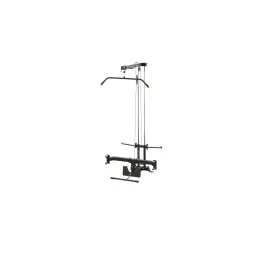
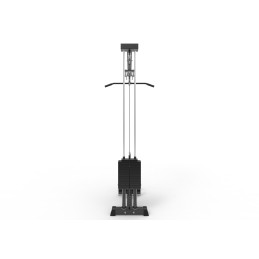
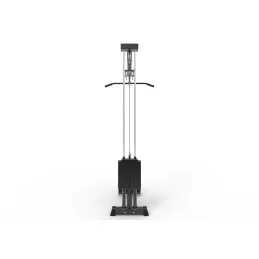
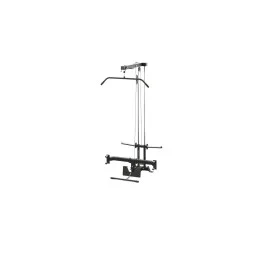
The high pulley places the cable attachment point above your head. It is mainly used for vertical pulls (lat pulldown), triceps extensions, face pulls and cable crunches. It is the reference tool for building back width and arm definition. On Uni Strength racks, the high pulley is built into the system or available as a dedicated accessory, notably with the CS-1 high/low pulley kit.
The low pulley
The low pulley places the anchor point at floor level. It is essential for biceps curls, seated rows, leg raises and horizontal pulls. The low cable position gives an optimal pulling angle for back thickness work and lower-body strengthening. Uni Strength systems always include a low point in their high/low configurations, as on the CS-Basic pulley.
The adjustable pulley
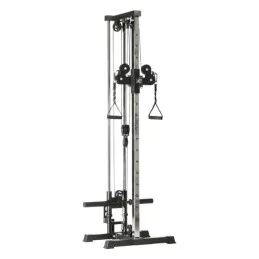
The adjustable pulley combines the high and low functions in a single machine thanks to a carriage that moves along a vertical rail. The attachment point can be set at any height, which lets you vary the working angles endlessly: chest flyes, lateral raises, shoulder rotations, woodchops and much more. The plate-loaded Athena adjustable pulley is the flagship Uni Strength model, with 33 height settings and a 76 x 76 cm footprint.
The all-in-one station (rack + pulley)
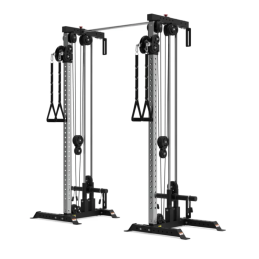
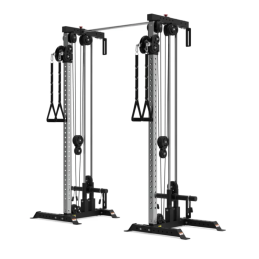
For lifters who want a complete setup without multiplying machines, the Athena all-in-one rack pulley combines a power rack and an adjustable pulley system in a single structure. This type of station lets you go from squats to cable pulls in seconds, without changing stations. It is the most compact and most versatile solution for a home gym focused on strength and hypertrophy.
Uni Strength pulley comparison table
| Pulley type |
Cable positions |
Main exercises |
Ideal for |
| CS-1 high/low pulley |
High + low (fixed) |
Lat pulldown, curl, triceps extension, row |
CS-1 rack owners |
| CS-Basic high/low pulley |
High + low (fixed) |
Lat pulldown, curl, row, crunch |
CS-Basic rack owners |
| Athena adjustable pulley |
33 adjustable positions |
Flyes, raises, rotations, face pull, curl, extension |
Versatile home gym, functional training |
| Athena all-in-one rack pulley |
Adjustable + built-in rack |
Squat, press, pulldown, curl, extension, dips |
Complete setup in a single machine |
How to choose the right cable pulley machine?
Investing in a cable pulley machine is a structuring choice for your training. Several criteria should guide your decision to find the model best suited to your goals and your environment.
The muscles you want to develop
If your priority is back width (lats, traps), a high pulley or a high/low system is the most relevant choice. For targeted work on the arms, shoulders and chest at varied angles, an adjustable pulley offers greater versatility. Lifters who want to train the whole body without compromise will turn to an all-in-one station combining rack and pulley.
Your experience level
Beginners benefit particularly from the pulley thanks to its guided movement and progressive resistance: simply add or remove plates to adjust the load precisely. Intermediate and advanced lifters will appreciate the high load capacity of Uni Strength systems (up to 250 kg on the CS-1 pulley) and the possibility of using intensity techniques such as drop sets, partial reps or controlled tempo.
Available space
In a home gym, footprint is often the deciding factor. The Athena adjustable pulley takes up only 76 x 76 cm of floor space, which makes it compatible with small rooms. If you already own a CS-1 or CS-Basic rack, a high/low pulley kit fits directly onto your existing structure with no extra floor space. In a commercial gym, all-in-one stations or crossover configurations optimise the exercises-per-square-metre ratio.
Budget
Olympic plate loading is the most economical option: you use the plates you already own, at no extra cost. A weight stack (built-in weight column) offers greater comfort for quick load changes, but is a bigger investment. At Uni Strength, both options are available in the Athena range, so you can choose according to your priorities.
The benefits of a cable pulley machine at home
Installing a cable pulley machine in your home gym radically changes the nature of your sessions. Here are the main benefits you will get.
The first advantage is versatility. A single adjustable pulley lets you perform dozens of exercises for the whole body: back, chest, shoulders, arms, abs, glutes and legs. On its own, it replaces several dedicated machines usually found in gyms.
The second strength is safety. Unlike free-weight movements, the pulley removes the risk of getting pinned under a bar when you fail a rep. The cable-guided movement also reduces the postural compensations that cause injuries over the long term.
The third benefit is fine progression. Plate loading allows increments of 0.5 or 1 kg, which is ideal for progressive overload without forcing overly large jumps. This granularity is especially valuable for small muscle groups (side delts, biceps, triceps), where standard load jumps are often too aggressive.
Finally, the pulley provides constant tension over the full range of motion, which maximises time under tension, a key factor in muscle hypertrophy. You get a more complete mechanical stimulus on every rep compared with dumbbells or resistance bands.
How to use a cable pulley machine?
The pulley is an intuitive machine, but a few basic principles help you get the most out of it and avoid common mistakes.
Set the cable height according to the exercise. The attachment point should face the target muscle or sit in line with the desired path. For a lat pulldown, the cable starts from the top. For a biceps curl, it starts from the bottom. For chest flyes, set it at shoulder height.
Choose the right handle. The straight bar suits lat pulldowns and extensions. The rope is ideal for face pulls and triceps extensions. Single handles allow unilateral work to correct muscle imbalances. Uni Strength offers a full range of handles and accessories compatible with all its pulleys.
Control both phases of the movement. The pulley is particularly effective when you master the eccentric phase (lowering the load). Resist the temptation to let the weight return freely: it is during this braking phase that the muscle undergoes the most mechanical damage, which is essential for muscle growth.
Main exercises and muscles worked
| Exercise |
Cable position |
Main muscles |
| Lat pulldown |
High |
Lats, traps, biceps |
| Seated row (horizontal pull) |
Low |
Back (thickness), rear delts |
| Biceps curl |
Low |
Biceps, forearms |
| Triceps extension |
High |
Triceps |
| Cable fly (chest fly) |
Middle (adjustable) |
Chest, front delts |
| Face pull |
High |
Rear delts, traps, rhomboids |
| Lateral raise |
Low |
Side delts |
| Cable crunch |
High |
Abs, obliques |
| Pull-through |
Low |
Glutes, hamstrings |
| Woodchop (rotation) |
High or low |
Obliques, transverse abdominis, abs |
How to maintain your cable pulley machine?
Regular maintenance guarantees the longevity of your equipment and a smooth movement over the years. Uni Strength pulleys are built from reinforced steel with galvanised cables and quality bearings, but a few simple steps will extend their service life.
Lubricate the bearings and axles every two to three months, or as soon as you feel unusual resistance when the carriage slides. Use a silicone- or PTFE-based lubricant suited to metal mechanisms. Avoid thick greases that attract dust and clog the pulleys over time.
Inspect the cable regularly. Look for signs of wear: frayed strands, deformations or abnormal kinks. A cable in good condition shows no loose strand along its entire length. If you notice visible wear, replace the cable before it gives way under load.
Clean the rail and carriage with a dry or slightly damp cloth to remove dust and chalk residue. On Athena pulleys fitted with aluminium bearings, monthly cleaning is enough to keep optimal sliding.
Check the bolts and fixing points once a month, especially if your pulley is mounted on a rack. Repeated vibrations can loosen some bolts over time. A quick check with a screwdriver or Allen key prevents any mechanical play.
Frequently asked questions about cable pulley machines
What is the difference between a high pulley and a low pulley?
The high pulley sets the cable above your head and is mainly used for lat pulldowns, triceps extensions and crunches. The low pulley places the cable at floor level for curls, rows and raises. Uni Strength high/low systems combine both in a single machine, while an adjustable pulley also offers every intermediate position.
Can a cable pulley machine be used for rehabilitation?
Yes. The pulley is one of the most widely used tools in rehabilitation and sports physiotherapy. Progressive resistance, controlled movement and no risk of being crushed make it an ideal choice for returning from a joint or muscle injury. Plate loading allows very fine increments (from 0.5 kg) for a progression adapted to each stage of recovery.
What maximum load can a Uni Strength pulley take?
Load capacity varies by model. The CS-1 high/low pulley takes up to 250 kg thanks to its galvanised steel cables and aluminium pulleys. The Athena adjustable pulley works at a 2:1 ratio by default, ideal for isolation work, and switches to 1:1 with the 2-in-1 adapter for heavy loads: the weight loaded then matches exactly the resistance you feel.
Do I need to bolt my pulley to the floor?
Yes for a free-standing pulley. The Athena adjustable pulley has a small footprint for its height: it must be securely fixed to the floor, a wall or a rack (fixing hardware not included). Pulley kits mounted on a rack (CS-1 or CS-Basic), on the other hand, benefit from the stability of the rack structure itself. If your rack is not anchored, weight storage sleeves or plates stored on the uprights improve overall stability.
Which pulley should a beginner choose?
For a beginner, the plate-loaded Athena adjustable pulley is the best entry point. It offers maximum versatility with 33 height settings, plate loading reduces the initial cost, and its small footprint suits small spaces. If you already own a CS-1 or CS-Basic rack, adding the high/low pulley kit is the most economical way to broaden your training options without an extra machine.
What is the difference between plate loading and a weight stack?
Plate loading uses your existing Olympic plates: it is the most economical and most scalable option, since you can load as much as your plates allow. A weight stack (built-in weight column) lets you change the load by simply moving a pin, which is faster and more practical for drop sets or supersets. At Uni Strength, the Athena range is available in both versions to suit every preference.
Our guides: which pulley to choose, how to maintain your pulley, setting elbows and wrists for chest and back.