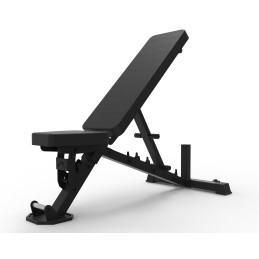
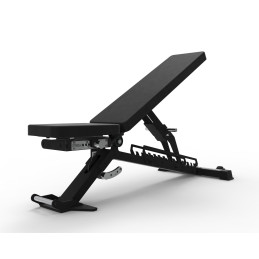
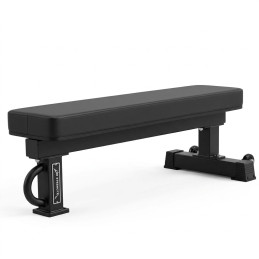
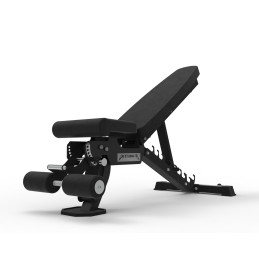
Flat bench or incline bench: which one to choose?
It is the first decision to make, and it depends on your training more than on your level. A strength athlete building their bench press does not have the same needs as someone training for hypertrophy who wants to vary the working angles.
| Criterion |
Flat bench |
Incline bench |
| Stability under heavy load |
Maximum, structure with no joint |
Very good, with an adjustment mechanism to check |
| Working angles |
One only, horizontal |
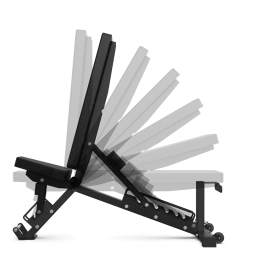
From 0 to 88° depending on the model, plus seat positions |
| Exercises covered |
Bench press, rows, flyes, crunches |
The same, plus incline press, Arnold press, incline curl |
| Footprint |
Small, often stackable |
Larger, transport wheels common |
| Suited to |
Powerlifting, strength sports, tight budget |
General strength training, single home gym bench |
In practice, if you can only buy one bench and do not compete in strength sports, the incline bench covers more movements for a moderate extra cost. If heavy bench pressing is your priority, the flat bench remains superior: no joint, so no play possible under 200 kg. We detail the comparison in our guide flat bench or incline bench.
The three criteria that really make the difference
Load capacity. It must cover your body weight plus the load on the bar, with a comfortable margin. A lifter weighing 80 kg who presses 120 kg already puts 200 kg on the bench. Our models range from 500 kg to 750 kg, leaving reserve even for long-term progress.
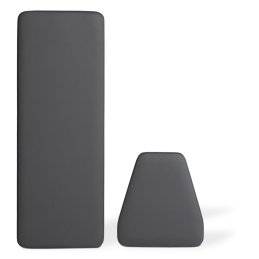
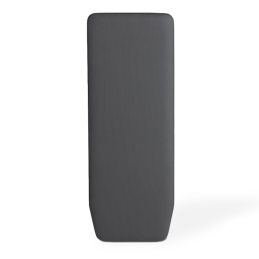
Backrest width. Often overlooked, yet decisive. A 25 cm backrest leaves the shoulder blades free but offers little support surface. At 30 cm, you are at the competition standard. At 35 cm, shoulder support is maximum, at the cost of a slightly reduced range at the bottom of the movement. Some of our benches accept an interchangeable Wide XL backrest, so you can try both.
The gap between seat and backrest. On most incline benches, a gap separates the two parts. In the incline position, the lower back is no longer supported in this area. The Zero Gap system removes this gap, which makes a real difference to comfort on long incline sets.
Steel thickness, seat height, weld quality, the minimum price not to go below: the other points to watch are gathered in our 9 criteria for choosing a weight bench.
What you will really be able to train
The bench is the most cost-effective piece of equipment in a home gym because it is not limited to the chest. Lying down, you cover the bench press, flyes, pull-overs, triceps extensions and lying curls. Supported, you add one-arm rows and the seated press. On a decline, the abs. And the bench also serves as a support for Bulgarian split squats and hip thrusts, two lower-body movements that are often forgotten.
A flat bench already covers a dozen exercises, an incline bench adds as many again. Our article details all the exercises you can do with a weight bench, upper and lower body.
Completing your bench
Combined with a power rack, the bench gives access to the barbell bench press in complete safety, thanks to height-adjustable safety bars. With a pair of adjustable dumbbells, you cover presses, flyes, one-arm rows and isolation work without taking up extra space.
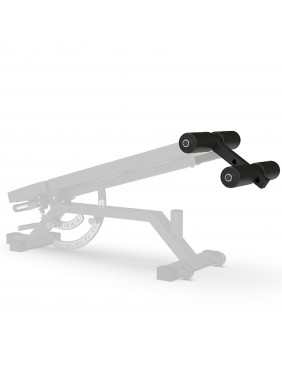
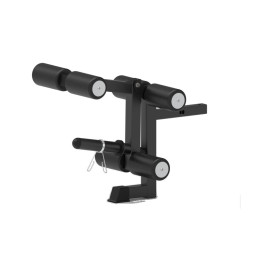
Several of our benches also accept dedicated accessories: leg support for decline work, leg curl and leg extension module, Wide XL backrest. A well-chosen bench evolves as you progress rather than being replaced.
UniStrength weight benches
Our benches are designed for intensive use at home and in the gym: 11-gauge steel on the premium models, high-density padding covered with non-slip vinyl, handle and transport wheels on most models. The range covers the 30 cm competition bench, the 35 cm extra-wide flat bench, and incline benches with up to 6 backrest positions and 3 seat positions.
Frequently asked questions about weight benches
30 cm or 35 cm wide flat bench?
The 30 cm bench follows the competition standard (powerlifting bench press) and leaves the shoulders free. The 35 cm wide bench gives more stability for broad lifters and heavy training loads. Both UF Power Benches share the same steel frame.
What is the difference between the UF-2, UF-4, UF-5 Plus and Zero Gap+ incline benches?
UF-2: sturdy, versatile incline bench. UF-4: adjustable to decline, flat and incline. UF-5 Plus: incline bench with vertical storage to save space. Zero Gap+: no gap between seat and backrest for continuous lower-back support, with leg curl and leg extension attachments.
What is a 'zero gap' bench?
A bench whose backrest and seat meet with no space at any angle. The hips stay supported, which improves stability on incline presses and removes the 'hole' under the lower back found on classic benches.
Which bench accessories are available?
Wide XL backrest and seat for the UF-5 and Zero Gap+ benches, decline attachment for UF benches, leg curl / leg extension module for the Zero Gap+, Athena rowing board. They attach without special tools.
Does a weight bench fit under a rack?
Yes, the UF Power Bench and incline benches are sized to slide between the uprights of the CS-1 and Athena racks for flat and incline presses. Check your rack's inside width and J-cup height.
Our guides: the best weight bench in 2026, what are the types of weight benches?, building a bench press arch, why commercial gym benches hold back your progress