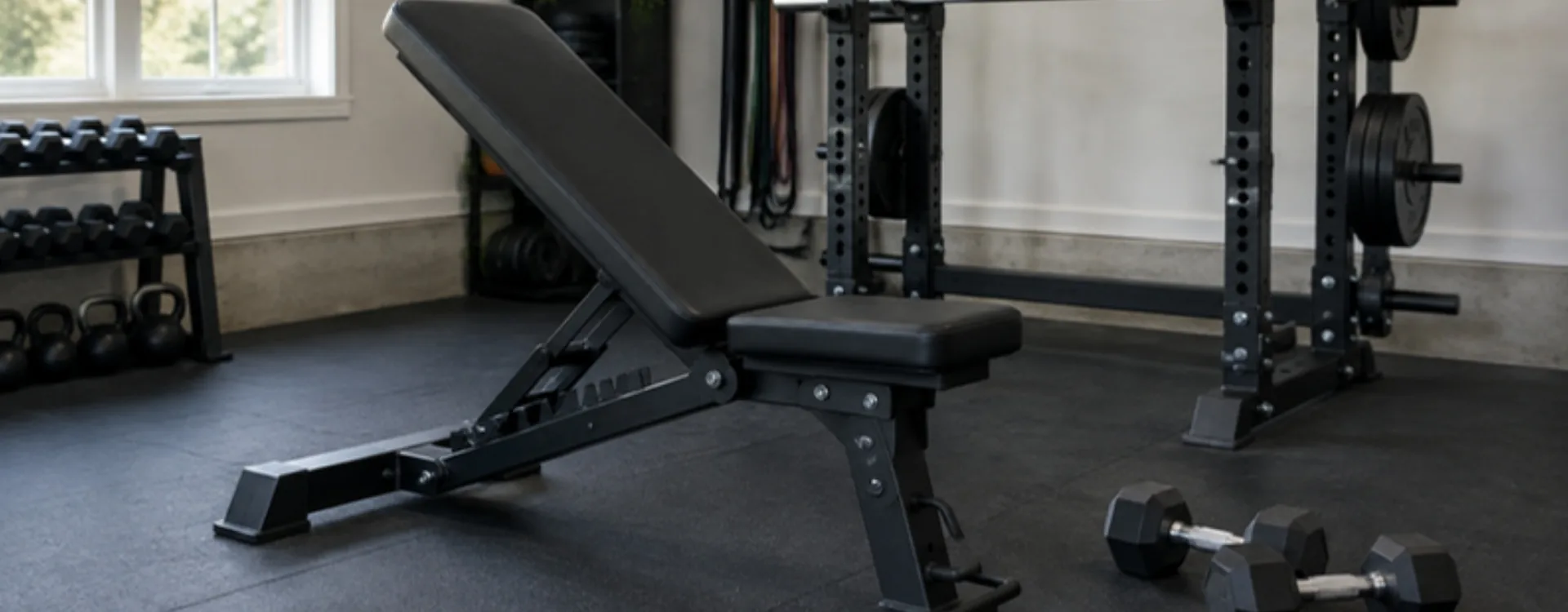
Buying guide for weight benches
In short. To choose a weight bench, check five points: stability (thick steel, a heavy bench, a wide rear foot and a slim front foot), a backrest at least 30 cm wide and 85 cm long, a non-slip cover on firm foam, a height of 42 to 45 cm and a load capacity above 250 kg. The flat bench is cheaper and has no gap between seat and backrest; the adjustable bench adds incline and decline presses.
Every sport needs its own equipment. While the quality of the equipment does not determine performance, it does contribute to it. Bodybuilding is no exception to this rule. Indeed, it's the mindset, regularity and structuring of training sessions that will be the key to progress. But the choice of bench is not insignificant - you need to train on a stable surface.
We've highlighted five criteria that we think will help you select a bench that's right for you.
Stability for greater safety
Steel thickness, bench weight and tripod design.
Stability is the first criterion for choosing a weight bench. Stability is linked to the quality of the construction, in particular the thickness of the steel and the resulting weight. A 15 kg bench will not be as stable as a 50 kg bench. A stable bench will allow you to push heavy weights safely. The design also helps to optimise stability. Wide legs are important for maximum stability. We recommend a tripod bench with a wide rear leg for stability and a slim front leg to allow you to position yourself optimally without being obstructed by the bench.
Wide backrest to avoid injury
The backrest should be at least 30 cm wide and if possible long.
A wide backrest is essential, especially for large people with wide collarbones. Powerlifting benches have backrests of around 30 cm. We advise you not to choose benches less than 30 cm wide. A narrow backrest will not allow you to support your shoulder blades, which will increase the risk of injury and loss of strength due to lack of stability. There are extra-wide benches with 35 cm backrests. This type of bench is ideal for heavy bench presses.
A long backrest is important; some low-end incline benches have backrests less than 85 cm long, which is problematic for taller people.
Non-slip surface for good posture
A non-slip surface and quality foam.
There are 2 criteria to take into account when choosing the upholstery:
- Non-slip surface: the surface's grip is important, as it allows the shoulder blades to be positioned correctly and the leg drive to be used without the user's position deteriorating over the course of repetitions.
- The quality of the foam: you need to find the right compromise between hard foam, which is more durable, and soft foam, which provides greater comfort, but above all better grip, by allowing the shoulder blades to sink slightly into the bench.
We therefore advise you to choose a high quality, thick foam with a good quality non-stick coating to prevent early tearing.
Height
Height between 42 and 45 cm.
Powerlifting benches are 42 to 45 cm high. This height will allow good bridging for most people. It will also allow a good transfer for strength trainers, although we advise them to use the same equipment as that used in competition, particularly in the run-up to competitions and at the end of the cycle.
Weight capacity
Weight capacity greater than 250 kg.
The weight capacity of the bench will depend on the quality of the construction and the thickness of the steel tubes used. Although these values are arbitrary, we do not recommend benches with a weight capacity of less than 250 kg, as stability will not be satisfactory.
Tilting vs. flat
Budget is the determining factor
The flat bench is less expensive, easier to move because it's lighter and has no space between the backrest and seat. This makes it the best choice for exercisers on a limited budget who don't do incline or decline presses.
The main drawback of the incline bench compared with the flat bench is the space between the seat and the backrest, so you should opt for benches with less space so that you can do flat bench presses without this hindrance. It's important to have several seat (e.g. 0°, 15°, 30°, 45°) and backrest (e.g. 0°, 15°, 30°, 45°, 60°, 75°, 90°) inclination settings. A backrest that reclines up to 80° and 85° is also useful to protect the shoulders.
The bench can be used for incline bench presses, and the stability of the bench is all the more important as is the quality of the ankle blocks. These benches are more versatile and often offer options such as abdominal planks.
Summary
A good bench is essential if you want to build muscle safely and make progress in the best possible conditions. Bodybuilders are only in contact with their barbell and bench when performing pressing movements, hence the importance of choosing the right equipment. A poorly designed bench represents safety and injury risks, as well as a loss of performance and therefore of muscle. An unstable bench will prevent you from fully expressing your strength and will force you to use lighter loads. Using lighter loads over years of practice results in missed gains in strength and muscle.
To go further in the shop: Weight benches, Flat benches, Adjustable benches. Also worth reading: our ranking of the best benches in 2026.
Uni Strength benches against these criteria
| Criterion | Model | Key figure |
|---|---|---|
| Wide backrest for heavy presses | UF Power Bench | 35 cm backrest (30 cm in the competition version), 750 kg maximum load, 32 kg |
| Competition format, 30 cm | Competition flat bench 30 cm | 43 cm high, 750 kg maximum load, 32 kg |
| Adjustable with a small gap | UF-5 Plus incline bench | 4 cm gap between backrest and seat, 500 kg maximum load |
| Adjustable, IPF-size backrest | Zero Gap+ adjustable bench | 101.5 x 31 cm backrest (35 cm option), 44.6 cm high |
| Decline, flat and incline | UF-4 adjustable bench | 500 kg maximum load, 34 kg, 132 cm long |
Specifications taken from the product pages on 9 October 2026.
Frequently asked questions
What is the number one criterion when choosing a weight bench?
Stability: it depends on steel thickness, bench weight and foot width. A 50 kg bench is far more stable than a 15 kg one.
How wide and how high should the backrest be?
A backrest at least 30 cm wide and, for taller lifters, more than 85 cm long. Powerlifting benches are 42 to 45 cm high.
What minimum load capacity?
Avoid benches rated under 250 kg: their stability will not be satisfactory for heavy work.