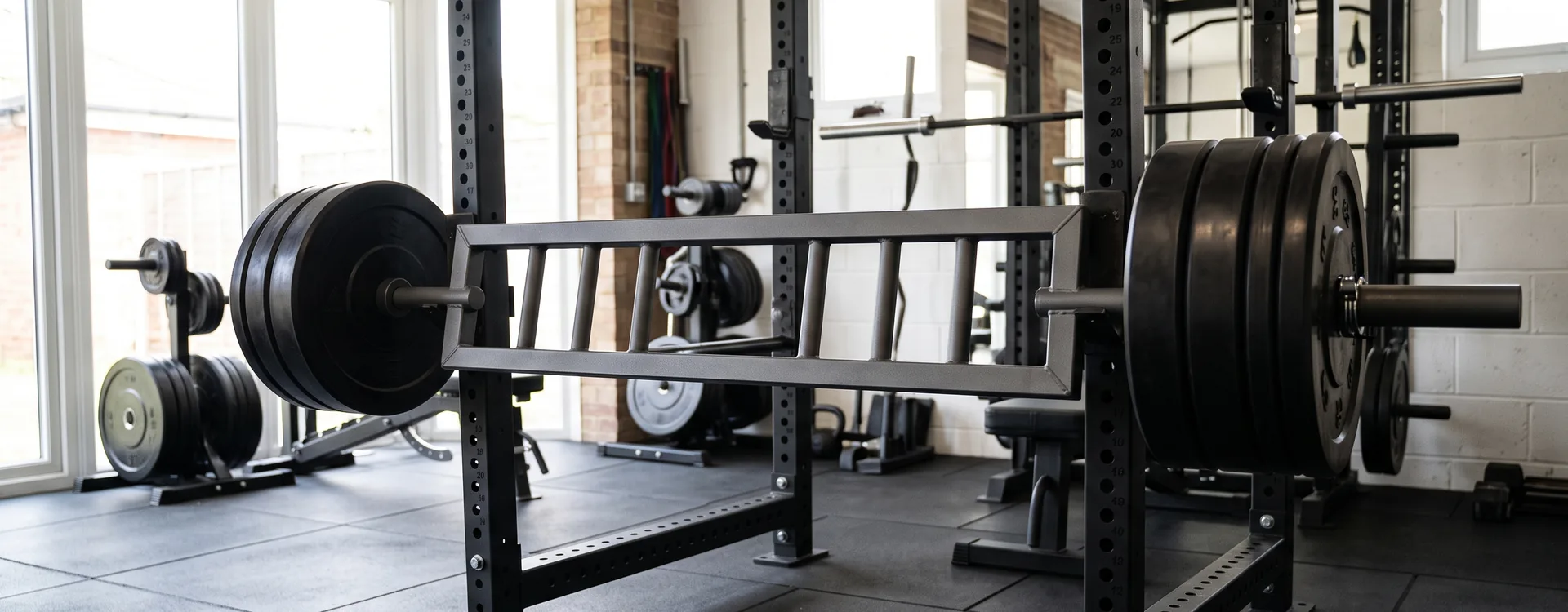
Swiss Bar Benefits
In short. The Swiss bar (football bar or multi-grip bar) has neutral or slightly angled grips that are easier on the shoulders than a straight bar. Versatile (presses, rows, pull-ups, push-ups on safety supports), it builds the triceps in particular, comes in several shapes and is generally cheaper than a quality straight bar. For stability, the article recommends a cambered, narrow bar with a slightly angled grip.
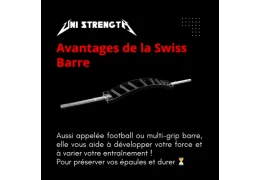
The Swiss bar, also known as a football bar or multi-grip bar, is a very popular piece of equipment for developing strength.
Not only does the Swiss bar help you strengthen, but it also allows you to vary your training and is ideal for those with shoulder issues!
1. It protects the shoulders
One of the main reasons people buy a Swiss bar is that it is less demanding on the shoulders than a straight bar. The majority of athletes have suffered from shoulder pain during their practice.
Thanks to its neutral or slightly inclined grips, the Swiss bar places the shoulder in a less compromising position, thus offering an opportunity for recovery while stimulating muscle growth. Sometimes, it is necessary to rest completely to heal an injury, but if your body allows it, it is very beneficial to work around the problem.
This also allows for variety; indeed, doing thousands of repetitions of bench press with a straight bar at the same angle creates wear on your joints, particularly the shoulders. Changing this angle allows for the distribution of wear and thus limits injuries and will allow you to gain legitimacy.
The Swiss bar is an excellent way to work around an injury. Indeed, after exclusively using the Swiss bar for the bench press for a few months, it is common for athletes to notice the disappearance of their shoulder pain.
2. It is versatile
Although the Swiss bar is often considered a tool for the bench press, its application in training is actually much broader.
Here are some examples:
- Military press
- Incline press
- Floor press
- Rowing, a cambered bar allows for full range rowing
- Inverted rowing (placed on safety supports)
- Pull-ups (placed at the top of the rack)
- JM Press
- Push-ups (placed on safety supports)
- Triceps Skull Crushers/Extensions
- Hammer Curls
- Front raise
- Clean and Press
- Stiff-legged deadlift
One of the great advantages of the Swiss bar, in addition to the many movements, is the variety of grips. This allows for even more variety in your training. For example, for the bench press, you can perform a bench press with a close grip or a wide grip (and other intermediate variations). If you choose a bar with a slightly inclined grip, you just need to rotate it 180° to switch from supination to pronation.
3. It makes you stronger
One of the greatest advantages of specialty bars is that they are useful for strengthening in different ways/angles.
Regarding the Swiss bar, it is very useful for developing the triceps through neutral grip pushing movements. This then has a strong impact on the straight bar bench press, especially if you struggle with locking out.
If you choose a model with a camber, the additional range will allow you to work even more on the stretching phase of the movement, while maintaining a less demanding position for the shoulders thanks to the neutral grip. We know the importance of stretching for hypertrophy, and thus this movement will be particularly hypertrophic.
In any case, the Swiss bar can lead to significant strength gains.
4. It comes in different shapes and sizes
Unlike a traditional straight bar where, apart from a few differences in knurling, diameter, etc., a Swiss bar comes in many different shapes and sizes.
For example, there are bars with all neutral grips, or all inclined grips, or a combination of both. Some bars are wider while others have a narrower profile (a narrower profile allows for better stability).
The bar tends to be a bit unstable, which requires you to stay braced during the movement. It can also be quite demanding on the stabilizers, and it may take some time to get used to certain movements.
Swiss bars with a camber allow for easier stability with a more balanced center of gravity. They also allow you to modulate the range (use the camber for more range or turn the bar to limit the range). Thus, to maximize stability, we recommend a cambered, narrow bar with a slightly inclined grip.
5. Bonus: they are not expensive
They are not very expensive; these bars are generally less costly than quality straight bars.
Summary
If you are looking for a specialized bar that is versatile, affordable, and effective for rehabilitating/preventing injuries, the Swiss bar is an excellent option.
At Uni Strength, we believe it is one of the best specialized bars you can have in your gym.
To go further in the shop: Specialty bars, Olympic bars, Barbells. Also worth reading: the 5 advantages of the Safety Squat Bar.
Frequently asked questions
What is a Swiss bar?
A multi-grip bar (also called football bar) whose neutral or slightly angled handles let you press and row without straining the shoulders.
Why does the Swiss bar relieve the shoulders?
The neutral grip puts the shoulder in a less compromising position than a straight bar; after a few months of Swiss bar bench pressing, many lifters see their pain disappear.
Which exercises can you do with a Swiss bar?
Close- or wide-grip bench press, rows, inverted rows and push-ups on safety supports, with strong triceps work that helps the lockout of the bench press.