Top 5 SSB Advantages
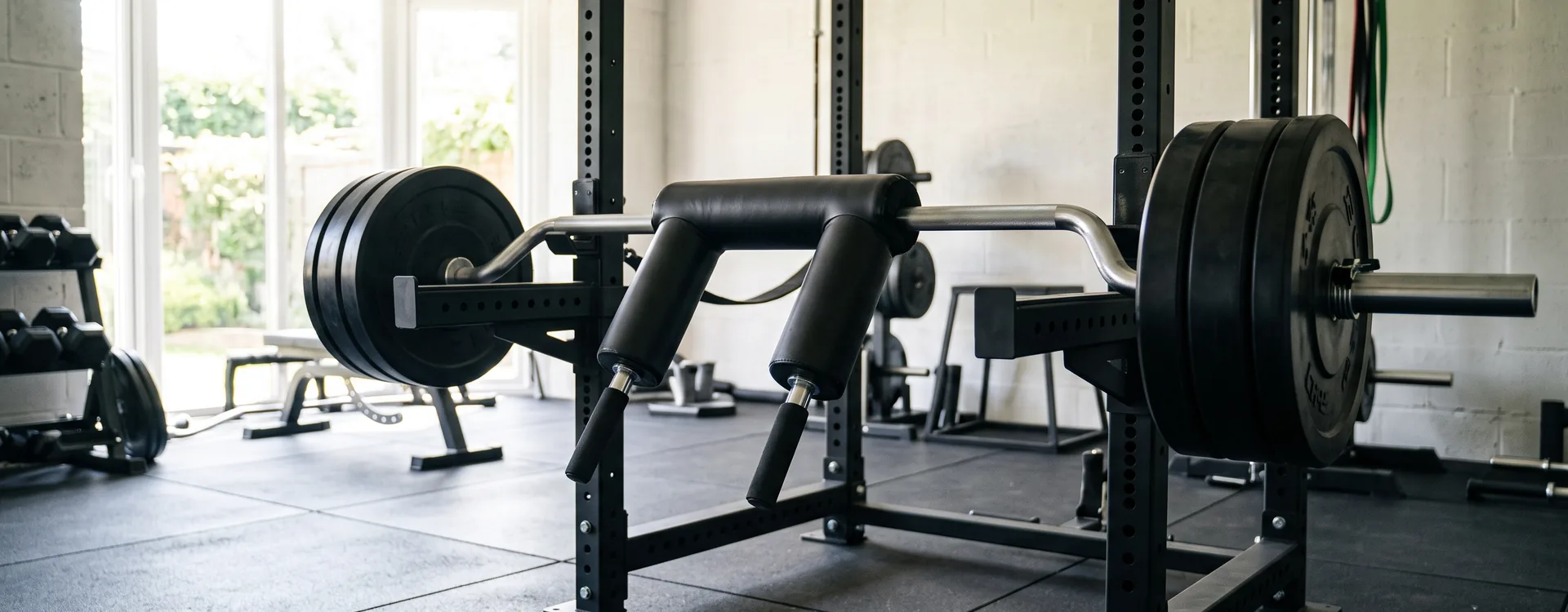
In short. The Safety Squat Bar is a squat bar with cambered ends, a pad on the neck and handles in front of the shoulders. It spares the shoulders, elbows and wrists, keeps the torso more upright and works the upper back hard, but you generally lift less than with a straight bar.
The Safety Squat Bar (SSB) is much more than just a simple fitness accessory: it is a versatile tool that offers comfort, safety, and efficiency to strengthen your entire body.
1. Versatility
One of the greatest advantages of a SSB bar is its versatility. You will never run out of movements with this bar:
- Back, front, and zercher squat
- Standing, seated, and single-leg good morning
- JM press
- Front and back lunge
- Split squats
- Step-ups
- Hip thrusts
- Military presses
- Triceps press
- Calf raises
- … and anything else you can imagine
Ultimately, this bar has multiple uses that can translate into serious strength and hypertrophy gains.
2. It will make you strong
The SSB is an incredibly effective tool designed to challenge your body in a unique way. The end result? Muscle/strength gains!
The bar has a camber at the ends that lowers the collar below the midline and at an angle to the vertical axis. We recommend a 20° camber, which is optimal for bar stability and will allow for effective work.
This anatomical subtlety, combined with the fact that the bar rests a bit higher on the shoulders, tends to tilt the athlete forward. In doing so, the athlete must struggle to stay upright to avoid collapsing like an accordion…
This struggle absolutely demolishes the upper back. Your traps and lats will become extremely strong with this bar!
Of course, your traps and lats are not the only muscles to become strong using this bar. Depending on how you use it, you can activate the entire posterior and anterior chains. With the SSB in the classic position, you will get anterior chain activation in addition to the quadriceps and glutes. With the reverse SSB, you will really hit the posterior while accentuating the work of the quadriceps due to the vertical position of the spine. As for the other variations listed above, you can more specifically target the quadriceps, erectors, etc.
It is important to mention that you probably won't be able to lift as much weight with the SSB as with your classic squat. You will need to stay humble and that's OK.
3. It is safe and comfortable
As its name suggests, the SSB (Safety Squat Bar) is safe (when used correctly), safer, at least…
The main advantage from this point of view is that it significantly reduces stress on the upper limbs, particularly the shoulders, elbows, and wrists.
The way the bar is designed, there is a padded section that rests around your neck with two handles extending over each shoulder. This allows you to easily hold the handles directly in front of your body. There is no need to rotate the shoulders outward, which many people struggle to do with a traditional straight bar.
So, if you have shoulder or elbow pain when doing back squats with a straight bar, or if you have wrist pain when doing front squats, this bar will relieve these joints by preserving them.
But it's not just the upper limbs it helps. When you squat with the SSB, the position of your spine will actually be more vertical. It resembles more of a front squat. This position minimizes shear forces on the lower back and also allows for a better range of motion through the hips, knees, and ankles.
As for the padding, some are more comfortable than others, but all provide some form of protection between your delicate neck and the raw steel. We strongly recommend a one-piece protection with a high-density coating for optimal comfort.
4. Excellent transfer with other movements
The SSB has an excellent transfer to your other movements. This bar was created by powerlifters, so it's no surprise that it has an excellent impact on your squat and deadlift. The SSB will help you on these movements as it strengthens the entire musculature of the legs and core.
Don't think that the SSB is only for powerlifters though. Strongmen widely use it in their training. Brian Shaw understood this well and completed training cycles where he completely replaced the back squat with the SSB squat.
Of course, if you are a competitive powerlifter, it is not advisable to completely abandon the back squat. The SSB has its place in your training as an accessory movement (outside of peaking periods for a competition).
5. Your technique will improve
Due to the way this bar is constructed, you will have to fight to stay upright. By using this bar and becoming stronger, your ability to stay upright under a straight bar will improve (Squat and Deadlift transfer). Similarly, you will probably be able to reach depth more easily with an SSB because it promotes a more upright torso and ankle flexion. This can also translate into better technique with a straight bar, as you should have a greater range of motion.
If you are an athlete who struggles to keep your chest up, you will probably benefit the most from this bar.
Summary
The SSB offers many advantages, particularly in terms of versatility, muscle strengthening, strength, and safety. It allows for a wide variety of movements, accentuates quadriceps work, strengthens the upper back, minimizes joint stress, and improves technique without facing the discomfort of the front squat. It effectively complements training and offers a safe alternative to the traditional squat.
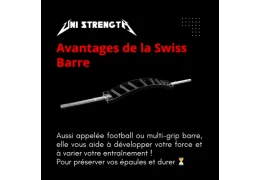
To go further in the shop: Specialty bars, Olympic bars, Squat racks and power racks. Also worth reading: the advantages of the Swiss bar.
Frequently asked questions
What is a Safety Squat Bar?
A squat bar with cambered ends (we recommend 20°), a padded section and two handles in front of the shoulders, which places the load slightly higher and tilts the lifter forward.
Why does the SSB spare the shoulders?
The handles are held in front of the body without external shoulder rotation, which greatly reduces stress on shoulders, elbows and wrists compared with a straight-bar back squat or front squat.
Can you lift as much as with a straight bar?
Usually not: the SSB works the upper back, traps and lats harder to keep you upright. That is precisely what makes it effective for strength and hypertrophy.