What exercises can you perform with a cast iron kettlebell?
Cast iron kettlebells offer a multitude of options for working the entire body. Here are some key exercises:
- Kettlebell swings: to improve explosiveness and strengthen glutes, hamstrings and lower back.
- Goblet squat: to target legs and glutes.
- Turkish get-up: a complete movement to work coordination, strength and mobility.
- Kettlebell press: to strengthen shoulders and triceps.
- Snatch and clean: to develop power and speed.
These exercises combine muscle work and cardio, offering effective and varied training.
How to choose your kettlebell?
To start with a kettlebell, it is essential to choose a weight adapted to your physical condition and your goals. A kettlebell that's too light won't allow sufficient muscle stimulation, while a weight that's too heavy could compromise your technique and increase injury risks.
Recommended weight:
For both women and men we recommend starting with a kettlebell weighing 4 kg or 8 kg depending on your strength level. Then you can gradually progress to 10 kg, then 24, then 32 according to your desire to have controlled or challenging exercises.
Important criteria:
At Unistrength, we believe these criteria should be considered before buying a kettlebell, which is why we take great care to respect them and offer the best products:
- Ergonomics: Choose a cast iron kettlebell with a comfortable handle that's wide enough for a good two-handed grip.
- Versatility: A moderate weight will allow you to perform a variety of exercises like swings, goblet squats or Turkish get-ups.
- Quality: Favor a durable model with smooth coating to avoid irritation.
By following these recommendations, you can start your training with a kettlebell that helps you progress safely. You can then gradually increase the weight based on your performance.
What muscles does the kettlebell work?
The kettlebell is a versatile tool that targets many muscles functionally, combining strength, endurance and coordination. Thanks to its unique design and offset weight, it allows working both primary muscles and stabilizers.
Main muscles targeted:
-
Upper body:
- Shoulders (deltoids): during presses or snatches.
- Back (lats, traps): with pulls and swings.
- Arms (biceps and triceps): through curls, presses or extensions.
-
Core and abs:
- Exercises like Turkish get-up and planks with pulls intensely target abs, obliques and deep core muscles.
-
Lower body:
- Glutes and hamstrings: activated during swings and deadlifts.
- Quadriceps: strengthened with squats and lunges.
- Calves: worked on dynamic movements like kettlebell jumps.
Stabilizing muscles:
Due to the complex and dynamic movements it allows, the kettlebell also engages the body's stabilizing muscles, like deep back and core muscles, to maintain balance and coordination.
In summary, the kettlebell is a complete tool that allows working the entire body harmoniously, while promoting muscle strengthening, mobility and power.
Why choose a cast iron kettlebell?
Cast iron kettlebells stand out for their durability and timeless design. Made from resistant material, they offer excellent longevity, even during intensive use. Their precise weight and comfortable grip make them an ideal choice for beginners as well as experienced athletes. Thanks to their offset center of gravity, they allow performing dynamic and functional movements that strengthen strength, power and coordination.
They are also available in a wide range of weights, allowing you to progress gradually or diversify your exercises according to your goals. Cast iron kettlebells are particularly suited to HIIT sessions, strength training exercises or functional routines.
Frequently asked questions
Which cast-iron kettlebell weights are available?
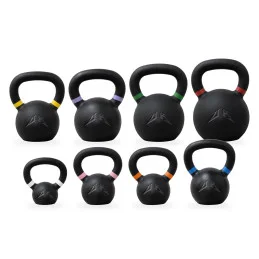
From 4 to 32 kg: 4, 8, 10, 12, 16, 20, 24 and 32 kg. Each kettlebell is sold individually and marked in kilograms and pounds, so you can build your own set.
What do the handle colours mean?
Each weight has its own colour: white 4 kg, pink 8 kg, orange 10 kg, blue 12 kg, yellow 16 kg, grey 20 kg, green 24 kg and red 32 kg. You can spot the load at a glance, even in a circuit.
What is the handle diameter?
It increases with the weight: 30 mm on the 4 kg, 32 mm on the 8, 10 and 12 kg, 33 mm on the 16 kg, 38 mm on the 20 kg, 39 mm on the 24 kg and 40 mm on the 32 kg.
How are these kettlebells made?
Cast in a single piece of iron, with no filling or assembly. The flat base keeps them stable on the floor, for example for rows or push-ups on the handles.
Our guides: kettlebell squats: complete guide.