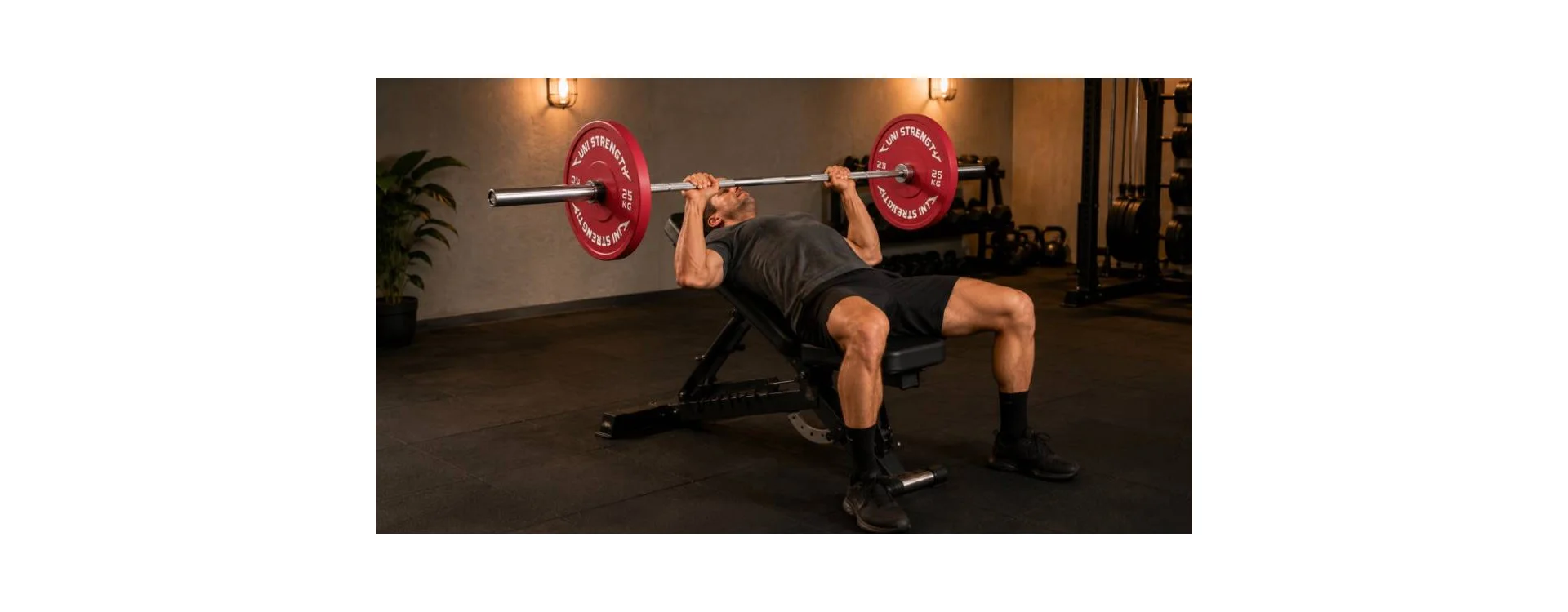
What exercises can you do on a weight bench?
Yes, a single weight bench is enough to train your whole body. With a flat or incline bench, you can chain the bench press for the chest, rows for the back and skull crushers for the triceps, but also Bulgarian split squats and hip thrusts for the legs and glutes. The bench is not just for the upper body: used well, it becomes the centrepiece of a complete home gym, from core work to glutes.
Here is the complete list of weight bench exercises you can do, area by area, with the equipment you already have. Whether your goal is building mass, losing weight or getting stronger, you will find what you need to build an effective session.
BUY A UNI STRENGTH WEIGHT BENCH
Why the bench is the most versatile piece of equipment
Most lifters see the bench as a simple support for the bench press. That is far too narrow. A stable bench changes the working angle, secures your position and unlocks dozens of exercises you cannot do properly on the floor. That is why you find one in every gym, and why a well-chosen range of weight benches remains the most cost-effective investment for training at home.
There are two main families: the flat bench, perfect for strength and stability, and the incline bench, which multiplies the working angles. The choice depends on your goals, and we come back to it below.
In the gym as at home, from beginners to experienced lifters, this versatility makes the bench a true pillar of strength training. A single piece of equipment covers mass building, strength work and core training, without multiplying machines.
Upper body: bench exercises
This is the bench's historic playground. Here are the most effective movements, grouped by muscle group.
Chest
- Barbell bench press: the king of exercises for chest mass and strength. It also works the triceps and shoulders.
- Incline dumbbell press: on an incline bench, the angle targets the upper chest, often lagging behind for many lifters.
- Dumbbell flyes: an isolation movement that stretches the muscle deeply and complements the press.
Back
- One-arm row: one knee and one hand on the bench, back straight, you pull the dumbbell along your side. Excellent for the lats and teres major.
- Pullover: lying across the bench, arms straight, you lower a weight behind your head. It opens the rib cage and works the back and chest.
Shoulders
- Seated military press: the upright back pad of an incline bench supports your back and secures the movement for the delts.
- Seated lateral raises: sitting down makes cheating harder, so the side delts work better.
Arms
- Skull crusher on a flat or incline bench: the reference exercise for triceps size.
- Bench dips: hands behind you on the edge of the bench, you lower your hips to target the triceps. No accessory needed.
- Incline biceps curl: sitting on an incline bench with your arms hanging, the stretch maximises biceps work.
- Concentration curl: elbow resting on your thigh, sitting on the edge of the bench, for a sharp peak contraction.
Lower body: yes, the bench works your legs too
This is the part everyone forgets. Yet the bench transforms your lower-body training, especially for the glutes and hamstrings.
- Bulgarian split squat: rear foot raised on the bench, you lower yourself on the front leg, knee bent above the ankle. One of the best unilateral exercises for the quads and glutes, with little load.
- Hip thrust: upper back resting on the bench, you drive your hips upwards. The absolute reference for building the glutes.
- Step-up: a functional movement that works the quads and glutes, ideal at the end of a session.
- Supported lunges: a more dynamic variant of the Bulgarian split squat, to work balance and explosiveness.
Abs and core on the bench
- Decline bench crunch: the incline increases resistance and focuses the work on the rectus abdominis.
- Seated leg raises on the edge of the bench: they target the lower abs, an area that is hard to isolate.
- Oblique crunch with feet on the bench: for the obliques, with no extra equipment.
A common trap to avoid: on both the Bulgarian split squat and the hip thrust, many people place the bench too far or too close. Adjust the distance so that the front knee stays in line above the ankle and the shin ends vertical. An unstable bench ruins both exercises, which is where the quality of the equipment really matters.
Flat or incline bench: what it changes for your exercises
The flat bench favours stability and heavy loads: it is the choice for pure strength (bench press, hip thrust). The incline bench opens extra angles (incline press, incline curl, seated military press) and makes your training more complete. If you are unsure, take a detailed look at the difference between a flat bench and an incline bench before choosing.
To load your movements, also think about your complementary equipment: an Olympic barbell for the bench press, and weight plates suited to your progress and your mass-building goals.
Key takeaways
A weight bench is anything but a chest accessory. From the bench press to the hip thrust, through rows, dips and Bulgarian split squats, it covers the entire body. The flat bench delivers strength, the incline bench multiplies the angles. With a barbell, a few plates and a stable bench, you already have a home gym capable of developing both the upper and lower body. For lasting muscle gains, consistency and stable equipment matter more than the number of exercises.
Quality weight benches at affordable prices
The equipment used for these bench exercises
| Exercises | Equipment | Key figure |
|---|---|---|
| Bench press, hip thrust, Bulgarian split squat | UF Power Bench wide flat bench | 43 cm high, 35 cm wide, 750 kg maximum load |
| Incline press, incline curl, seated military press | UF-5 Plus incline bench | backrest adjustable from 0 to 88° in 6 positions, 500 kg maximum load |
| Decline crunch | UF-4 adjustable bench | decline, flat and incline positions, 500 kg maximum load |
| Barbell bench press, skull crusher | UF Basic Olympic bar | 20 kg, 220 cm, 50 mm sleeves, 350 kg maximum load |
| Flyes, one-arm row, pullover, curls | HR-32 adjustable dumbbells | 2 to 32 kg per dumbbell, 2 kg steps |
Specifications taken from the product pages on 9 October 2026.
Explore the shop: Weight benches, Flat benches, Incline benches. Also read: our flat vs incline bench comparison.
Frequently asked questions
How do you perform a bench press correctly?
Lie on the bench with your feet flat on the floor and your shoulder blades squeezed together. Grip the bar slightly wider than your shoulders, lower it under control to the lower chest while keeping your back straight, then press while keeping your wrists straight. Keep a slight natural arch and never lift your glutes off the bench.
How do you avoid injuries when training on a bench?
Warm up before each session, increase loads gradually and always favour controlled execution over raw weight. Keep your core braced, control the eccentric phase (the lowering) and train on a perfectly stable bench. For heavy bench pressing, safety supports or a spotter are strongly recommended.
Is one bench enough to train the whole body?
With a flat or incline bench, you cover the chest (bench press, flyes), back (one-arm row, pullover), shoulders, arms and even legs with Bulgarian split squats and hip thrusts. The bench already covers all the major areas, but for a complete long-term programme you will benefit from pairing it with a barbell, dumbbells and plates. This combination unlocks most of the fundamental exercises and covers strength, muscle mass and conditioning, in the gym as at home.
Which leg exercises can you do with a bench?
The Bulgarian split squat (rear foot on the bench), the hip thrust (upper back resting on the seat) and step-ups are the three most effective movements for the quads, glutes and hamstrings.
Flat or incline bench for beginners?
The flat bench favours stability and strength; the incline bench multiplies the angles (incline press, incline curl, seated military press). For a versatile home gym, the incline bench is the most complete choice.