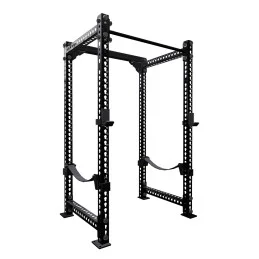
Resistance bands in the home gym: eight uses, from heavy squats to joint care
In strength training, bands serve eight purposes: making resistance progressive on barbell exercises, lightening the bottom of the movement with a reverse setup, developing speed and explosiveness, replacing assistance machines, preparing and recovering around the session, getting a joint working again after an injury, correcting the knee, shoulder and hip, and maintaining conditioning. A rack that offers a low anchor and a high anchor is enough to do it all. Here you will find how to set them up, what tension to aim for and when to do without them.
Low anchor or high anchor: two opposite effects on the bar
It all depends on where you attach the band.
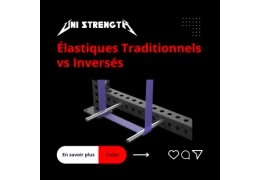
Anchored low, it connects the foot of the rack to the bar. Almost slack when the bar is at its lowest, in the range where you produce the least force, it tightens as the bar rises, where you are strongest. The resistance thus follows your strength curve on the squat, bench press and deadlift. Two further effects come on top: during the descent, the bar is pulled toward the floor faster, and at the end of the press you can no longer ease off before lockout.
Anchored high, it is the reverse setup, or reverse band: the band hangs from the crossmember and supports part of the bar. Its help is greatest at the bottom, in the position where the joint is most exposed, and it leaves you the full load at the top, where it is most stable. You can then either handle a load above your max at the end of the movement, or keep pressing and squatting with damaged shoulders or hips. For a sense of scale: on a 236 cm tall rack such as the CS-1 in its tall version, a medium band attached to the crossmember takes about 40 kg off at the bottom of a bench press.
Both setups are compared in detail in our article traditional or reverse bands.
Finding the right tension in three steps
- Test your bands with a speed load, from the thinnest to the thickest. As long as the bar keeps its speed, move on to the next one; as soon as it slows down, go back to the previous one: that one is yours.
- As a guideline, the band provides roughly 25% of the working load, with a bar loaded at 45 to 65% of your max depending on your level.
- Progress the load over a three-week cycle. The criterion does not change: a bar that drags signals too much tension.
Speed, explosiveness and conditioning
A dynamic effort session consists of moving a non-maximal load quickly. With the band, the descent speeds up and the end of the press gets harder, which makes this work more productive than with plates alone. The box squat with bands is its most widespread application. A few weeks before a competition, a heavier tension lets you get close to a maximal load at the top of the movement while keeping the bottom manageable.
Away from the bar, the band also resists 10 m sprints, lateral movements and jumps. For conditioning, the format is simple: lots of sets, 20 to 30 seconds of rest, a submaximal load and a light band. It fits when you are coming out of a heavy block and need a breather, when you are returning after an injury or when you are aiming for hypertrophy.
Assistance exercises, without a pulley or machine
A low anchor point and a high anchor point on the rack cover the entire table below.
| Exercise | Setup | What to watch |
|---|---|---|
| Pull-apart | Thin band, arms straight in front of you | Hands brought down alongside the hips, 1 s pause |
| Face pull | High anchor | Pull toward your forehead while squeezing your upper back |
| Assisted pull-up | Loop around the pull-up bar, one foot in it | The band takes off part of your body weight |
| Triceps extension | High anchor | Push down, elbows still |
| Leg curl | Light band at the bottom of the rack, loop around the ankle, seated on a bench 1 m away | Bring your heels toward your glutes |
| Pull-through | Low anchor, back to the rack, band between the legs | Hip hinge movement |
| Good morning | Band on the back of the neck, the other end under the feet | Hips back, flat back |
Around the session: prepare, then recover
- Squat: during your ramp-up sets, a mini band placed above the knees engages the glutes and forces you to keep your knees out.
- Bench press: a shoulder circuit with a mini band, in the high position then the low position.
- Sumo deadlift: hip abduction and adduction against the band.
- Beginners: a mini band on the empty bar immediately shows any loss of bracing or posture in the squat.
- After training: stretch the posterior chain, lats and pecs with the band, with a single goal, getting back the range of motion you had when you arrived. Trying to go beyond it is not the point.
Joints: returning after injury and corrective exercises
These three tools go at the end of a session or in a dedicated session, with the approval of the professional treating you if you are injured.
- Supported bench press, empty bar: the bands attached at the top carry the bar, you only guide it. Protocol: 1 to 2 sets of 100 reps, 2 to 4 times a week, to get circulation and the movement going again without putting load on the injured area. Once you have recovered, one set of 100 at the end of the session helps maintain the tissues.
- Joint traction: tie two medium bands together, attach one end to the top of the rack and loop the other around your wrist. Step away until you feel the shoulder loosen up, then move your arm in every direction. Same logic for the hip, lower back or neck. Unlike a stretch held still, you keep moving while the band pulls on the joint.
- Corrective exercises: terminal extension and “heel touchdown” for the knee, external rotation and diagonals for the shoulder, Pallof press to resist trunk rotation, adduction for the hip. Light load, careful execution: you are reinforcing a position, not trying to wear yourself out.
When to ease off the bands
- Do not put them on every exercise. The tension can slow down the action of the antagonist muscle and encourage hyperextension, a risk that mainly concerns throwers and sprinters.
- Conversely, nothing stops a beginner from using them, as long as they stick to a light tension.
- After years of never lifting the bar without bands, stabilizing it on its own can become harder: insert cycles without them.
- The band is added to the bar, the rack and the effort; it replaces none of the three.
The Uni Strength bands and rack for these eight uses
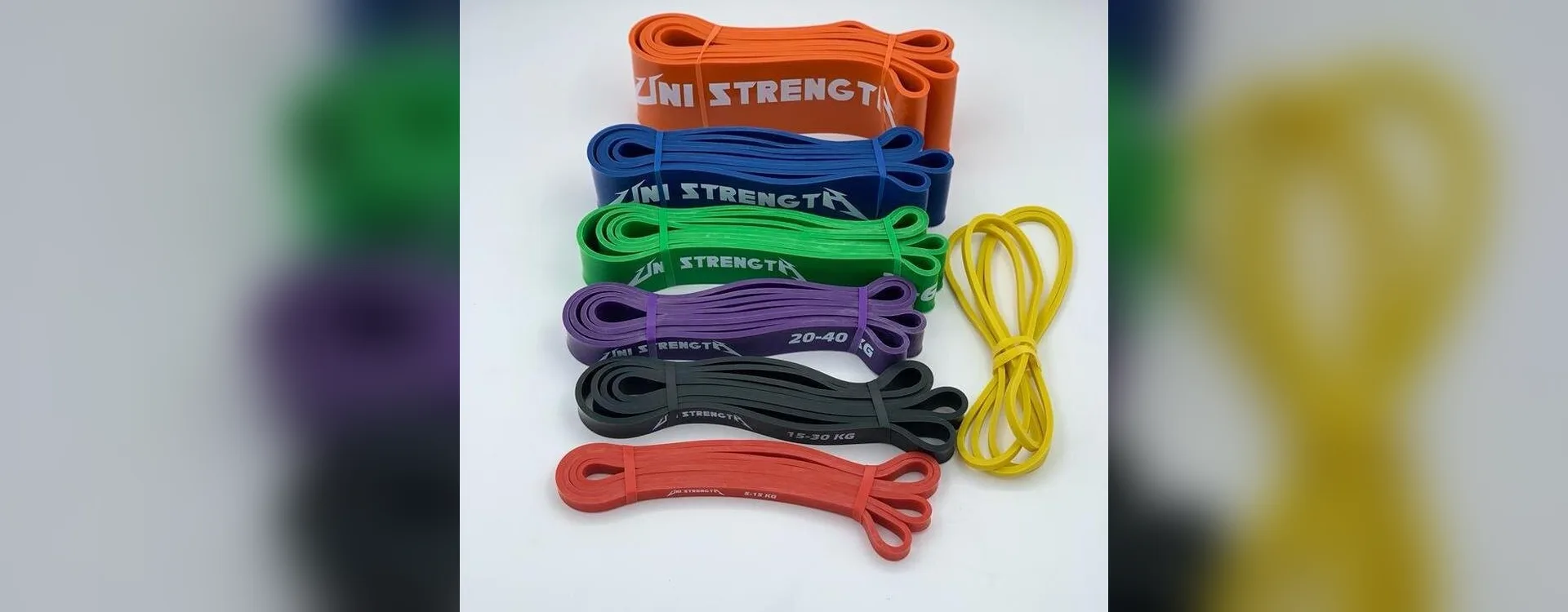
Band kits in several resistances and a rack to anchor them high or low: here is the equipment we offer for these eight uses, shipped from our warehouse in France.
| Product | Key points | Price incl. VAT |
|---|---|---|
| Kit of 7 Uni Strength elastic bands - training band | 7 multilayer latex bands, smooth progressive elasticity | 129,99 € |
| Uni Strength 5-piece Resistance Band Kit | 5 resistance bands for strength, mobility and pull-up assistance | 64,99 € |
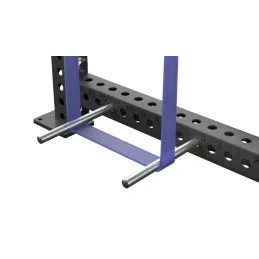
| CS-1 Band Pegs | Set of 4 band anchor points for the 75 x 75 mm uprights of the CS-1 rack | 59,99 € |
| CS-1 Power Rack 204 cm, 4 uprights, 76 cm depth | Complete bundle | 75 x 75 mm uprights, 800 kg capacity, holes every 5 cm, pull-up bar and J-cups included | 1 199,99 € |
| Squat cage and Power Rack - CS-Basic | Compact squat cage, H 212 x W 122 x D 122 cm, 350 kg capacity | 399,99 € |
Prices incl. VAT as of 9 October 2026. Free delivery from €300 excl. VAT in mainland France, instalment payment available. For advice on your home gym setup, write to [email protected] or call +33 4 83 39 67 96.
Further on the shop: Strength Training Accessories, CS-1 Rack and Squat Cage Accessories, Rack CS-1 - Complete and Modular Rack, Power Racks & Squat Racks.
Frequently asked questions
How much tension should you use on the squat or bench press?
Aim for the band to provide about 25% of the working load at the top of the movement, with a bar at 45 to 65% of your max. A bar that slows down means the band is too strong.
What is the reverse band for?
Attached to the top crossmember, the band supports part of the bar at the bottom of the movement and leaves you the full load at the top. You use it to handle more than your max or to spare a fragile joint.
Where should you attach bands in a home gym?
At the bottom of the rack for progressive resistance and low-anchor exercises, on the crossmember for the reverse band, face pulls and joint traction. The CS-1 offers both thanks to its rack band supports.
If you are injured, can you keep using bands?
Yes: supported bench press with an empty bar, 1 to 2 sets of 100 reps, 2 to 4 times a week, and joint traction, always with the approval of the professional treating you.
Where to start
A set of bands in several tensions and a rack with low and high anchors, such as the CS-1 rack, are enough for all the uses described here, and the rest of the small equipment is in our accessories. If you are unsure which tensions to buy, our guide to choosing your bands helps you build your set. To go further into setups, read the comparison traditional or reverse bands, and, for another form of progressive resistance, our chains guide.