The progressive range of motion method means keeping a fixed load, between 100 and 103 % of your max, and lengthening the bar path by one notch every session or every other session, starting from a very short range. After 6 to 10 sessions per lift, the cycle ends with a full squat, bench press or deadlift, using the same load you started with. It is meant for advanced lifters who are stuck even though they have already increased volume and intensity.
The principle: a fixed load, a longer and longer range
You pick a load between 100 and 103 % of your current max and keep it until the end of the cycle. Only the distance the bar travels changes: very short at first (high box on the squat, five boards on the bench press, bar set at knee height on the deadlift), it gains one notch every session or every other session, until you reach competition range.
The idea is credited to Paul Anderson, an American weightlifter from the 1950s, who was already training these partial ranges with makeshift equipment. Racks with safeties, adjustable boxes and boards have simply made each step easier to set up.
Before you start
This method assumes a real history under heavy loads: several years of training, technique that holds up on all three lifts, and a plateau that has lasted more than one or two cycles despite increases in volume and intensity. You also need to be able to unrack a bar heavier than your max while staying calm, without having to psych yourself up for every set.
If your technique is still a work in progress, or if you rely on adrenaline to break a heavy bar off the floor, wait: a load above your max exposes the smallest flaw.
What the method really trains
The nervous system. Golgi tendon organs shut down the contraction well before your actual capacity. By exposing yourself, session after session, to a load above your max, you push back that protective threshold. Also, above 80 % of your max, all motor units are already recruited: to get stronger, they have to fire faster, and that is exactly what training at 100 % and above demands.
Tendons and bracing. In an advanced lifter, the tendons are often the limiting link. Because a short range costs little in fatigue, it lets you accumulate a lot of volume at very high loads, which a full lift would not allow. At the same time, your upper back and your core get used to stabilizing a weight they had never carried.
Confidence. On meet day, your opener weighs less than what you held throughout six weeks of the cycle. There is nothing unfamiliar about the bar anymore.
Building the cycle
The load stays between 100 and 103 % of your max. Loading 105 or 110 % in the hope of a more spectacular PR is the most common cause of failure: your nervous system protects itself instead of adapting, and progress usually stalls around the fourth week.
Stage
Bar path
Sets
Target reps
Start of the cycle
The shortest
2 to 3
As many as possible while staying clean; 15 to 20 reps mean the load is well chosen
Up to two thirds of the cycle
One more notch every session or every other session
3
They drop as the range gets longer
Last third
Almost full
2
Few, because recovery becomes more costly
Final session
Full
2
1 to 3
The shortest cycle fits into six sessions: five board steps, from five down to one, then the final session with the bar touching your chest. With 8 to 10 sessions, each step is cleared more smoothly.
For most advanced lifters, each lift only goes through progressive range of motion every other week: squat and bench press one week, deadlift the next. With exceptional recovery, all three can go through it every week. Conversely, an equipped lifter handling very heavy loads will limit it to once a month per lift.
Lift by lift: setting the range and keeping good technique
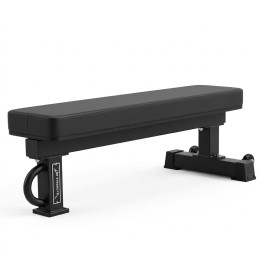
Squat. You set the range with the box height: start high, then lower it as the cycle progresses. You need a height-adjustable box, from 28 to 41 cm for example, sturdy enough for a load above your max; a flat bench rated for 500 kg can serve for the highest position. Descend vertically until contact, bar over midfoot, and give the box only about half of your weight before driving back up without releasing tension. If you rock back and the bar drifts behind midfoot, you are rehearsing a movement that does not exist in the free squat, and the work no longer carries over to the full lift. The positioning details are covered in our article on the box squat.
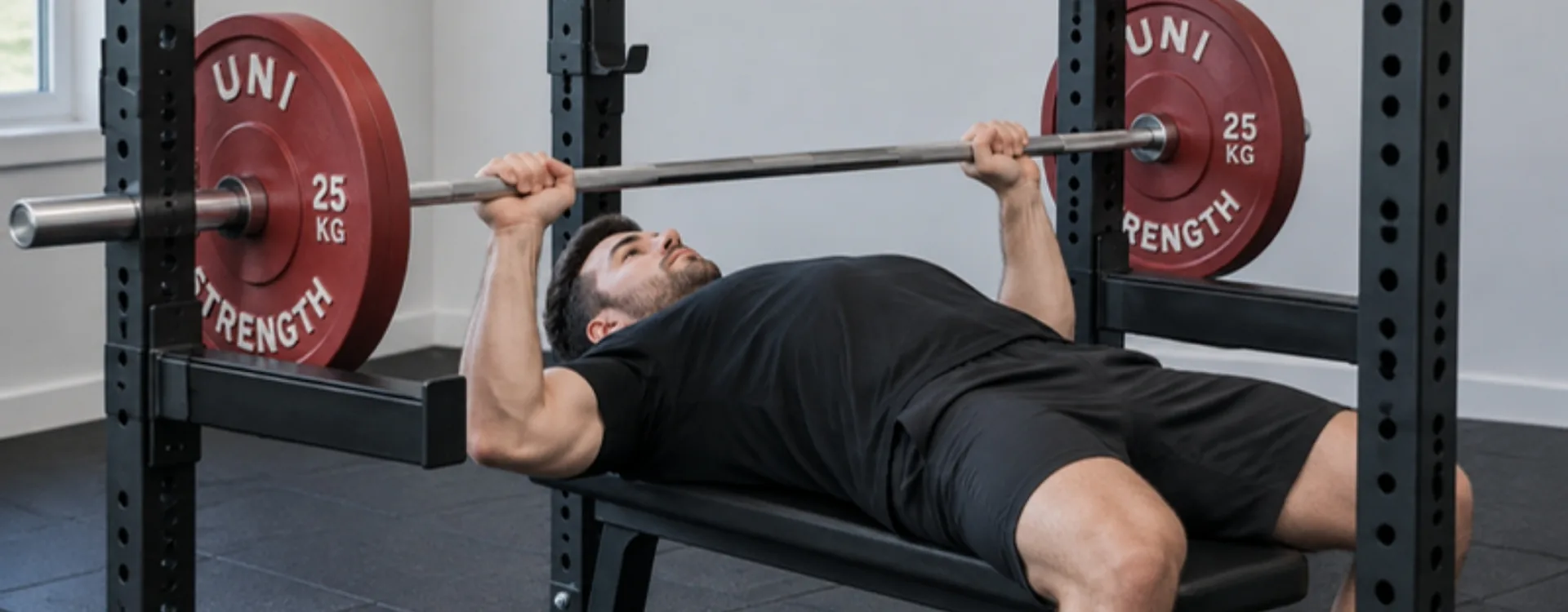
Bench press. You shorten the range with boards placed on your chest, or with the rack safeties set above your chest for a pin press. On the CS-1 (75 × 75 mm uprights, 800 kg load capacity), the hole spacing determines how fine each step can be. On every rep, let about half of the load rest on the board without relaxing the rest: elbows stacked under your wrists, upper back tight. If the bar sinks into the boards, your elbows flare and your back relaxes, it is no longer the intended exercise.
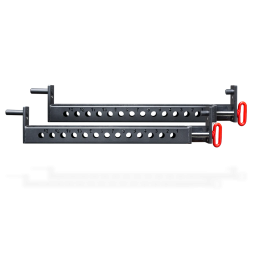
Deadlift. The bar starts from the rack safeties, at knee height in the first sessions, and drops one hole at each step. This top portion of the lift mainly works the hamstrings and glutes: keep your shins nearly vertical and drive your hips forward. If your knees come back under the bar to restart it (the "hitch"), the exercise turns into a squat and no longer strengthens the targeted portion. Technically, it is close to a very heavy stiff-legged deadlift.
For all three lifts. Above 100 % of your max, the load has to be exact: calibrated plates, accurate to 10 g, keep you from believing you cleared a step when your cast iron plates weigh 2 kg less than their marking. Also film your sets and compare your positions with those of the full lift: if they drift away from it, the partial work loses its value.
What about the bottom position?
During the first weeks, the short range leaves out the bottom of the lift, which may become your weak point when you return to full range. You have two ways to maintain it:
slot in, on the same lift, full range sessions focused on speed and technique;
keep an assistance exercise that loads the bottom position in every session: narrow stance pause squat, front squat, heels elevated squat or deficit deadlift.
The Uni Strength equipment for a progressive range of motion cycle
The whole cycle relies on a starting height you can adjust notch by notch and on an exact load: a rack with closely spaced holes, solid safeties to rest the bar on every rep and calibrated plates. Here is what we offer, shipped from our warehouse in France.
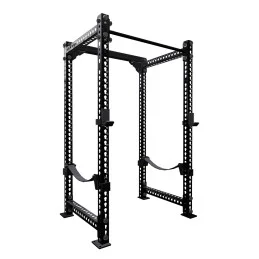
Compact squat cage, H 212 x W 122 x D 122 cm, 350 kg capacity
399,99 €
Prices incl. VAT as of 9 October 2026. Free delivery from €300 excl. VAT in mainland France, instalment payment available. For advice on your home gym setup, write to [email protected] or call +33 4 83 39 67 96.
No. It stays set between 100 and 103 % of your max on the full lift; it is the bar path that progresses.
How many sessions should I plan?
Six per lift at a minimum, 8 to 10 for a more solid result, gaining one notch of range every session or every other session.
Can all three lifts follow the cycle in the same week?
Rarely. Most advanced lifters alternate: squat and bench press one week, deadlift the next. Only exceptional recovery allows all three every week.
How do I avoid losing strength at the bottom of the lift?
With light full range sessions, or an assistance exercise targeting the bottom position in every session.
To apply this method at home, a rack with finely adjustable safeties, like the CS-1 rack, and calibrated plates make up the core of the equipment. To refine your squat positioning, reread our guide on the box squat. And to fit this cycle into the rest of your programming, browse power rack exercises and our SBD tips.