How should you prepare for your first powerlifting competition?
To prepare for a first powerlifting competition, learn the referees' commands and rehearse them in training, then set a cautious attempt plan, opening with a weight you have recently lifted for three clean reps. Next, sort out the logistics: bag packed the night before, rack heights declared at weigh-in while wearing your competition shoes, food you digest well for a 6 to 8 hour day. On the day itself, the main thing is to leave with a valid total and to understand how a competition runs.
Several weeks out: make the commands a reflex
In competition, a lift only counts if it follows the rhythm set by the head referee. Each lift has its own signals, and the right response has to come without thinking.
| Lift | Referee's signal | What you do |
|---|---|---|
| Squat | “Squat”, when the bar is out of the hooks and motionless | You descend, then come back up to lockout |
| Squat | “Rack”, after lockout | You return the bar to the hooks |
| Bench press | “Start”, bar motionless with arms extended | You bring the bar down to your chest and hold it still there |
| Bench press | “Press”, bar motionless on the chest | You press to lockout |
| Bench press | “Rack”, after lockout | You rack the bar |
| Deadlift | No start signal | You pull as soon as you are ready |
| Deadlift | “Down”, once standing and locked out | You lower the bar to the floor |
Practice these signals out loud, with a partner or a timer, on your heavy sets as well as your warm-ups. A press started before “Press” or a bar racked before “Rack” earns a red light that has nothing to do with your strength: it is a training habit, and therefore the easiest fault to eliminate. The validity criteria for each lift are detailed in the technical rules of the French federation, published by the Fédération française de force (FFForce); read them before you register so you know exactly what will be judged.
Setting an attempt plan that keeps you in the competition
Open conservatively. With three attempts per lift, missing all three on any single one of them (the “bomb-out”) leaves you without a total, and the chain reaction most often starts with an opener that is too heavy. The plan is therefore built by increasing the risk you take from one attempt to the next.
- Opener: a weight lifted recently for 3 clean reps, i.e. about 88 to 92% of your max. Its only purpose is to get the lift validated.
- Second attempt: around 95% of your max, or a former personal record. It consolidates the total.
- Third attempt: a small personal record, 2.5 to 5 kg above your best. This is the only attempt where you accept taking a risk, since the total is already secured.
Your training numbers don't carry over as they are. On the bench press, the bar has to stay motionless on your chest until “Press”, which makes the pause longer than you are used to; on the squat, you are no longer the one who decides whether the depth is sufficient. Write down the full plan in kilos before the big day, so you have no calculations to make on site.
At home: recreating the competition cues
Training in a home gym is no obstacle to preparing for a competition, provided the equipment gives you the same cues as the equipment on the platform:
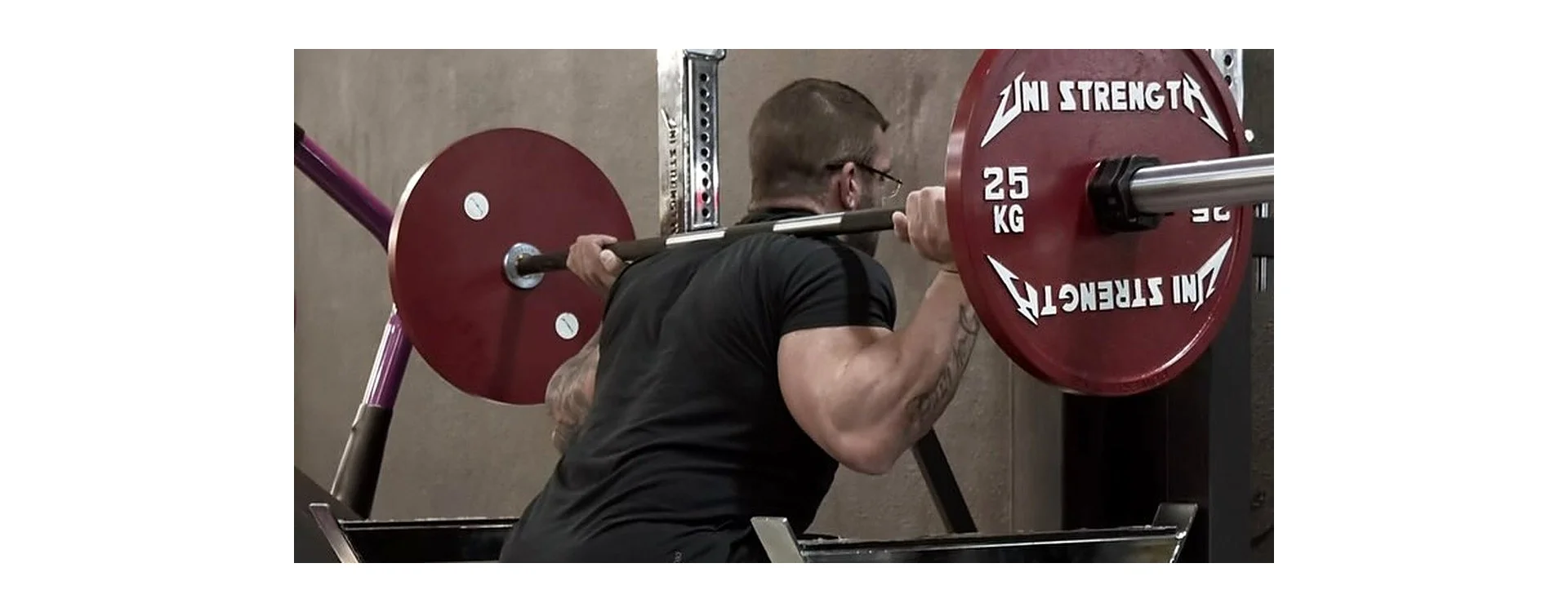
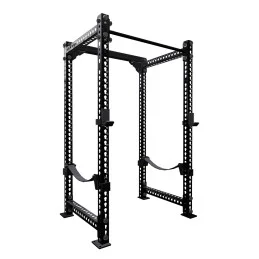
- the combo rack reproduces competition heights and hooks, which lets you rehearse unracking the bar and returning it on “Rack”; the settings are explained in our combo rack user guide;
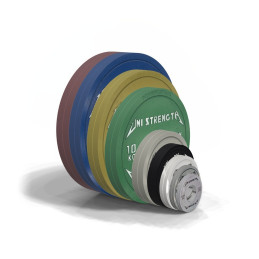
- calibrated plates, accurate to within 10 g, ensure that the displayed load is the real load: your 92% in training is 92% on competition day;
- a competition-standard bench is 42 to 45 cm high, with a backrest 29 to 32 cm wide.
With these three elements, the setup you practice at home is exactly the same on the day.
The night before: packing your bag
- Paperwork: federation license, ID, the organizer's emails printed or downloaded, attempt plan in kilos.
- Clothing: lifting suit (singlet), compliant T-shirt and underwear, knee-high socks for the deadlift.
- Shoes: one pair for the squat, one flat pair for the deadlift.
- Accessories: belt, wrist wraps, compliant knee sleeves, chalk if it is allowed.
- Food and drink: water, electrolytes, food.
Packing your bag the same morning is the surest way to arrive without your license or your knee sleeves.
In the morning: what gets settled at weigh-in
Weigh-in takes place before the competition starts, usually two hours before the first flight; the exact time is given in the organizer's emails. Your weight class and the compliance of your kit are checked there, and you announce your opening weights.
This is also when you declare your rack and safety heights. Bring the shoes you will lift in: the right height depends on the thickness of the heel, and a measurement taken with another pair will leave the bar badly positioned when you unrack it.
During the day: lasting 6 to 8 hours
Between weigh-in and the last deadlift, you will spend 6 to 8 hours on site. Drink water and electrolytes throughout the day, and bring carbohydrates you know and digest quickly: bread, rice, fruit compotes, cereal bars. Competition day is not the day to try a new food. Bring more than you think you will eat; if you lift poorly on a full stomach, stay light before the squat and eat more once that lift is over.
Getting support from a helper
A helper, often called a “handler”, takes care of everything around the lifts: they keep track of the lifting order and the schedule, pass your weights to the referees' table, work out the next attempt and remember to make you drink and eat. All you have to do is focus on your three attempts per lift.
Facing the referees
A red light penalizes a rule that wasn't met, never the person. The referees apply the same standards to everyone: squat depth, bar motionless on the chest, lockout, following the commands. If you know these criteria, you know exactly what they are looking at, and the atmosphere at a competition stays welcoming toward beginners.
The Uni Strength equipment to prepare your meet
Training on the same kind of bench, plates and hooks as on the platform makes meet day more predictable: here is the equipment we offer to prepare your first meet at home, shipped from our warehouse in France.
| Product | Key points | Price incl. VAT |
|---|---|---|
| Competition Flat Weight Bench 30 cm Red - UF Power Bench | Competition-compliant 30 cm flat bench, 750 kg capacity, 10 cm pad | 239,99 € |
| 159 kg UF Calibrated Plates Set | Cast-iron calibrated plates, IPF colour code, 10 g tolerance per plate | 899,99 € |
| Monolift for Rack and powerlifting CS-1 | Spring-loaded monolift sold as a pair: squat and bench press without a walkout | 269,99 € |
| CS-1 Power Rack 204 cm, 4 uprights, 76 cm depth | Complete bundle | 75 x 75 mm uprights, 800 kg capacity, holes every 5 cm, pull-up bar and J-cups included | 1 199,99 € |
| CS-1 Folding Safeties | 76 or 104 cm folding safeties, 3 mm steel, 500 kg, sold as a pair | from 249,99 € |
Prices incl. VAT as of 9 October 2026. Free delivery from €300 excl. VAT in mainland France, instalment payment available. For advice on your home gym setup, write to [email protected] or call +33 4 83 39 67 96.
Further on the shop: Calibrated Powerlifting Plates, CS-1 Rack and Squat Cage Accessories, Rack CS-1 - Complete and Modular Rack, Olympic Bars.
Frequently asked questions
At what percentage of my max should I set my opener?
Around 88 to 92%, which corresponds to a weight you have recently lifted for three clean reps.
When am I allowed to press on the bench press?
Only on the “Press” signal, given when the bar is motionless on the chest. It is preceded by “Start” and followed by “Rack”. Pressing early earns a red light.
Do I have to wait for a signal to pull on the deadlift?
No, you start when you are ready. The only signal is “Down”, once you are standing and locked out.
How much time should I plan to spend on site?
Allow 6 to 8 hours between weigh-in and the last deadlift, which is why well-chosen food and a helper are worthwhile.
Organizing your preparation
To structure your preparation, reread our SBD tips on the three lifts and our article on how to use a combo rack in conditions close to competition. As for equipment, a bar chosen from our Olympic bars, calibrated plates and one of our weight benches give you cues at home that are close to those of the platform. On the day, all you will have left to do is follow your attempt plan and the commands you have rehearsed.