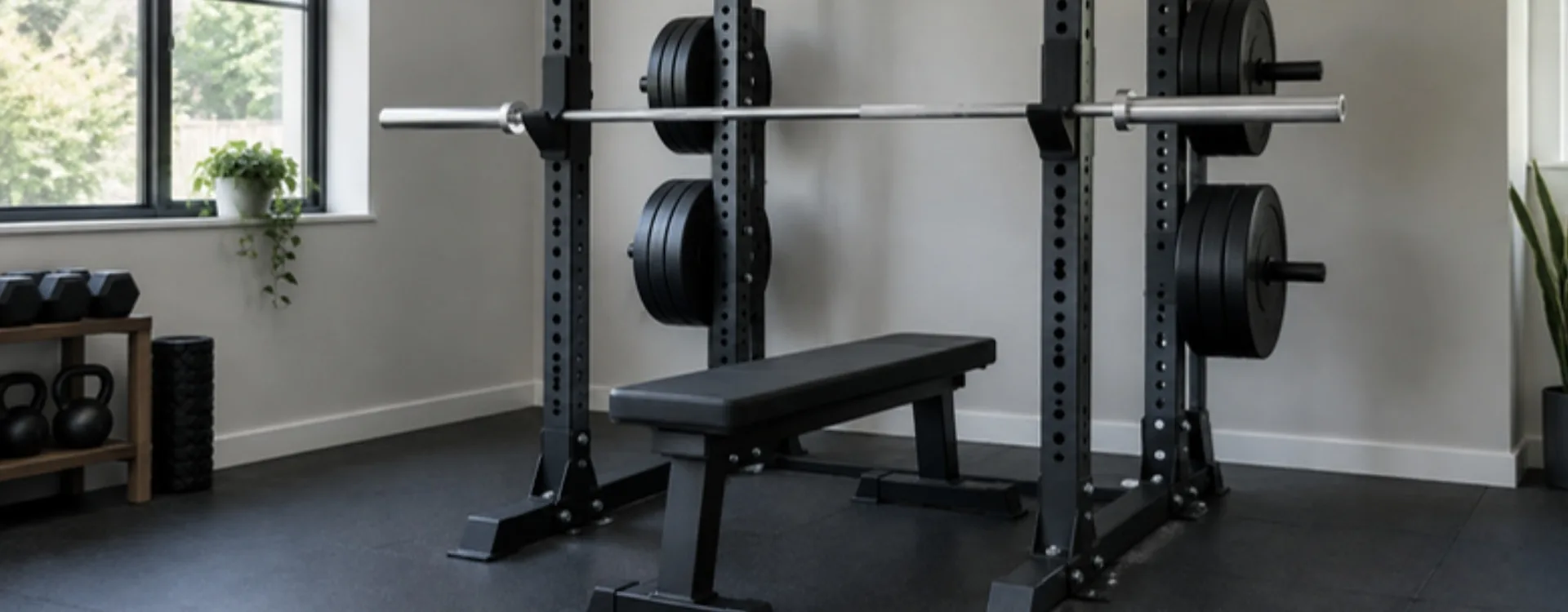
How to Use a Combo Rack for Your Workouts

The combo rack is an essential tool for any strength training enthusiast looking to optimize training space and performance. This versatile piece of equipment combines the functions of a squat rack and a weight bench, enabling a variety of exercises such as squats, bench press or military press. Here's how to use it effectively:
In short
- A combo rack combines a squat rack and a weight bench: squats, bench press, military press, inverted rows, partial deadlifts and good mornings on a single structure.
- Set the safety arms just below your maximum range of motion, so they catch the bar if you fail a rep.
- Adjust the height of the hooks for each movement: slightly below shoulder height for the military press, safeties at knee level for partial deadlifts.
- Maintenance: check parts for wear and loosening, clean after every session and lubricate the moving parts.
Installation and preparation
To use a combo rack safely, it's crucial to prepare it properly. Start by choosing an unobstructed location that allows you to move around freely. Install the rack according to the manufacturer's instructions, ensuring that all parts are securely fastened. Once assembled, adjust the vertical uprights to a height appropriate for the exercise you plan to perform.
For squats, the bar should be positioned at a comfortable height for lifting from a standing position, while for bench presses, it should be easily accessible from a lying position.
Essential safety settings
Safety arms are a key feature of the combo rack. They should be positioned just below your maximum range of motion to guarantee protection in the event of failure. These settings are essential for safe training, especially when working with heavy loads.
How to use the combo rack on different exercises
- Squats: After adjusting the uprights to the appropriate height, place the bar on your shoulders, step back to position yourself, then perform the squat movement. In case of difficulty, the safety arms are there to support the bar.
- Bench press: With the bench in place and the hooks adjusted, lie back, grasp the bar and perform the movement. The safety arms should be positioned to catch the bar if you fail to press it back up.
- Military press: For the military press, adjust the hooks to a height slightly lower than your shoulders when standing or sitting. Grab the bar, lift it up, and push it over your head until your arms are fully extended. This exercise is excellent for strengthening shoulders, triceps and upper back. Safety arms can be positioned to catch the bar if you fail to lower it safely.
- Inverted rows: Inverted rows are an excellent exercise for the back and biceps. Adjust the safety arms or hooks to an intermediate height, so that the bar is at a height that allows you to hang under it. Positioning your feet on the floor and keeping your body aligned, pull your chest towards the bar. This exercise can be made more difficult by elevating your feet on a support.
- Partial deadlifts: For partial deadlifts, place the safety arms at a height that limits the range of motion, generally at knee level. This configuration works the final phase of the movement and strengthens the muscles of the lower back, legs and hips. Load the bar with a suitable weight and concentrate on correct posture to avoid injury.
- Good mornings: Position the bar on your shoulders as for a squat. With your knees slightly bent and your back straight, slowly tilt your torso forward until you feel tension in your hamstrings. Then return to a standing position. Good mornings are ideal for strengthening hamstrings, glutes and lower back.
Care and maintenance
Regular maintenance is essential to ensure the durability and safety of your combo rack. Inspect parts for signs of wear or loosening. Clean equipment after each session to remove sweat and dust, and apply lubricant to moving parts to prevent corrosion and ensure smooth operation.
To go further in the shop: Combo racks, Squat racks and power racks, Weight benches.
The equipment used in this guide
| Use | Equipment | Key figure |
|---|---|---|
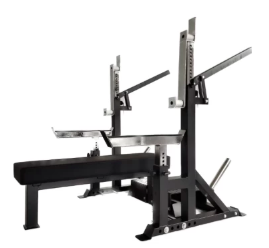
| Squat and bench press on a single frame | Powerlifting combo rack | 400 kg for squats, 250 kg for bench press, bench height 44.5 cm |
| Same use, simpler adjustments | Affordable powerlifting combo rack | hooks from 100 to 170 cm, safeties from 56 to 78 cm, 44 cm bench |
| The bar for all three lifts | UF-Power Zeus powerlifting bar | 20 kg, built to IPF specifications, 1,000 kg capacity |
| Exact loads | 159 kg calibrated plate set | 10 g tolerance per plate, IPF colours |
Specifications taken from the product pages on 9 October 2026.
Frequently asked questions
What is a combo rack?
A piece of equipment that combines a squat rack and a weight bench, so you can chain squats, bench press, overhead press, inverted rows or partial deadlifts on a single structure.
How do you set the safety arms?
Just below your maximum range of motion: they must catch the bar if you fail, in the squat as in the bench press, especially with heavy loads.
Which exercises can you do on a combo rack?
Squats, bench press, overhead press, inverted rows, partial deadlifts and good mornings, adjusting the hook height for each movement.
Also worth reading: the combo rack is also the equipment used on the platform: read our guide to prepare for your first powerlifting meet (commands, attempts, weigh-in).