The 9 Key Criteria for Choosing the Perfect Weight Bench
In short. Nine criteria matter when choosing a weight bench: a load capacity equal to your body weight plus your maximum load, increased by 20%; stability (wide base, non-slip feet); strength (steel, checked welds); flat or adjustable; a minimal gap between seat and backrest; a height of 42 to 45 cm; a backrest 30 to 35 cm wide; firm padding at least 5 cm thick; and a budget above €200 for real durability.

Choosing the right weight bench is a crucial decision for anyone wishing to train seriously at home. More than just an accessory, it's the central pillar of your home gym. A weight bench enables you to effectively work a wide variety of muscle groups, including pecs, shoulders, arms, as well as abs and legs.
However, not all weight benches are created equal. Opting for a poor-quality model can hinder your progress, compromise the quality of your workouts, and above all, increase the risk of injury. So it's essential to make an informed choice.
In this article, we'll guide you through the 9 essential criteria for selecting a weight bench that meets your needs, guaranteeing sessions that are both effective and safe.
How to choose the ideal weight bench?
Choosing the right weight bench means taking into account several essential criteria to ensure safety, performance and comfort. Here are 9 key points to bear in mind:
-
Weight capacity: Choose a bench capable of supporting your maximum loads with a safety margin.
-
Stability: Make sure the bench offers good stability, especially with non-slip feet.
-
Sturdiness: Opt for quality materials such as steel, and check the welds.
-
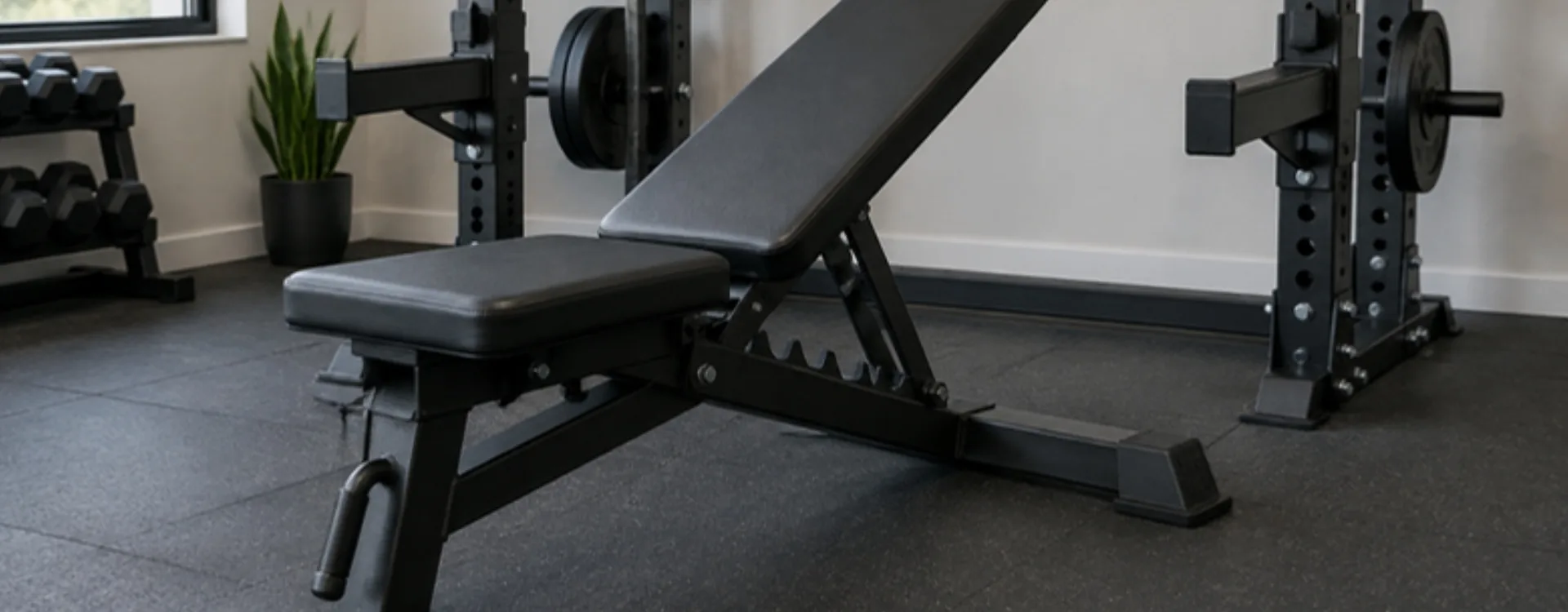
Flat or tilting: Depending on your objectives, choose between a flat bench for stability or a tilting bench for greater versatility.
-
Minimal gap: Choose a bench with a minimal gap for greater comfort.
-
Height: Select a bench height between 42 and 45 cm for optimum posture.
-
Backrest width: A width of between 30 and 35 cm is ideal for stability and safety.
-
Comfort and padding: Choose a well-padded bench for greater comfort during prolonged sessions.
-
Price: A price above €200 often guarantees better durability and safety than lower-end models.
1. What weight capacity should I choose for my weight bench?
The first criterion to consider is the weight capacity the weight bench can support. This feature is crucial to guaranteeing your safety, as well as the long-term durability of the bench.
When you lift weights, the bench must be able to support not only your own weight, but also that of the dumbbells or bars you're using. So, to determine the weight capacity required, add your body weight to that of the maximum loads you plan to lift.
In general, it's advisable to choose a bench that can support at least 20% more than the total of these two elements, to allow for a safety margin.
How to calculate the ideal weight capacity for a weight bench?
User weight |
Maximum weight lifted |
Recommended capacity (user weight + maximum weight + 20%) |
|
80 kg |
100 kg |
216 kg |
|
90 kg |
120 kg |
252 kg |
|
100 kg |
150 kg |
300 kg |
Why it's important:
Weight capacity directly influences the safety and durability of the equipment. Choosing a model capable of supporting your maximum loads while allowing for a safety margin will enable you to train with complete peace of mind, even when you're making rapid progress in your performance.
Product example:
All Uni Strength benches, including the UF-2 Tilt UF-5 or the UF-1 Zero Gap are designed to support up to 500 kg (UF-5) or 750 kg (UF-2 and UF-1 Zero Gap). This high weight capacity makes them suitable for a wide range of users, from beginners to powerlifters, enabling you to train with the confidence that your equipment is up to the task.
2. Stability: a key criterion for safety and performance
The stability of a training bench is crucial to ensuring safe and effective workouts. An unstable bench can lead to uncontrolled movements, which not only limit the quality of exercises, but also considerably increase the risk of injury, particularly when using heavy loads.
Models with a wide base and non-slip feet offer greater stability and grip on the floor, reducing the risk of tipping over or slipping during your sessions.
Product example:
The UF-2 Tilt Bench is an excellent example of equipment designed to offer maximum stability thanks to its thick steel frame and non-slip feet. It features a wide base that ensures optimum grip on the floor and reduces the risk of slipping during intense exercise. Its narrow front base allows ideal positioning of the feet, guaranteeing additional stability while promoting good bridging.
3. How do I assess the strength of a weight bench to ensure its durability?
The strength of a weight bench depends on the quality of its materials and the precision of its design. A well-designed bench, often made of steel, with sturdy welds and reliable fastenings, is capable of withstanding intensive use and heavy loads without buckling.
What's the best material for a weight bench?
|
Material |
Advantages |
Disadvantages |
|
Steel |
Very sturdy, supports heavy loads |
Heavier, difficult to move |
|
Aluminum |
Lightweight, easy to move |
Less sturdy, limited weight capacity |
Expert advice:
Take a close look at welds, frame thickness and fastener quality. A thick frame and impeccable welds indicate a bench capable of withstanding heavy loads and intensive long-term use.
Product example:
Uni Strength benches, like the UF-1 Zero Gap, the UF Power and the UF-5 Tilt are made of steel, guaranteeing exceptional strength. Capable of withstanding 500 to 750 kg depending on the model, these models are built to last, offering consistent performance even under intensive use.
4. Flat or tilting bench: why is it essential for your performance?
One of the most important criteria in choosing a weight bench is whether it should be whether it should be flat or incline. Each type of bench offers unique advantages, depending on your training objectives.
Advantages of a flat weight bench
-
Greater stability: No tilting mechanism, reducing the risk of imbalance.
-
Superior weight capacity: Excellent for heavy loads.
-
Ease of use: Quick and easy to use, ideal for beginners.
-
Affordable: Often less expensive than tilt benches.
-
Durability: No moving parts, more durable.
Advantages incline weight bench
-
Exercise versatility: Greater variety of exercises thanks to different incline levels.
-
Specific muscle targeting: By adjusting the incline, you can target specific muscles.
-
Improved performance: Varying the angle prevents muscle stagnation.
-
Improved ergonomics: Reduce stress on shoulders by choosing the right incline.
What's the difference between a flat bench and an incline bench?
|
Criterion |
Flat bench |
Incline bench |
|
Stability |
Very stable, ideal for heavy loads |
Less stable, but adjustable |
|
Versatility |
Limited to standard exercises |
Offers a variety of exercises |
|
Muscle targeting |
Less variety |
Allows you to target specific groups |
|
Price |
Generally more affordable |
More expensive due to mechanism |
|
Durability |
Very robust, few moving parts |
Can wear out more quickly |
Product example:
Uni Strength benches offer both tilting and flat models. Tilting models, such as the UF-2 and the UF-1 Zero Gap allow you to vary the angles at which you target different muscle groups, while maintaining a high level of sturdiness.
5. Adjustable bench gap size: what is it and why does it matter?
Gap size, or the space between the backrest and seat of an adjustable bench, can create an imbalance and make exercise less effective.
Why is a minimal gap preferable?
-
Improves comfort: Reduces uncomfortable positions.
-
Increases stability: Prevents the body from sinking into an uneven position.
-
Optimizes performance: Helps maintain consistent form.
Product example:
The UF-1 Zero Gap bench from Uni Strength solves this problem thanks to its system, which eliminates the gap between seat and backrest, whatever the angle chosen.
6. Bench height: an often overlooked but essential factor
A bench that's too low or too high can compromise the efficiency of your movements, particularly for the leg drive, which is crucial for strength exercises such as the bench press.
Powerlifting benches are generally between 42 and 45 cm high, an ideal range for most users. This height provides good bridging, making it easier to use the legs to maximize the load lifted.
Product example:
Uni Strength benches, such as the UF-1 Zero Gap, the UF Power and the incline benches, meet these height standards, with measurements of around 43 to 45 cm, guaranteeing an ideal configuration for athletes of both hypertrophy and pure strength.
7. Backrest width: essential for stability and safety
Backrest width is an often overlooked criterion, but one which plays a crucial role in stability and safety during strength training exercises.
Why it's important:
A sufficiently wide backrest, ideally 30 to 35 cm, provides better support for your shoulder blades, reducing the risk of injury and optimizing your strength by better stabilizing your posture during heavy lifts.
Product example:
Uni Strength bench models feature backrest widths ranging from 29.5 cm to 35 cm, offering greater stability for users of all sizes, especially for tall athletes or those with broad shoulders.
8. Comfort and padding: essential for long sessions
Comfort, which includes padding, is another key element to consider when buying a weight bench, especially if you're planning long sessions.
Quality padding is essential to support your back and shoulders, while minimizing discomfort during exercises where you spend a lot of time lying down, such as bench presses or crunches.
Good padding needs to be both firm and thick to provide adequate support without deforming under pressure. Ideally, it should be at least 5 cm thick to guarantee optimum comfort.
Product example:
All Uni Strength benches, such as the UF-2 Incline, UF Power, UF-1 Zero Gap and UF-5 Incline feature thick, firm padding for optimum support during extended sessions.
9. Price: should you really invest more than €200 in a weight bench?
Price is often a decisive criterion when choosing a weight bench. It's important to strike the right balance between budget and equipment quality, without compromising other essential criteria such as sturdiness, stability and versatility.
How to choose the right weight bench at the right price?
-
Quality materials: benches made from durable materials such as steel are often more expensive, but offer greater durability.
-
Versatility: An incline bench will be more expensive than a flat one, but will offer greater exercise variety.
-
Well-known brands: Benches from well-known brands, such as Uni Strength, may cost a little more, but guarantee better quality and safety.
Weight bench price comparison: under €200 vs. over €200
|
Features |
Under €200 |
Over €200 |
|
Weight capacity |
Up to 300 kg |
300 kg and over |
|
Stability |
Moderate |
Good to excellent |
|
Material |
Aluminum or light steel |
Sturdy or reinforced steel |
|
Comfort (padding) |
Thin, low-strength |
Thick, durable and ergonomic |
Product example:
Uni Strength benches offer a wide price range to suit all budgets, while guaranteeing exceptional quality. The UF-5 Incline, at €269.99, stands out for its versatility at a competitive price, while the UF-1 Zero Gap, at €549.99 offers top-of-the-range features. For power users, the UF Power, at €239.99 combines strength and comfort, and the UF-2 Inclinable, at €499.99 combines sturdiness and durability.
Still have questions?
If this article doesn't answer all your questions, don't hesitate to contact us or leave a comment. We'll be delighted to help you make the right choice.
Discover our other articles on strength training equipment
Want to know more about equipment to optimize your home gym? Explore our other specialized articles on Uni Strength and find the ideal equipment to support your progress.
To go further in the shop: Weight bench, Incline bench, Wide Weight Bench (30 or 35 cm) - UF Power Bench, Incline Weight Bench – UF-5 with Vertical Storage.
Frequently asked questions
What height and width for a weight bench?
A height of 42 to 45 cm for an optimal position, and a backrest 30 to 35 cm wide for stability and safety.
Flat or adjustable bench?
The flat bench for stability, the adjustable bench for versatility; in both cases a minimal gap between seat and backrest improves comfort.
Which sturdiness criteria should you check before buying?
The weight capacity with a safety margin, stability with non-slip feet, and quality materials such as steel with checked welds.
Also worth reading: once you have chosen your bench, learn how to keep your arch when you unrack the bar: the bench press setup in six steps.