Best Exercises to Build Your Legs (With and Without Machines)
The best exercises to build your legs rest on a few big compound movements (squat, lunges, Romanian deadlift), done with your bodyweight or free weights, then completed by guided machine work (hack squat, leg press, leg extension, leg curl) that lets you load heavy safely. To build complete legs, you need to train all four areas: quadriceps, hamstrings, glutes and calves. No single exercise is enough, the combination makes the difference.
In this guide, we start with the machine-free movements (the most accessible and often the most effective), then move to machines to add volume and safety on heavy loads. Whether your goal is muscle gain, fat loss or general strengthening, these leg exercises cover every level, from beginner to advanced.
The leg muscles in brief
Before choosing your exercises, you need to know what you are training. The leg is made up of several complementary muscle groups:
- The quadriceps, at the front of the thigh, responsible for knee extension.
- The hamstrings, at the back, which flex the knee and extend the hip.
- The glutes, drivers of hip extension and overall power.
- The adductors, on the inner thigh, often neglected stabilisers.
- The calves, at the back of the lower leg, for propulsion and ankle stability.
A good programme balances work between the front (quadriceps) and the back of the body (posterior chain). The classic mistake is to put everything on the squat and neglect the hamstrings, which creates an imbalance and increases the risk of injury.
Why train your legs?
Training your legs is not just about aesthetics. The lower limbs contain the biggest muscles in the body: developing them increases overall strength, athletic power and calorie expenditure, which also helps with fat loss. To go further, see our strength training exercises to lose weight and how to calculate your basal metabolic rate. A strong lower body protects the knee and hip joints, improves posture and balance, and limits the risk of injury in daily life. It is the base of almost every athletic movement, from sprinting to jumping. Neglecting your legs means depriving yourself of the muscle group that pulls all your progress upward.
Machine-free leg exercises
You do not need a machine to start building solid legs. These bodyweight or free-weight movements recruit several muscles at once, which makes them the foundation of any leg training.
The squat, the king exercise
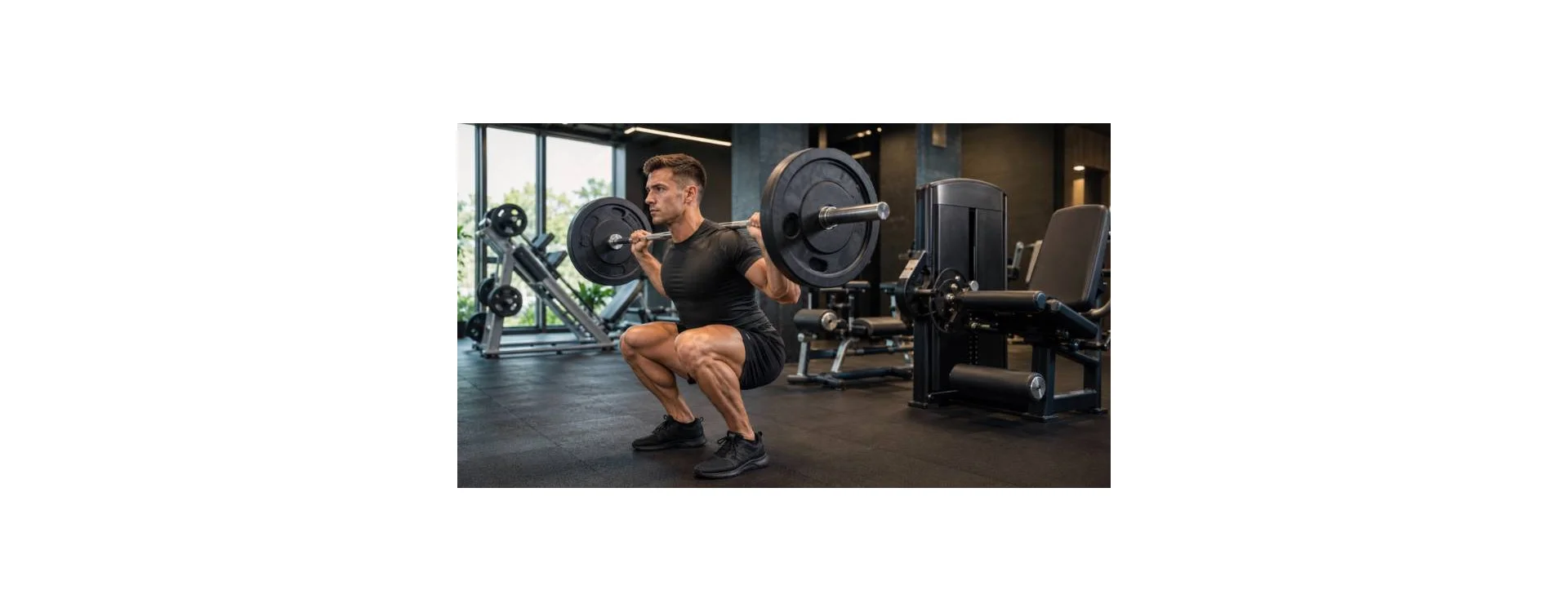
The squat is the reference exercise for the legs. With your bodyweight to learn the movement, then with a barbell on your back (back squat) to progress, it works mainly the quadriceps and glutes, with strong core engagement. Descend hips below your knees if your mobility allows, keeping your back straight and your heels on the floor. The sumo squat variation (wide stance, toes pointing out) emphasises the adductors and glutes. It is the best starting point, and it loads infinitely with a barbell and plates from our barbells and weight plates.
Lunges
Lunges (forward, reverse, walking or loaded with dumbbells) are a unilateral exercise that corrects imbalances between the two legs and strongly works glutes and quadriceps. The most effective variation is the Bulgarian split squat, rear foot elevated on a weight bench, which increases the range and intensity on the front leg.
The Romanian deadlift
The stiff-leg deadlift, or Romanian deadlift, is one of the best movements for the hamstrings and glutes. Barbell close to your legs, back straight, you lower the load by pushing your hips back until you feel the hamstrings stretch, then rise back up. It perfectly balances the quad-dominant work of the squat.
The hip thrust
The hip thrust is the absolute reference for building the glutes. Upper back braced on a bench, a loaded barbell across your hips, you drive your pelvis up to full extension. It is a movement that accepts heavy loads and targets the glutes better than any other exercise.
The good morning and the nordic curl
To strengthen the posterior chain without a machine, two complementary options: the good morning (barbell on your back, torso tilting forward with hips going back) and the nordic hamstring curl (knees on the floor, feet anchored, controlled descent). The latter is formidable for the hamstrings and very useful for injury prevention.
Calves and the sissy squat
Do not neglect the extremities. Standing calf raises (bodyweight then loaded) develop the calves, often left aside. The sissy squat isolates the quadriceps intensely with no equipment, by leaning your torso back while bending your knees forward.
Building your legs at home with no equipment
No barbell or machine? You can already make a lot of progress with your bodyweight, especially as a beginner. These exercises need no equipment and can be done at home:
- The wall sit: back flat against the wall, thighs parallel to the floor, you hold the position isometrically. Formidable for the quadriceps.
- The bodyweight squat: to master before adding load, focusing on posture and range of motion.
- Step-ups: step up and down from a bench or a step, one leg at a time, for the glutes and quadriceps.
- The jump squat: an explosive version of the squat to add intensity and train power.
- Walking lunges: chain your steps in a lunge for complete unilateral work.
To increase the difficulty without a machine, add dumbbells, a kettlebell (goblet squat) or resistance bands. Light equipment is enough to restart progress when bodyweight becomes too easy, and prepares the move to heavier loads.
Machine-based leg exercises
Machines do not replace the base movements, they complete them. Their benefit: guiding the path, securing heavy loads and letting you reach muscular failure without the risk of imbalance. They are ideal for adding volume at the end of a session. Find our full range of strength machines to equip a complete home gym.
The hack squat
The hack squat guides your squat along rails, shoulders braced under the pads, which removes the balance constraint of the free squat and lets you load heavy while targeting quadriceps and glutes. It is the perfect exercise for those who want to push intensity safely. The Leg Combo Machine Hack Squat and Leg Press from Uni Strength actually combines this exercise and the leg press on a single structure, with a maximum load of 500 kg and multi-notch safety stops that protect the knees at the bottom of the movement.
The leg press
The 45° leg press lets you work the whole lower body by varying foot placement on the platform: feet high to emphasise glutes and hamstrings, feet low to isolate the quadriceps, feet wide to work the adductors. It is an excellent way to accumulate volume without tiring the back, especially after a big base movement. On a 2-in-1 model like the hack squat / press combo, you switch from one exercise to the other in seconds, a real space saver in a home gym.
The leg extension and the leg curl
These two isolation machines are complementary. The leg extension isolates the quadriceps in knee extension, ideal to finish the session and work the mind-muscle connection. The leg curl (seated or lying) isolates the hamstrings in knee flexion. Used at the end of a session, they let you target a muscle precisely without involving the whole body.
The Smith machine squat
The guided bar (Smith machine) is an intermediate between the free squat and the machine: the path is fixed, which secures the movement while keeping good intensity on the quadriceps and glutes. It is an interesting option for beginners or to load heavy without a spotter.
Equipment used in this article
| Exercise | Equipment | Key figures |
|---|---|---|
| Squat | CS-1 rack and UF Basic Olympic bar | rack: 75 × 75 mm uprights, 800 kg; bar: 20 kg, 350 kg |
| Lunges | 4 to 36 kg adjustable dumbbells | 2 kg increments, expandable to 65 kg |
| Romanian deadlift | UF Basic Olympic bar | 50 mm sleeves, 220 cm |
| Hip thrust | UF Power Bench flat bench | 43 cm high, 750 kg maximum load |
| Good morning and nordic curl | Uni Strength GHD | 178 × 130 cm, built-in band pegs |
| Hack squat and leg press | Hack squat and leg press combo machine | 500 kg maximum load |
| Leg extension and leg curl | Seated leg curl and extension machine or attachment for the Zero Gap+ bench | adjustable backrest to line the knee up with the pivot |
Specifications taken from the product pages on 1 October 2026.
With or without machines: which to choose?
The two approaches complement each other, they do not compete. Machine-free movements (squat, lunges, deadlift) recruit more muscles, work the stabilisers and transfer better to daily life and sport. Machines bring safety, isolation and the ability to load heavy without a balance risk. The best programme combines both: the big movements at the start of the session when you are fresh, the machines afterwards for volume. To go further on the front of the thigh, see our guide to the best exercises to build your quadriceps.
Building an effective leg session
Having the right exercises is not enough, you still need to organise them. Here is a leg day template balanced between the front and posterior chain:
| Exercise | Sets x reps | Main target |
|---|---|---|
| Squat | 4 x 6 to 8 | Quadriceps, glutes |
| Romanian deadlift | 3 x 8 to 10 | Hamstrings, glutes |
| Leg press | 3 x 10 to 12 | Quadriceps, glutes |
| Bulgarian split squat | 3 x 10 per leg | Glutes, quadriceps |
| Leg curl | 3 x 12 to 15 | Hamstrings |
| Calf raises | 4 x 15 to 20 | Calves |
A few principles to progress:
- Progressive overload: regularly increase the load or the reps. It is the key to muscle gain over the long term.
- Number of reps: 6 to 8 reps for strength, 8 to 12 for muscle gain, 15 and more for muscular endurance. Adapt to your goal.
- Warm-up: a few light sets before loading heavy, especially on the squat and the deadlift.
- Rest time: 2 to 3 minutes on the big movements, 60 to 90 seconds on isolation exercises.
- Control of the eccentric phase: lower slowly, that is where much of the muscular work happens.
- Frequency: fit this routine in once or twice a week, leaving at least 48 hours of recovery.
The coach's tip: most lifters stall because they neglect the posterior chain. For every pair of quadriceps sets, always plan a pair of hamstring or glute sets. Balanced legs are stronger, more aesthetic and less prone to injury.
Key takeaways
To build your legs effectively, first rely on the big machine-free movements (squat, lunges, Romanian deadlift, hip thrust), which recruit the most muscle mass. Then complete with machines (hack squat, leg press, leg extension, leg curl) to add volume and load heavy safely. Work all four areas (quadriceps, hamstrings, glutes, calves), apply progressive overload and respect recovery. With a barbell, a few plates and a good leg machine, you have everything for complete training, at home or in the gym.
FAQ
How do you perform a squat correctly?
Place your feet shoulder-width apart, toes slightly turned out. Keep your torso straight and your gaze forward, push your hips back then bend your knees, descending until your thighs are at least parallel to the floor. Keep your heels anchored and your back braced, then rise by pushing through your heels. Never let your knees cave inward.
How do you avoid injuries when training your legs?
Warm up systematically, increase loads gradually and always favour clean technique over heavy weight. Keep your back straight on the squat and the deadlift, control the descent and train on stable equipment. On heavy movements, safety stops or a spotter clearly limit the risks.
What exercises work the quadriceps?
The quadriceps respond very well to the squat, the hack squat, the leg press (feet low), the leg extension and the sissy squat. For targeted work, alternate a big compound movement and an isolation exercise like the leg extension at the end of the session.
To go further in the shop: Lower-body machines, Squat racks and power racks, Weight benches. Also worth reading: the best quadriceps exercises.
Read also: how to build your glutes, a glute workout programme for the gym.
Frequently asked questions
What are the best exercises to build your legs?
The big movements without machines first (squat, lunges, Romanian deadlift, hip thrust), then machines (hack squat, leg press, leg extension, leg curl) to add volume and safety.
Do you need a machine to build your legs?
No: squats, lunges and Romanian deadlifts with bodyweight or free weights are enough to build strong legs; machines then complement heavy loads.
Why train your legs?
The lower body holds the largest muscles: developing them increases overall strength, athletic power and calorie expenditure, and protects the joints.