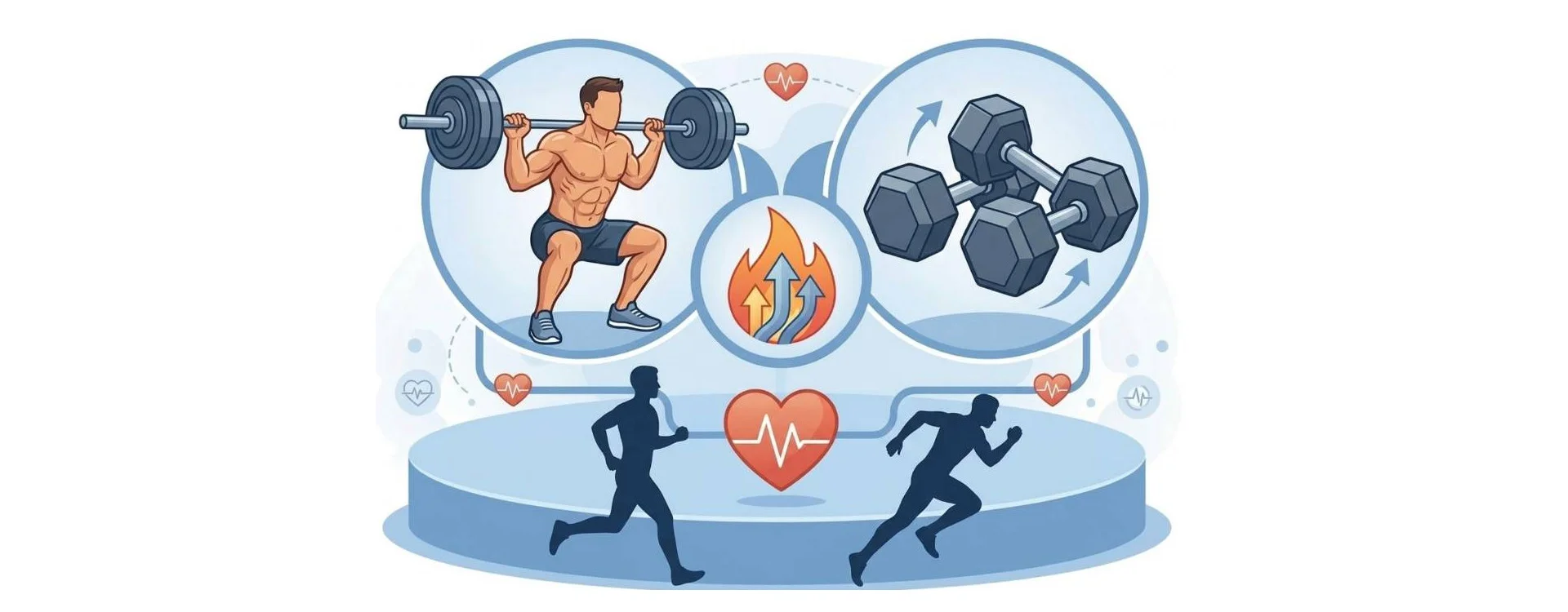
What strength training exercises to lose weight? Top 10 fat-burning movements
In short. The most effective strength exercises for losing weight are compound movements: barbell squat, deadlift, thrusters, bench press, barbell row, dumbbell lunges, military press, kettlebell swings, weighted burpees and clean and press, burning 170 to 500 calories per 30 minutes for a 75 kg person. Organised in circuits or supersets, 3 to 5 times a week, with a deficit of 300 to 500 calories a day and 1.6 to 2.2 g of protein per kilo, they help you lose fat while preserving muscle.
Losing weight through strength training is not only possible, it is one of the most effective long-term strategies available. Contrary to popular belief, lifting weights is not just about building size: a well-structured resistance training programme can burn between 300 and 600 calories per session, while permanently increasing your basal metabolic rate. The result? Your body keeps burning energy even at rest, for up to 48 hours after your workout thanks to the EPOC effect (Excess Post-Exercise Oxygen Consumption). In this article, we break down the most effective exercises for weight loss, the physiological mechanisms at play, and how to structure your sessions to maximise fat loss.
Also discover all our tips to improve your strength training, whether in the gym or your home gym.
Why does strength training help you lose weight?
When people think about weight loss, they usually think cardio: running, cycling, rowing. These activities do burn calories during exercise, but their impact stops almost as soon as the session ends. Strength training, on the other hand, acts on a far more powerful lever: body composition.
Each kilogramme of muscle burns roughly 13 calories per day at rest, compared to just 4.5 calories for a kilogramme of fat tissue. In other words, the more muscle mass you build, the more energy your body expends without any additional effort on your part. Over a year, gaining 3 to 4 kg of muscle can represent an extra caloric expenditure of 15,000 to 20,000 calories, equivalent to 2 to 3 kg of fat eliminated passively.
The other major advantage of strength training lies in the afterburn effect (or EPOC). After an intense session (particularly with heavy loads or compound movements), your body needs more oxygen to recover, rebuild muscle fibres and replenish energy stores. This process can increase your caloric expenditure by 6 to 15% above your normal metabolic rate for 24 to 48 hours post-workout.
Finally, strength training preserves lean mass during a caloric deficit. Dieting without resistance training can result in a loss of 20 to 30% muscle mass on top of fat. The consequence: your metabolism slows down, your physique loses definition, and the yo-yo effect sets in. By incorporating strength training into your programme, you direct weight loss towards fat reserves while maintaining (or even building) your muscle mass.
Top 10 most effective strength training exercises for weight loss
Not all exercises are created equal when it comes to burning calories. Compound movements, which engage multiple muscle groups simultaneously, are by far the most effective: they require more energy to perform and generate a greater EPOC effect. Here are the 10 exercises to prioritise for maximum caloric expenditure.
| Exercise | Calories burned (30 min)* | Muscle groups targeted |
|---|---|---|
| Barbell squat | 250 – 400 | Quadriceps, glutes, hamstrings, lower back |
| Deadlift | 300 – 450 | Full posterior chain, forearms, traps |
| Thrusters | 280 – 420 | Quadriceps, shoulders, glutes, triceps |
| Bench press | 180 – 280 | Chest, anterior deltoids, triceps |
| Barbell row | 200 – 300 | Lats, rhomboids, biceps, lower back |
| Dumbbell lunges | 220 – 350 | Quadriceps, glutes, hamstrings |
| Overhead press | 170 – 260 | Deltoids, triceps, upper traps |
| Kettlebell swings | 300 – 450 | Glutes, hamstrings, lower back, shoulders |
| Weighted burpees | 350 – 500 | Full body |
| Clean and press | 280 – 400 | Posterior chain, shoulders, traps, triceps |
*Estimates for a 75 kg individual at moderate to high intensity. Actual expenditure varies depending on body weight, load used and tempo.
1. The barbell squat
The squat is the king of compound exercises. It engages over 200 muscles on its own and ranks among the most energy-demanding movements you can perform in the gym. Executed with a barbell on the traps (back squat) or in a front rack position (front squat), it heavily targets the quadriceps, glutes and hamstrings, while engaging the core to stabilise the load. For a weight-loss goal, aim for sets of 8 to 12 reps with short rest periods (60 to 90 seconds): this rep range maximises caloric expenditure while stimulating hypertrophy.
2. The deadlift
Together with the squat, the deadlift forms the most powerful duo for energy expenditure. This movement engages virtually the entire posterior chain (glutes, hamstrings, spinal erectors, traps), as well as the forearms and core for stability. Perform it with weights appropriate to your level, prioritising flawless technique over excessive load.
3. Thrusters
The thruster combines a front squat and an overhead press into a single fluid movement. This combination makes it a tremendously effective exercise for fat loss: it works both the lower and upper body, and imposes intense cardiovascular demand even at moderate loads. Performed with an Olympic barbell or dumbbells, the thruster is often included in HIIT-style circuits (High-Intensity Interval Training). A classic protocol: 5 sets of 10 reps with 45 seconds of rest between each set.
4. The bench press
The bench press remains a staple in any strength training programme, including those focused on weight loss. It primarily targets the chest, anterior deltoids and triceps, three large muscle groups whose development contributes to raising your basal metabolic rate. Performed on a weight bench with a barbell or dumbbells, it can be done on an incline to emphasise the upper chest. To maximise caloric expenditure, pair it in a superset with a pulling exercise (rows or pull-ups).
5. The barbell row
The bent-over barbell row is the most complete horizontal pulling exercise. It engages the lats, rhomboids, mid and lower traps, biceps and spinal erectors. The bent-over position demands intense isometric work from the lower back and hamstrings, making it a particularly energy-demanding movement. It pairs perfectly with the bench press in an antagonist circuit to keep your heart rate elevated throughout the session.
6. Dumbbell lunges
Lunges are a unilateral exercise that corrects muscular imbalances while burning a significant number of calories. Working one leg at a time demands additional stabilisation effort, recruiting more muscle fibres than a bilateral squat at equivalent load. Walking lunges, reverse lunges, Bulgarian split squats: the variations are numerous and all effective. With a pair of dumbbells or a weighted vest, you can easily increase intensity without needing a power rack.
7. The overhead press
Performed standing with a barbell, the overhead press (or military press) is much more than a shoulder exercise. The standing position demands constant engagement of the core, glutes and quadriceps to stabilise the trunk, making it a functional and energy-demanding movement. It also serves as an excellent indicator of overall strength. Add it to your sessions in sets of 6 to 10 reps to combine muscle development with caloric expenditure.
8. Kettlebell swings
The kettlebell swing is a ballistic exercise that combines power, endurance and explosiveness. A study by the American Council on Exercise (ACE) measured an expenditure of 20 calories per minute during swing sessions, placing it among the most effective fat-burning exercises in existence. The swinging motion targets the glutes, hamstrings and lower back in a hip hinge pattern that is particularly effective for the posterior chain. Recommended protocol: 10 to 15 swings every 30 seconds for 10 to 20 minutes.
9. Weighted burpees
The burpee is already, at bodyweight, one of the most demanding exercises in terms of caloric expenditure. Add a weighted vest or light dumbbells, and you get a movement that can burn up to 15 to 17 calories per minute. The burpee combines a squat, a hip extension, a push-up and a jump, creating a complete sequence that works the entire body while imposing maximum cardiovascular stress. It is ideal as a session finisher or within a HIIT circuit.
10. The clean and press
The clean and press is a simplified Olympic lift that chains a clean and a press together. This combo targets the posterior chain for the pulling phase, the shoulders and triceps for the pressing phase, and the core throughout for stabilisation. It is the ideal exercise for those looking to combine strength, power and fat loss in a single movement. Performed with an Olympic barbell or dumbbells, it can be programmed in sets of 5 to 8 reps for maximum metabolic effect.
Structuring your sessions to maximise fat loss
Choosing the right exercises is essential, but how you organise them within your session matters just as much. Here are the key principles for turning your strength training workouts into genuine fat-burning sessions.
Prioritise circuits and supersets
Rather than performing your sets with long rest periods, organise your exercises into circuits (3 to 5 exercises chained together) or supersets (two exercises performed back-to-back targeting antagonist muscle groups). This approach keeps your heart rate elevated throughout the session, increasing caloric expenditure by 30 to 40% compared to a traditional workout with full rest periods.
Example of an effective superset: bench press + barbell row, or squat + Romanian deadlift. Perform 3 to 4 supersets of 8 to 12 reps with 60 seconds of rest between each pair of exercises.
Incorporate weighted HIIT
HIIT (High-Intensity Interval Training) applied to strength training is one of the most effective methods for burning fat. The principle: alternate phases of maximum effort (20 to 40 seconds) with short recovery phases (10 to 20 seconds). A Tabata-style protocol (8 rounds of 20 seconds effort / 10 seconds rest) applied to thrusters or kettlebell swings can burn as many calories in 4 minutes as a light 20-minute jog.
Manipulate volume and density
For fat loss, training density (the amount of work performed per unit of time) is a determining factor. In practice, aim to do more work in less time as the weeks progress: increase the number of reps, add a set, or shave 10 seconds off your rest periods. This constant progression forces the body to adapt and maintains a high level of caloric expenditure session after session.
Don't neglect complementary activities
Strength training is a central pillar of weight loss, but it does not work in isolation. Several complementary activities, often underestimated, can significantly accelerate your results.
Walking, for example, remains one of the most effective and accessible tools for increasing your daily caloric expenditure. Walking 10,000 steps per day represents roughly 300 to 500 calories burned depending on your weight and pace, without generating muscle fatigue that could compromise your strength training sessions. The question of how many steps you should take per day to lose weight is, in fact, one of the most commonly searched fitness topics.
Skipping rope is another formidable ally: 10 minutes of skipping is equivalent in caloric expenditure to approximately 30 minutes of running at a moderate pace. It can easily be incorporated as a warm-up or session finisher.
Finally, core strengthening exercises, although not the most calorie-intensive, help improve stability and posture. This in turn allows you to perform compound movements with greater intensity and safety, and therefore burn more calories on those exercises.
Nutrition: the number one factor
No training programme, however well optimised, will compensate for poor nutrition. Weight loss relies on one fundamental principle: a caloric deficit, meaning consuming fewer calories than your body expends. Strength training increases that expenditure, but if your food intake exceeds it, you will not lose fat.
A moderate deficit of 300 to 500 calories per day is generally recommended to lose fat while preserving muscle mass. This deficit, combined with adequate protein intake (1.6 to 2.2 g per kilogramme of body weight), allows you to preserve muscle while drawing on fat reserves. Below this protein threshold, the risk of muscle catabolism increases significantly, which slows the metabolism and hinders weight loss in the medium term.
Sample weekly fat-burning programme
Here is an example of a 4-day programme designed to maximise caloric expenditure while building muscle mass. Each session lasts approximately 45 to 60 minutes and is built around the compound exercises presented above.
| Day | Focus | Main exercises | Format |
|---|---|---|---|
| Monday | Lower body (strength) | Barbell squat, Romanian deadlift, walking lunges, leg press | 4 × 8-10 reps, 90 s rest |
| Tuesday | Upper body (push/pull) | Bench press, barbell row, overhead press, pull-ups | Supersets, 4 × 10-12, 60 s rest |
| Thursday | Full body (circuit) | Thrusters, kettlebell swings, burpees, clean and press | Circuit 4 rounds, 10-15 reps, 45 s rest |
| Friday | Lower body (volume) | Front squat, Bulgarian split squats, hip thrust, calves | 4 × 12-15 reps, 60 s rest |
On rest days (Wednesday, weekends), include a low-impact activity such as walking, easy cycling or swimming to maintain a high daily caloric expenditure without compromising muscular recovery.
To go further in the shop: Kettlebells, Olympic bars, Power racks, Rackable EZ Curl Bar - Curved Bar for Biceps and Triceps.
Read also: calculate your basal metabolic rate.
The equipment used for these 10 exercises
| Exercises | Equipment | Key figure |
|---|---|---|
| Squat, deadlift, row, military press, thrusters | UF Basic Olympic bar | 20 kg, 220 cm, 50 mm sleeves, 350 kg maximum load |
| Clean and press, thrusters in circuits | Bumper plates | 450 mm diameter, 1 % tolerance |
| Heavy squats, safely | CS-Basic squat rack | 212 x 122 x 122 cm, 5 x 5 cm uprights |
| Bench press, incline or flat | UF-5 Plus incline bench | backrest adjustable from 0 to 88° in 6 positions, 500 kg maximum load |
| Lunges, thrusters and clean and press with dumbbells | HR-32 adjustable dumbbells | 2 to 32 kg per dumbbell, 2 kg steps |
| Kettlebell swings | Cast iron kettlebells | 8 weights from 4 to 32 kg, colour coded |
Specifications taken from the product pages on 9 October 2026.
Frequently asked questions
Do I need to do cardio on top of strength training to lose weight?
It is not essential, but it can speed up results. Strength training alone, combined with a caloric deficit and a high-protein diet, is sufficient to lose fat effectively. Cardio (walking, cycling, swimming) is an additional tool for increasing daily caloric expenditure, particularly useful if your margin for dietary deficit is limited.
How many times per week should I train to lose weight?
A minimum of 3 sessions per week is necessary to see significant results. The sweet spot is between 3 and 5 sessions, alternating muscle groups to allow for adequate recovery. Beyond 5 sessions per week, the risk of overtraining increases, which can raise cortisol levels and slow down fat loss.
Are isolation exercises useless for weight loss?
Not useless, but less of a priority. Isolation exercises (bicep curls, tricep extensions, lateral raises) burn significantly fewer calories than compound movements. They remain useful as supplementary work for developing specific muscle groups, but should not form the foundation of a programme aimed at weight loss. Dedicate 15 to 20% of your total training volume to them.
Can you lose weight doing strength training at home?
Absolutely. With minimal equipment (a pair of adjustable dumbbells, resistance bands and optionally a bench), it is entirely possible to complete effective fat-loss sessions. Bodyweight exercises (push-ups, squats, lunges, burpees) are also highly effective, especially when organised into circuits. To progress long-term, investing in a power rack and a barbell gives you access to the most effective movements such as the squat and deadlift with significant loads.
How long before you see results?
With a well-structured programme and appropriate nutrition, the first visible changes typically appear after 4 to 6 weeks. The scale is not always the best indicator: it is common to lose fat while gaining muscle, which can stabilise or even increase total body weight. Waist measurements, progress photos and the mirror are often better benchmarks than the number on the scale.
Why does strength training make you lose weight?
Each kilo of muscle burns about 13 calories a day at rest against 4.5 for a kilo of fat, the afterburn effect extends energy expenditure after the session, and training preserves lean mass during a calorie deficit.
Which exercises burn the most calories?
Compound movements: barbell squat, deadlift, thrusters, bench press, barbell row, lunges, overhead press, kettlebell swings and weighted burpees.
What do you lose when dieting without strength training?
A diet without resistance training can lead to a 20 to 30 % loss of muscle mass.