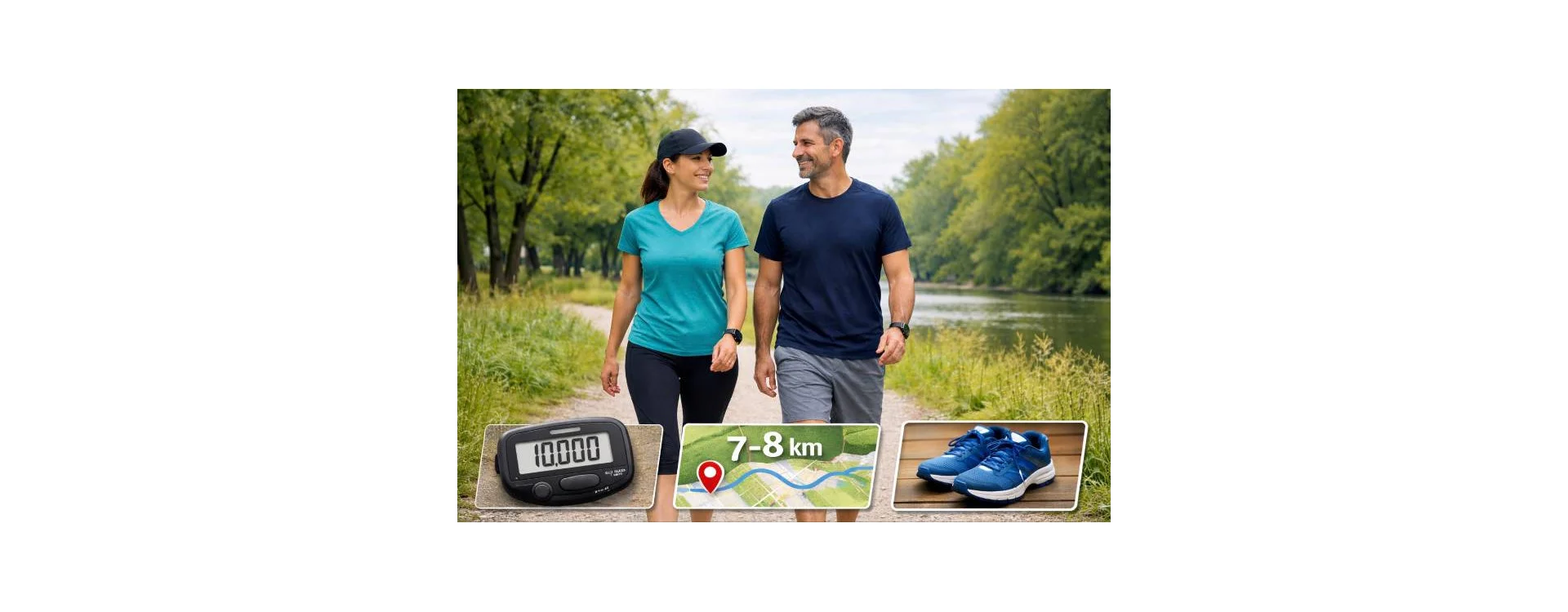
Walk 10,000 steps a day: Benefits, distance in km, and tips for success
Walking is often perceived as a trivial, almost mundane activity. Yet, it is one of the most powerful weapons for maintaining long-term health. Between WHO recommendations and challenges posed by our smartwatches, the figure of 10,000 steps per day has become the holy grail of physical fitness. But what does this distance really represent? What are the concrete impacts on your body and mind? Whether you want to lose weight or simply break free from a sedentary lifestyle, discover why every step counts.
Why aim for 10,000 steps a day?
In an increasingly sedentary society, where office work and screens dominate, we move less and less.
The reality of the numbers
On average, a French adult takes between 4,000 and 6,000 steps per day. This figure is well below the threshold needed to counteract the negative effects of inactivity. Dropping below the 5,000-step mark is even considered a "sedentary" lifestyle by health professionals.
The benefits of a daily goal of 10,000 steps
Reaching the threshold of 10,000 steps per day can radically transform your physiology:
-
Cardiovascular Health: Reduction in blood pressure and stroke risk.
-
Weight Management: An additional calorie expenditure allowing for weight stabilization or loss.
-
Mental Health: Reduction in stress and anxiety through the release of endorphins.
-
Blood Sugar: Improvement in insulin sensitivity, crucial for preventing type 2 diabetes.
10,000 steps in km: What distance does it represent?
This is the question everyone asks: if I walk 10,000 steps, what distance have I covered on a map? The short answer is that on average, 10,000 steps correspond to about 7.5 to 8 kilometers.
However, this distance varies according to a key factor: your stride length.
The personalized calculation
The length of a step depends on your height and pace (slow walk, active walk, or run). On average:
| Profile | Average Step Length | Distance for 10,000 steps |
| Short height / Slow walk | 60 cm | 6 km |
| Average height / Active walk | 75 cm | 7.5 km |
| Tall height / Fast walk | 85 cm | 8.5 km |
10,000 steps: A scientific recommendation or an urban legend?
If you're wondering where this precise figure of 10,000 comes from, the answer might surprise you. It is not, originally, the result of a medical study, but the result of a Japanese marketing campaign launched in the 1960s.
To accompany the launch of a pedometer named "Manpo-Kei" (which literally means "the 10,000-step counter"), this figure was chosen because the Japanese character for 10,000 resembles a walking man.
Should we ignore it? No. Although the figure is arbitrary, recent studies (notably from Harvard University) confirm that increasing physical activity towards this threshold significantly reduces all-cause mortality. However, major benefits start to be felt as early as 7,000 to 8,000 steps. The essential thing is not the exact number, but the regularity and progression.
5 tips to reach your 10,000 steps without thinking about it
For many, 8 km of walking seems insurmountable in a busy schedule. Here's how to "hack" your daily routine:
-
The 10-minute rule: Walk for 10 minutes after each meal. In three meals, you will have already added about 3,000 steps to your count.
-
The moving call: Take all your phone calls standing up and walk around the room or hallway while you talk.
-
The strategic parking: Always park at the back of the parking lot or get off one metro station before your destination.
-
Prefer the stairs: Beyond the number of steps, the elevation strengthens your gluteal muscles and increases your calorie expenditure.
-
The challenge among friends: Use an app to create a friendly competition with your friends or colleagues.
Go further in optimizing your physical condition with Uni Strength
Reaching 10,000 steps a day is an exceptional health foundation, but to sustainably transform your figure and strengthen your metabolism, walking should be complemented by targeted strengthening.
At Uni Strength, we believe that a healthy body is a functional body, capable of moving without pain and performing daily. Whether your goal is to support your joints for long walks, burn more fat, or gain tone, we have designed solutions tailored to each stage of your progression.
To go beyond simple walking and move to a higher level of physical fitness, discover our strength training equipment designed to maximize your results while respecting your pace.
To go further in the shop: Other equipment, Training equipment, Kettlebells.
Read also: strength exercises to lose weight, calculate your basal metabolic rate.
Frequently asked questions
How far is 10,000 steps in kilometres?
About 7.5 to 8 km for an average stride; the exact distance depends on your height and pace.
Where does the 10,000-step goal come from?
From a Japanese marketing campaign in the 1960s for the Manpo-Kei pedometer. Recent studies nevertheless confirm that approaching this threshold lowers mortality, with clear benefits from 7,000 to 8,000 steps.
How can you reach 10,000 steps without thinking about it?
Walk 10 minutes after each meal, take the stairs, get off one stop early and turn some calls or meetings into walks.