How to build your glutes: the exercises, the programme and the equipment that make the difference
To build your glutes, you need to load two or three hip extension movements (hip thrust, squat, Romanian deadlift), add an abduction exercise for the gluteus medius, and repeat all of it twice a week while steadily increasing the load. Bodyweight is enough for the first few weeks, no longer than that: without progressive overload, the glute muscle has no reason to grow.
That is the main reason so many glute programmes lead nowhere. You string together donkey kicks and fire hydrants for months, you sweat, but the load never moves. This guide gives you the exercises that genuinely work, how to organise a session, and the minimum equipment to do everything at home. If you are in the middle of kitting out your space, our guide on how to build a home gym covers the budget and the layout step by step.
In short
- The glutes are three muscles: the gluteus maximus (the volume), the gluteus medius (width and pelvic stability) and the gluteus minimus.
- The hip thrust is the single most effective exercise for the gluteus maximus, ahead of the squat.
- An abduction exercise is essential, otherwise the lateral part stays behind.
- Two sessions a week, 10 to 15 weekly sets in total, is plenty.
- A bench, a barbell and a few plates let you do everything at home.
- Expect 8 to 12 weeks of consistent work before you see a real change.
The three glute muscles and what they do
Talking about the glute in the singular is a shortcut that costs you results: it is a group of three muscles, and each one needs a different angle of work.
- The gluteus maximus: the largest muscle in the human body. It drives hip extension and it is the one that gives you shape. It responds to movements where you push the pelvis forward or stand up out of a low position.
- The gluteus medius: it sits on the outer surface of the ilium and runs to the greater trochanter. It handles abduction, meaning lifting the leg out to the side, and it stabilises the pelvis when you are on one leg. It is the one that gives you width at the top of the hip.
- The gluteus minimus: deeper, it supports the medius on abduction and rotation.
Remember this: the squat alone is not enough. It trains the central portion, barely the lateral one. A complete programme covers both families of movement, extension and abduction.
The best exercises to build your glutes
Here are the movements that produce results, ranked from most to least productive. Any coach will tell you the same thing: to gain muscle mass in this area, three well executed exercises beat ten sloppy ones.
1. The hip thrust, exercise number one
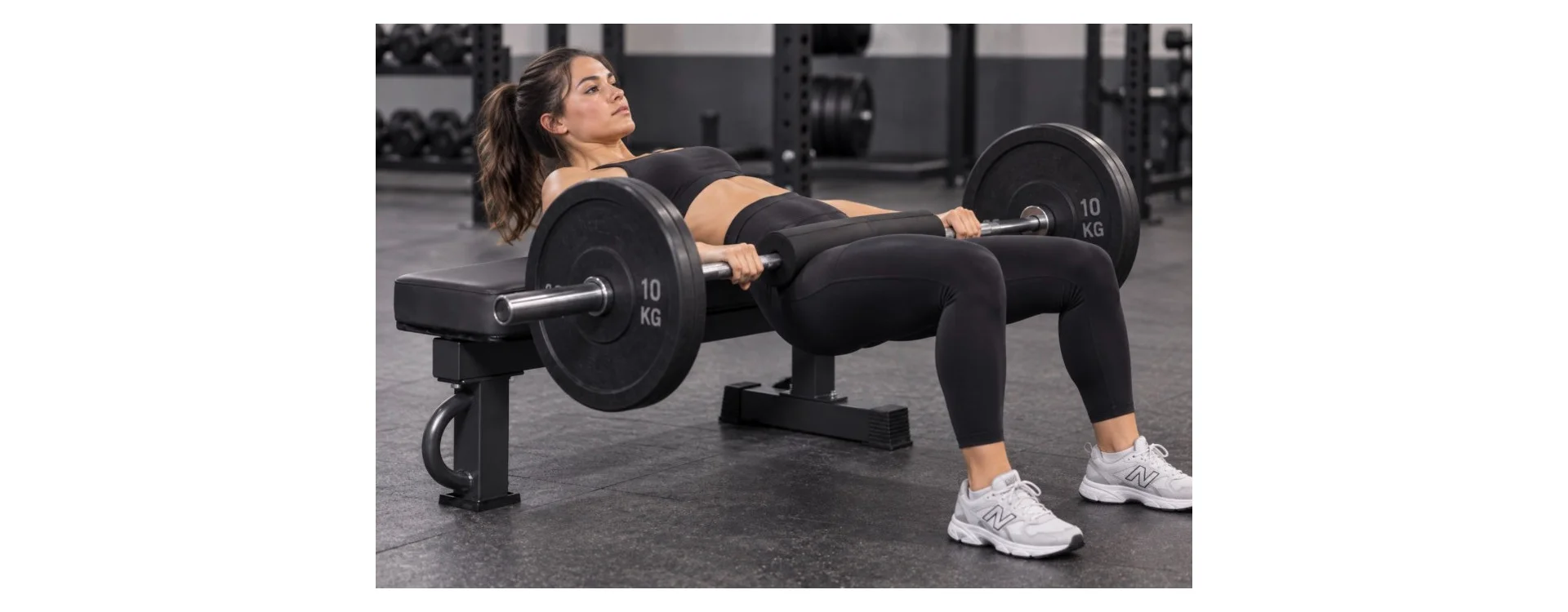
Starting position: upper back set on a bench, feet flat, heels under the knees and toes turned slightly out. From there, you drive the pelvis toward the ceiling to full hip extension, then lower without setting the load down on the floor. What makes it better than the rest: peak tension sits at the top of the movement, exactly where the gluteus maximus is shortest and most contracted. It is the ideal exercise for real glute strengthening without needing a dedicated machine.
Three practical details that change everything:
- The bench should sit just below your shoulder blades, around 40 cm high. Too high and you arch your back, too low and you lose range.
- A wide pad (30 to 35 cm) spreads the pressure across your shoulders far better than a narrow bench. It is a criterion few people check when buying, and you pay for it on heavy sets.
- Wedge the bench against a wall. A support that slides mid set is the classic home gym problem with this exercise. Our weight benches for hip thrust weigh over 30 kg for the adjustable models, which already reduces the issue considerably.
Without a barbell, the glute bridge is the entry level version: back on the floor, you push through your heels to lift the pelvis, with a dumbbell or a kettlebell resting on the hips for resistance.
2. The squat
The squat remains a staple, provided you actually go down. A partial range turns it into plain quadriceps work. Descend at least until the thighs pass below parallel if your mobility allows, keeping the torso upright and the heels anchored to the floor. The sumo variation, feet wider and toes turned out, increases recruitment of the glutes and adductors.
3. The Romanian deadlift
The Romanian deadlift is performed with the bar close to the legs and a flat back: you push the hips backwards until you feel the stretch in the back of the thighs, then return by driving the pelvis forward. A useful variation is doing it on one leg, free leg extended behind you, to add pelvic stability work. It trains the muscle in a lengthened position, the opposite of the hip thrust, so the two complement each other perfectly across the same week. An Olympic bar and a pair of plates are all you need, and it is all in our Olympic barbells and weight plates range, with cast iron plates from €9.99 a pair so you can build your load gradually.
4. The Bulgarian split squat and lunges
Rear foot raised on a bench, you descend on the front leg. Unilateral work corrects imbalances between the two legs and heavily recruits the gluteus maximus with a much lighter load than the squat. Lean the torso slightly forward to target the glute rather than the quadriceps. Alternate right leg and left leg without rest between sides, and on the concentric phase, think about pushing hard through the front heel while keeping the pelvis square.
5. Abductions and gluteus medius work
This is the part almost everyone skips. Standing or lying abduction on a mat with a band, fire hydrant, donkey kick, lateral walk with a mini band: these exercises train the gluteus medius and the tensor fasciae latae. They do not load well, so put them at the end of the session, in long sets of 15 to 25 reps, keeping the pelvis square to the floor rather than letting it tip to the side.
| Exercise | Main target | Equipment | Sets x reps |
|---|---|---|---|
| Hip thrust | Gluteus maximus | Bench + barbell + plates | 4 x 8 to 12 |
| Squat | Gluteus maximus, quadriceps | Rack recommended | 4 x 6 to 10 |
| Romanian deadlift | Glutes, hamstrings | Barbell + plates | 3 x 8 to 12 |
| Bulgarian split squat | Gluteus maximus, unilateral | Bench + dumbbells | 3 x 10 per leg |
| Band abduction | Gluteus medius and minimus | Resistance band | 3 x 15 to 25 |
| Glute bridge | Gluteus maximus (beginner) | Bodyweight | 3 x 15 to 20 |
Building your glutes at home: the equipment that is enough
Good news: the glutes are probably the easiest muscle group to train seriously at home. No specific machine is required, unlike the back or the chest. Where the leg press or the abduction machine are gym solutions that are hard to reproduce at home, the best glute movements ask for almost nothing.
The basic trio covers the whole table above:
- A bench for the hip thrust and the Bulgarian split squat. It is the item most people underestimate even though it unlocks the two most effective exercises.
- An Olympic barbell of 220 cm and some plates, to load the three basic movements. With us, an Olympic bar starts at €129.99.
- A resistance band for abductions, a few euros, essential for the lateral part.
Two stopgap solutions if you are short on space or budget: the bench can be temporarily replaced by a low sofa for the hip thrust, and the plates can be supplemented by a kettlebell held against the chest on squats. These are workarounds rather than a lasting solution, but they let you start right away. Remember to train the core in the same session too: strong glutes and weak abs mean a pelvis that tips and a lower back that takes the hit.
A rack becomes useful as soon as you want to squat heavy without a partner, but it is not the number one priority if your goal is specifically the glutes: the two best movements load from the floor, with nothing to catch you. That is the buying order we recommend to customers focused on the lower body: bench, barbell, plates, then rack.
For placement in the room, allow length in front of the bench rather than width: in the hip thrust you are sitting on the floor with your legs out in front of you and a 220 cm bar across your hips. Count on 2.50 m of clearance.
Glute programme: frequency, volume and progression
An effective week comes down to three rules.
Two sessions a week. The gluteus maximus recovers fast. Two stimuli 72 hours apart produce noticeably more than one big weekly session at equal volume.
10 to 15 weekly sets for the whole area, split across the two sessions. Beyond that, recovery becomes the limiting factor.
Progressive overload above all. Each week, add either 2.5 kg on one exercise or one rep per set. Write everything down. It is the only variable that really counts over time, well ahead of the precise choice of exercises.
Before loading up, take five minutes to run an activation: a few band abductions and one light set of glute bridge are enough to engage the muscle and improve the mind-muscle connection. It is a detail beginners systematically skip and it changes the feel from the very first working set.
A template to alternate:
- Session A: hip thrust 4 x 8, squat 4 x 8, band abduction 3 x 20.
- Session B: Romanian deadlift 3 x 10, Bulgarian split squat 3 x 10 per leg, glute bridge 3 x 15.
The coach's tip: keep a written record of your performances and stop changing your training every three weeks. What we see in the people who progress is almost always the same thing: few exercises, for a long time, with a logbook. The ones who stall are the ones who switch programmes before the previous one has produced anything.
If you want to widen this work to the whole lower body, our best exercises to build your legs cover the quadriceps, the hamstrings and the calves, with and without machines.
The mistakes that block progress
- Never increasing the load. Repeating the same 20 bodyweight reps for six months builds nothing after the first few weeks.
- Arching the back at the top of the drive. If you feel your lower back and not the target muscle, tuck the ribs down and stop the movement when the pelvis is in line with the shoulders and knees. Hyperextension recruits nothing extra, it just hurts you.
- Ignoring the lateral part. That is what makes a glute trained only with squats lack width at the top.
- Piling on light isolation exercises at the expense of the three big movements. Donkey kicks are a complement, not a programme.
- Neglecting range of motion. On the squat as on the glute bridge, a full range at moderate load beats a partial range at heavy load.
- Rushing the descent. You need to keep control on the negative phase, two to three seconds, rather than dropping the load. That is where a good part of the muscular work happens.
- Letting the knee cave inwards on squats and lunges. Push it out in line with the foot, even if it means dropping the load while you fix it.
Key takeaways
A glute is built with three or four well chosen movements, loaded progressively, twice a week. The hip thrust first, a squat or a Romanian deadlift to vary the angle, some abduction work for the gluteus medius, and consistency over several months. On equipment, a stable bench, a barbell and a few plates cover the essentials at home, with no dedicated machine. The real variable is neither the miracle exercise nor the premium kit: it is the load going up, week after week.
The equipment mentioned in this guide
| Use | Equipment | Key figure |
|---|---|---|
| Hip thrust, Bulgarian split squat | UF Power Bench wide flat bench | 43 cm high, 35 cm wide, 750 kg maximum load |
| Hip thrust, squat, Romanian deadlift | UF Basic Olympic bar | 220 cm, 20 kg, 50 mm sleeves, 350 kg maximum load |
| Loading up gradually | Cast iron Olympic plates | pairs from 1.25 to 20 kg, 50 mm hole, 2 % tolerance from 10 kg |
| Abductions, activation | Set of 7 resistance bands | 7 resistance levels, up to 100 kg for the strongest |
| Heavy squats without a spotter | CS-Basic squat rack | 212 x 122 x 122 cm, 5 x 5 cm uprights |
Specifications taken from the product pages on 9 October 2026.
Read also: a glute workout programme for the gym.
FAQ
Why should you build your glutes?
Beyond aesthetics, these muscles stabilise the pelvis and take pressure off the lower back, which often compensates for their weakness. They improve posture, hip mobility and power in every running, jumping and lifting movement. That holds true almost everywhere, from elite sport to a Sunday bike ride. They are also one of the largest muscle volumes in the body: developing them raises energy expenditure at rest, which indirectly helps fat loss. The benefits go well beyond appearance: better balance, better joint health, easier everyday movement. Men and women alike have every reason to strengthen this area, and the same exercises apply in both cases.
What results can you expect, and how long does it take?
The first sensations of muscular strengthening arrive in 3 to 4 weeks, but a visible change in your silhouette takes 8 to 12 weeks of consistent training with a load that keeps going up. The pace then depends on your starting point, your nutrition and your consistency. If a layer of fat covers the muscle, the shape will show later, whatever sport you practise: no coach can promise a precise timeline on that. A year of serious work transforms a glute, two months wakes it up.
Can you build your glutes without equipment?
Yes to get started, no to go far. Glute bridge, lunges, bodyweight squats and band abductions are enough to progress for roughly six to eight weeks. Past that point you need external load: the gluteus maximus is a powerful muscle and it adapts very quickly to bodyweight alone. Moving to the barbell is the moment most people finally unlock their progress.