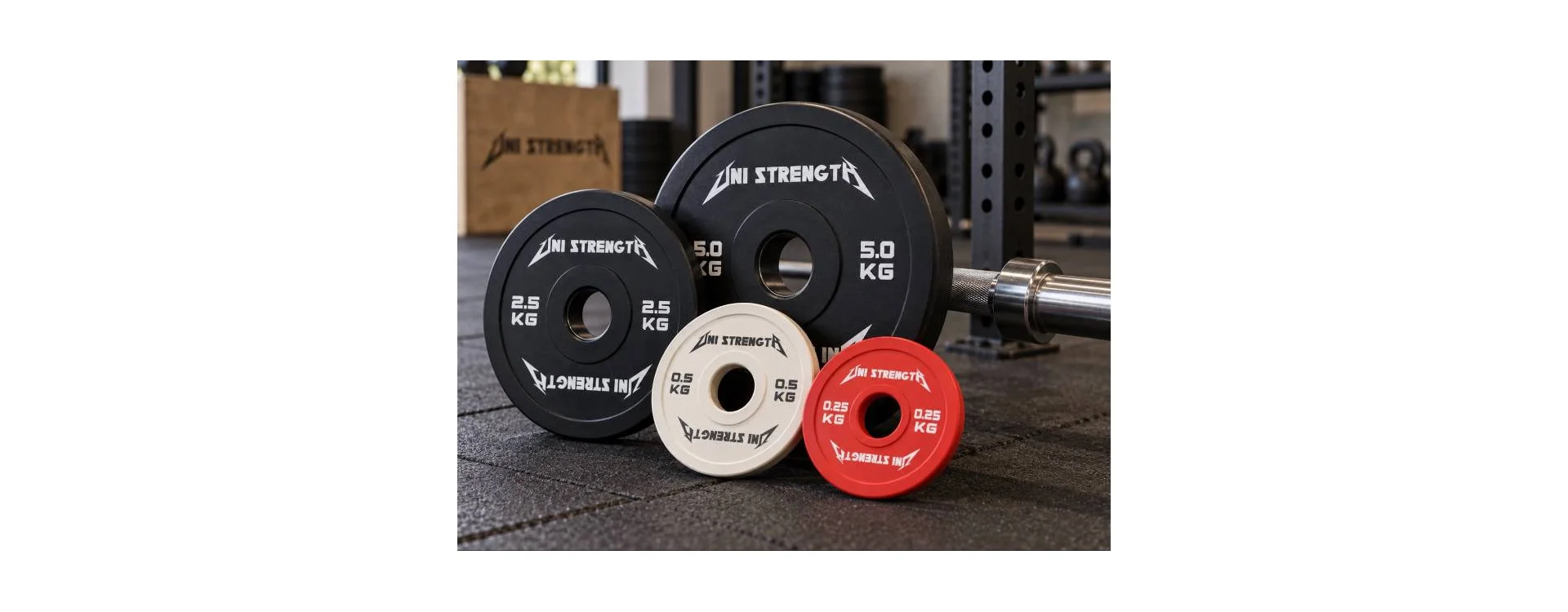
Olympic weight plates: how to choose them, how much load to plan for and for which exercises
An Olympic weight plate is defined by a single feature: its 50 mm central bore, which lets it mount on the sleeve of an Olympic barbell. Everything else, material, outer diameter, weight accuracy, depends on your practice. For classic strength training, cast iron is enough. For cross training and weightlifting, you need bumpers. For competition powerlifting, calibrated plates.
The real issue, once that choice is made, is not the brand: it is the total load you plan for and how finely it lets you progress. This guide covers the three families, the criteria for choosing suitable Olympic plates, the prices, the load to aim for depending on your level, and the exercises involved. Enough to buy Olympic plates with your eyes open rather than at the mercy of a product page. You can browse our range of weights directly if you already know what you are after.
In short
- Olympic means a 50 mm bore, not a specific weight or outer diameter.
- Three families: cast iron (general strength training), rubber bumper (weightlifting and cross training), calibrated (powerlifting and competition).
- A competition bumper measures 450 mm in outer diameter, whatever its weight.
- A standard Olympic barbell weighs 20 kg and measures 220 cm.
- Plan on 100 kg of plates to start, 150 to 200 kg for a complete home gym.
- Expect around €3 to €4 per kilo in cast iron, roughly twice that in bumper.
- Micro plates of 0.25 to 1 kg are what unlocks progress once 2.5 kg jumps get too big.
What exactly is an Olympic weight plate?
The most common confusion is around the word diameter. There are two of them, and they do not serve the same purpose. On materials, three broad categories exist on the market: cast iron, rubber, and plastic filled with sand or cement, the last of which is best avoided for any serious training.
The central bore, the hole the plate slides onto the bar through, measures 50 mm on an Olympic plate. That is the standard which defines the category. So-called standard plates have a 28 or 30 mm bore and fit low-end bars that are not compatible with racks and quality barbells. If you invest in an Olympic bar, your plates have to be Olympic: compatibility is not optional.
The outer diameter varies with material and weight. On cast iron plates it grows with the load: a 1.25 kg measures 166 mm across where a 20 kg reaches 442 mm. On bumpers and competition plates, every plate from 10 kg up shares the same 450 mm outer diameter, which guarantees the bar always sits at the same height off the floor whatever is loaded. That constant height is what makes the snatch and the clean and jerk safe to repeat.
For concrete reference points, here are the dimensions of our cast iron range:
| Plate weight | Outer diameter | Thickness |
|---|---|---|
| 1.25 kg | 166 mm | 12.7 mm |
| 2.5 kg | 210 mm | 15.24 mm |
| 5 kg | 238 mm | 15.24 mm |
| 10 kg | 272 mm | 35.56 mm |
| 15 kg | 350 mm | 33 mm |
| 20 kg | 442 mm | 33 mm |
| 25 kg | 442 mm | 36 mm |
Thickness deserves a mention: it determines how many kilos you can load onto a sleeve before running out of room. It is a criterion that only concerns very advanced lifters, but it explains why calibrated plates are deliberately thin.
The three families of Olympic plates
Cast iron plates
This is the strength training classic. Sturdy, inexpensive, close to indestructible, they take years of use without flinching. Our Olympic cast iron plates start at €9.99 a pair and run from 1.25 kg to 20 kg, with a rubber finish that protects the floor and the bars from scratches. Their one limit: they are not built to be dropped from height. If your practice includes neither snatch nor clean and jerk, this is the default choice and the best kilo-per-euro ratio on the market.
Bumper plates, the rubber option
Made of high density virgin rubber around a metal insert, bumper plates are designed to be dropped to the floor from shoulder height. Bounce is minimal, floor and bar take it without damage. Our bumpers meet the 450 mm diameter of IWF standards and run from 5 kg to 25 kg from €59.99 for a pair of two. Essential in cross training and for Olympic weightlifting plates, they are a pointless luxury if all you do is bench press and squat. The colour coding also lets you identify the size of the load from a distance, a real convenience in a gym.
Calibrated plates
Here it is no longer about material but about accuracy. A calibrated powerlifting plate holds a weight tolerance of just 10 g, where a standard cast iron plate allows 2 percent above 10 kg and 3 percent below, meaning up to 400 g on a 20 kg. They also follow the IPF colour code, which lets you read a load off the bar at a glance. Their very thin profile also lets you fit more kilos on the sleeve. They are aimed at powerlifting competitors and at anyone who wants 100 kg to actually weigh 100 kg.
| Family | Who it is for | Can be dropped | Entry price |
|---|---|---|---|
| Cast iron | General strength training, home gym | No | €9.99 a pair |
| Rubber bumper | Weightlifting, cross training | Yes | €59.99 a pair of 2 |
| Calibrated | Powerlifting, competition | No | €22.99 a pair |
How to choose your Olympic plates
Three questions settle it, and they are about how you train, not about the plate specs.
Do I drop the bar on the floor? If you do weightlifting or cross training, the answer is yes and you need bumpers. Otherwise cast iron does the job for three times less.
Am I planning to compete? If so, calibrated is the way, if only to train on the same real loads as in competition. If not, accuracy to the gram has no practical value.
What is my floor? On tiles or wood flooring, plan for rubber tiles whichever family you pick. A pair of 20 kg plates slipping off a rack does immediate and permanent damage.
One last criterion few people check before buying: the finish. Bare cast iron rusts in a damp garage and leaves black marks on your hands. A rubber or painted finish solves that and also protects your bars, whose sleeves wear against bare metal.
Two side points are worth checking before you confirm the order: the warranty offered on the product, and the real stock. On heavy equipment like this, an item listed as available but actually on restock can push your installation back by several weeks. Finally, think about storage at purchase time: a plate holder frees up floor space and stops you stacking loads on top of each other, which damages the finish and makes loading awkward.
How much total load should you plan for?
This is the question that really matters, and the one most home gyms get wrong. It is not about buying the load you lift today, but the one that will carry you for three years.
Some realistic benchmarks, 20 kg bar included:
- Beginner: 100 kg of plates comfortably covers the first months. Squat and deadlift climb fast, bench press much less so.
- Intermediate: 150 to 190 kg. At that level, a 120 kg squat including the bar already puts 100 kg on the sleeves, and you need to be able to load the deadlift in parallel without stripping everything between two exercises.
- Advanced or gym: beyond 200 kg, with several pairs of 20 and 25 kg.
Buying as a set becomes worthwhile as soon as you pass a hundred kilos. Our 187.5 kg Olympic cast iron plate set brings together 8 pairs, from 1.25 kg to 25 kg, for €599.99 instead of €624.92 bought individually. Its breakdown (one pair of 25, three pairs of 20, then 15, 10, 5, 2.5 and 1.25 kg) is designed to build any load in 2.5 kg steps without ever missing an intermediate plate. That is the point most budget sets get wrong: they pile on the big plates and forget the small ones, and you end up unable to go from 80 to 82.5 kg.
Worth noting, the shop applies 10 percent off a barbell with any purchase of a weight set over 100 kg, and shipping is free from €300 excl. VAT of purchase in mainland France. On an order of this size, the final gap in price is not trivial.
How much do Olympic plates cost?
The right indicator is not the sticker price but the price per kilo, because that is what makes ranges comparable. Here are the orders of magnitude across our selection.
| Product type | Price | Indicative price per kilo |
|---|---|---|
| Cast iron, pair of 1.25 kg | €9.99 | around €4 |
| Cast iron, pair of 20 kg | €129.99 | around €3.25 |
| 187.5 kg cast iron set | €599.99 | around €3.20 |
| Bumper, pair of 2 from 5 kg | €59.99 | around €6 |
| Calibrated plate, the pair | €22.99 | varies with size |
Three takeaways. First, small plates cost proportionally more per kilo than big ones, which is normal: manufacturing cost is not linear. Second, a set always brings the price per kilo down compared with buying individually, on top of guaranteeing a coherent selection. Third, bumper costs roughly twice what cast iron does: only pay that difference if your practice genuinely calls for it.
A lot of searches are about cheap Olympic plates, and that is fair enough: this is the line where you can genuinely save without risk. On the second hand Olympic plate market, cast iron remains an excellent deal: it does not wear out, a trace of rust changes nothing about how it works, and decent gear regularly turns up at half price. Be wary of used bumpers though, whose rubber cracks over time, and of plastic plates filled with sand or cement, sold very cheap but whose real weight is often low and approximate. At that price, better to buy new in small quantity and add over the months: that is the advice we give most often in the shop.
What exercises can you do with Olympic plates?
The use of Olympic plates is not limited to the barbell. Free weights cover every fundamental movement, and that is precisely their advantage over machines and specialised fitness equipment: one set of weight plates serves everything.
- Squat and its variations (front, sumo, box squat): the movement that eats the most load.
- Deadlift, conventional or Romanian: the one that climbs highest in maximum load.
- Bench press and overhead press: slower progress, hence the importance of small plates.
- Barbell row, hip thrust, lunges, cleans: all the rest of the structural work.
- Loading accessories: Olympic plates also serve on a plate-loaded pulley, a lat pulldown, a leg press or a weighted GHD. One stock of equipment covers several machines.
A word on progression, because that is where plates become strategic. Adding 2.5 kg to a bar takes two 1.25 kg plates. When that step gets too big, especially on upper body movements, you move to micro loads: our precision Olympic plates go down to 0.125 kg each, with a tolerance of plus or minus 10 g, and let you add 250 g to 2 kg to the bar. It is the €18.99 accessory that unlocks more progress than an €800 machine.
Key takeaways
An Olympic plate is a 50 mm bore and nothing else. The choice then comes down to three families: cast iron for classic strength training, bumper if you set the bar down on the floor, calibrated if you compete. On volume, aim for 100 kg to start and 150 to 200 kg for a home gym that will follow you for years, checking that the set actually contains the small plates needed for 2.5 kg steps. The rest, brand, colour and finish, plays out at the margin. Our advice, if you are still torn between two ranges: take the one with the intermediate pairs, not the one with the biggest headline total. What counts is that available load is never the thing limiting your progress.
If you are starting from scratch and plates are only one piece of the puzzle, our guide on how to build a home gym covers the space, the flooring, the bar and the rack in the most cost-effective buying order. The rest of the equipment, dumbbells, kettlebells, a bench, comes later to round out the selection according to your physical goals.
FAQ
What is the diameter of Olympic weight plates?
The central bore is 50 mm, the measurement that defines an Olympic plate and determines compatibility with bars. The outer diameter depends on material and weight: on our cast iron plates it runs from 166 mm for a 1.25 kg to 442 mm for a 20 or 25 kg, while bumpers of 10 kg and above are all 450 mm.
What is the diameter of a weightlifting plate?
450 mm outer diameter, in line with IWF standards. That value is identical for every weight from 10 kg up, so the bar always sits at the same height off the floor whatever the load. That is what lets you repeat the snatch and the clean and jerk with the same starting position on every set.
How much does an Olympic barbell weigh?
A standard Olympic bar weighs 20 kg and is 220 cm long. The official women's weightlifting version weighs 15 kg for 201 cm, with a thinner grip diameter. Lighter technique bars also exist for learning. Always remember to include the weight of the bar in your total load calculation.
Where can I find weight plates?
Go for a specialist retailer rather than a generalist chain: real weight tolerance, cast iron quality and the availability of intermediate pairs make the difference over time. Compare prices per kilo rather than sticker prices, read customer reviews on the finish and on how accurate the stated weight is, and check 50 mm compatibility. Also look at delivery terms, since this equipment is heavy and shipping thresholds weigh on the total, and at whether you can extend the set within the same range over the years. At Uni Strength, the whole range is available individually, in pairs or as complete sets, with free shipping in mainland France from €300 excl. VAT of purchase and payment in instalments.