Kettlebell Squats: Complete Guide
The kettlebell squat is much more than just a variation on the classic squat: it's a highly effective exercise for strengthening legs, glutes and core, while improving stability and coordination. Whether you're a beginner or an experienced exerciser, incorporating the kettlebell into your squats can transform your workouts. Find out why and how to master this essential movement.
In short
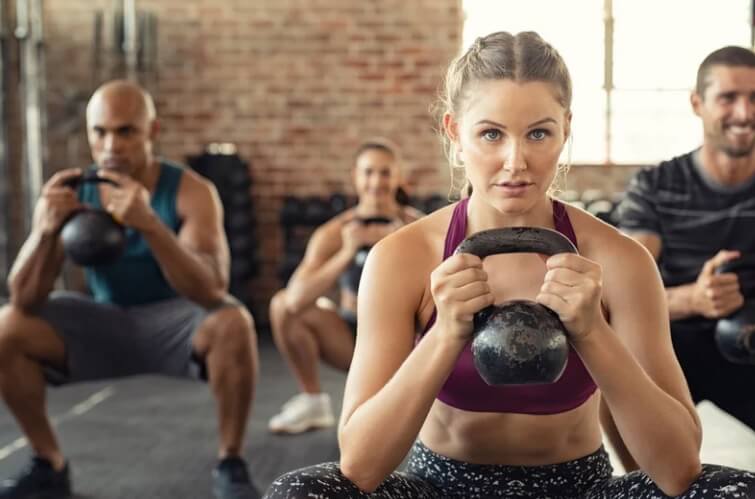
- To start: goblet squat, kettlebell held by the horns against the chest, feet shoulder-width apart.
- Suggested loads: beginners 8 to 12 kg (men) and 4 to 8 kg (women), intermediate 16 to 24 kg and 8 to 16 kg, advanced 24 to 32 kg and more, 16 to 24 kg and more.
- Beginner volume: 2 to 3 sets of 10 to 15 reps, 2 to 3 times a week.
- Technique: hips pushed back, straight back, knees in line with the toes; allow 48 hours of recovery for the muscles worked.
The different variations of kettlebell squats
Goblet squat (kettlebell held against chest)

The goblet squat is the most accessible variant for beginners. The kettlebell is held against the chest, making it easier to keep the trunk upright and work on balance.
Execution:
- Hold the kettlebell by the horns (the sides of the handle) against your chest.
- Feet shoulder-width apart or slightly wider
- Lower yourself by pushing your hips backwards
- Keep your back straight and your chest open
- Push up on your heels
Front squat with kettlebell
In this variant, the kettlebell is held in front of the shoulders, elbows pointing forward. This position places greater demands on the core muscles and shoulders.
Execution:
- Hold the kettlebell by the handle in front of you, at shoulder height.
- Elbows bent and pointing forward
- Perform a squat, keeping your back straight
- Maintain a high elbow position throughout the movement
Squat overhead (kettlebell overhead)

This advanced variant involves holding the kettlebell overhead during the squat. It places heavy demands on the stabilizing muscles of the shoulders and trunk.
Execution:
- Hold the kettlebell at arm's length overhead.
- Keep your arm straight and engage your core muscles
- Perform a squat, keeping the kettlebell stable
- Be careful not to arch your back
Squat with kettlebell between the legs (sumo squat)

This variation provides extra work for the inner thighs and adductors.
Execution:
- Hold the kettlebell by the handle with both hands.
- Stand in a wide stance, toes slightly outwards
- Lower into a squat, letting the kettlebell hang between your legs
- Push up with your heels
Bulgarian squat with kettlebell
The bulgarian squat is a single-leg squat with the back leg elevated. Adding a kettlebell increases the intensity of the exercise.
Execution:
- Place the top of the back foot on a bench or step
- Hold a kettlebell in each hand or one on the side of the front leg
- Squat down on the front leg
- Push up on the heel of the front leg
Perfect basic kettlebell squat technique
To derive maximum benefit from the kettlebell squat while minimizing the risk of injury, here's the technique to adopt:
Starting position
- Feet: shoulder-width apart or slightly wider, toes slightly turned outwards (15-30°)
- Kettlebell: cup position (against chest) to start with
- Posture: back straight, chest open, shoulders low and back, gaze horizontal
Lowering phase
- Initiate movement by pushing hips backwards
- Bend the knees while keeping the back straight
- Descend until thighs are parallel to the floor (or lower, depending on your mobility)
- Keep your knees in line with your toes (don't let them turn inwards)
- Keep weight on heels and mid-foot
Ascent phase
- Push firmly on the heels to initiate the ascent
- Contract the glutes at the top of the movement
- Keep back straight and chest open
- Exhale as you lift
Breathing
- Inhale on descent
- Exhale on ascent
- Keep your core engaged throughout the movement
The benefits of the kettlebell squat
What is the kettlebell squat?
The kettlebell squat is a versatile exercise that combines the fundamental squat movement with the use of a kettlebell (a cannonball-shaped weight with a handle). Unlike the barbell or dumbbell squat, the kettlebell offers a different dynamic due to its off-center center of gravity, which places greater demands on the stabilizing muscles and core.
The exercise involves flexing and extending the hips, knees and ankles while holding a kettlebell in different positions, depending on the variant chosen. This versatility makes it an exercise suitable for all levels, from beginners to advanced athletes.
All-round muscle strengthening
The kettlebell squat is a compound exercise that calls on several muscle groups simultaneously:
- Quadriceps
- Hamstrings
- Glutes
- Core muscles (abdominals, lumbar)
- Back muscles
- Shoulders and arms (depending on kettlebell position)
This multi-tasking makes it a highly effective exercise for developing functional strength and muscle mass in the lower limbs.
Improved mobility and stability
Correct execution of the kettlebell squat requires and develops:
- Hip mobility
- Ankle mobility
- Core stability
- Balance and proprioception
These qualities are essential not only for sporting performance, but also for injury prevention in everyday life.
Cardiovascular benefits
When performed dynamically or in circuits, the kettlebell squat becomes an excellent cardiovascular exercise that:
- Increases heart rate
- Improves endurance
- Promotes caloric expenditure and fat loss
Gains functional strength
The movements involved in kettlebell squats are similar to those performed in everyday life (standing up, carrying loads, etc.). Kettlebell training therefore develops strength directly applicable to everyday movements.
Anatomy and muscles involved
Main muscles
- Quadriceps: vastus lateralis, vastus medialis and rectus abdominis
- Hamstrings: biceps femoris, semimembranosus and semitendinosus
- Glutes: gluteus maximus, medius and minimus
Secondary muscles
- Core muscles: abdominals, obliques, transversus abdominis and spinal erectors
- Adductors: adductor longus, adductor brevis and adductor magnus
- Calves: gastrocnemius and soleus
- Shoulders and arms: deltoids, trapezius, rhomboids (depending on kettlebell position)
The position of the kettlebell (in front, in a goblet, above the head, etc.) modifies the muscular load and makes certain muscle groups work harder.
Common mistakes to avoid
Posture errors
- Rounded back: keep your back straight and your chest open
- Knees drawn in: keep them in line with your toes
- Looking down: keep your gaze horizontal to maintain spinal alignment.
Technical errors
- Rising on tiptoes: keep feet flat on the ground
- Coming down too low without control: respect your current mobility
- Coming up with your glutes before your shoulders: keep your back straight on the way up
Load errors
- Load too heavy: prioritize technique over load
- Progressing too quickly: gradually increase the weight of the kettlebells
Progression and programming
For beginners
- Start by mastering the bodyweight squat
- Progress to the goblet squat with a light kettlebell (8-12 kg for men, 4-8 kg for women)
- 2-3 sets of 10-15 repetitions, 2-3 times a week
- Focus on perfect technique
For intermediates
- Try different kettlebell squat variations
- Gradually increase the load (16-24 kg for men, 8-16 kg for women)
- 3-4 sets of 8-12 repetitions, 2-3 times a week
- Integrate supersets or circuits with other exercises
For advanced users
- Incorporate complex variations such as the overhead squat
- Use heavier kettlebells (24-32+ kg for men, 16-24+ kg for women)
- Experiment with advanced techniques such as explosive squats
- 4-5 sets of 5-8 repetitions, 2-4 times a week
Integration into a training program
- Leg day: combine the kettlebell squat with other leg exercises
- Full-body training: use the kettlebell squat as your main lower-body exercise
- Circuit training: integrate the kettlebell squat into HIIT circuits to maximize caloric expenditure.
Recommended equipment
Choice of kettlebell
- Material: prefer cast-iron kettlebells for their durability
- Covering: opt for a vinyl or neoprene covering to protect your floor.
- Handle: choose a smooth, non-slip handle with a width suited to your hand.
Recommended weights
- Beginners: 8-12 kg (men), 4-8 kg (women)
- Intermediate: 16-24 kg (men), 8-16 kg (women)
- Advanced: 24-32+ kg (men), 16-24+ kg (women)
Other useful equipment
- Training mat: to protect your floor and absorb impacts
- Mirror: to check your technique
- Minimalist shoes or bare feet: for better ground contact
To go further in the shop: Kettlebells, Kettlebells Uni Strength, Adjustable Kettlebell 100% Steel | Handle Only.
Frequently asked questions
What's the difference between kettlebell squats and dumbbell squats?
The kettlebell offers an off-center center of gravity, which places greater demands on the stabilizing muscles. It also allows a greater variety of positions and movements than dumbbells.
Can I do kettlebell squats every day?
It's best to give your muscles 48 hours to recover. However, you can alternate between different types of kettlebell squats to target different muscle groups if you wish to train daily.
Is the kettlebell squat good for weight loss?
Yes, the kettlebell squat is excellent for weight loss because it involves large muscle groups, increases caloric expenditure and can be integrated into HIIT circuits that are highly effective for fat loss.
How to avoid back pain during kettlebell squats?
- First master the bodyweight squat technique
- Engage the core muscles throughout the movement
- Keep your back straight and your chest open
- Progress gradually in terms of load
- Warm up properly before each session
Which kettlebell squat variation to start with?
The goblet squat, kettlebell held by the horns against the chest, feet shoulder-width apart: the position helps keep the torso upright.
How do you descend correctly?
Hips pushed back first, then knees bend, back straight, thighs parallel to the floor or lower depending on mobility, knees in line with the toes, weight on the heels and midfoot.
Which muscles does the kettlebell squat work?
A compound exercise that works several groups at once: legs and glutes, core, and shoulders and arms depending on the kettlebell position.