Leg Curl: The essential exercise for the hamstrings
To achieve massive and aesthetic legs, focusing solely on the quadriceps through squats or presses is not enough. The Leg Curl stands out as the king of isolation exercises to specifically target the back of the thigh. Often relegated to the end of a session, it is nevertheless essential for balancing the physique and preventing injuries. Here's everything you need to know to master this movement and unlock the growth of your hamstrings.
In short
- The leg curl isolates the hamstrings (biceps femoris, semitendinosus, semimembranosus) through knee flexion and balances quadriceps strength, which protects the knee.
- Seated, it stretches the hamstrings at the hip, often considered the better version for muscle gain; lying, it favours peak contraction at the end of the movement: ideally, alternate both.
- Do 3 to 4 sets of 10 to 15 reps, lowering twice as slowly as you lift.
- Mistakes to avoid: lifting the hips off the bench, swinging the weight, cutting the range of motion short.
What is the purpose of the Leg Curl? (Muscles targeted)
The Leg Curl is a single-joint strength training exercise whose primary goal is to isolate and strengthen the hamstrings. Unlike multi-joint movements like squats that mainly target the front of the leg, this exercise focuses exclusively on knee flexion. It allows for intense recruitment of the three muscle bundles that make up the back of the thigh, namely the biceps femoris, semitendinosus, and semimembranosus, while slightly engaging the calves to initiate the flexion.
Beyond simply developing muscle volume, the Leg Curl plays a crucial structural role in the stability of the knee joint. By actively strengthening the hamstrings, it helps counterbalance the natural strength of the quadriceps and provides essential protection to the anterior cruciate ligament. It is an indispensable tool for correcting common muscle imbalances in athletes and achieving a complete leg shape, visible both from the side and from the back.
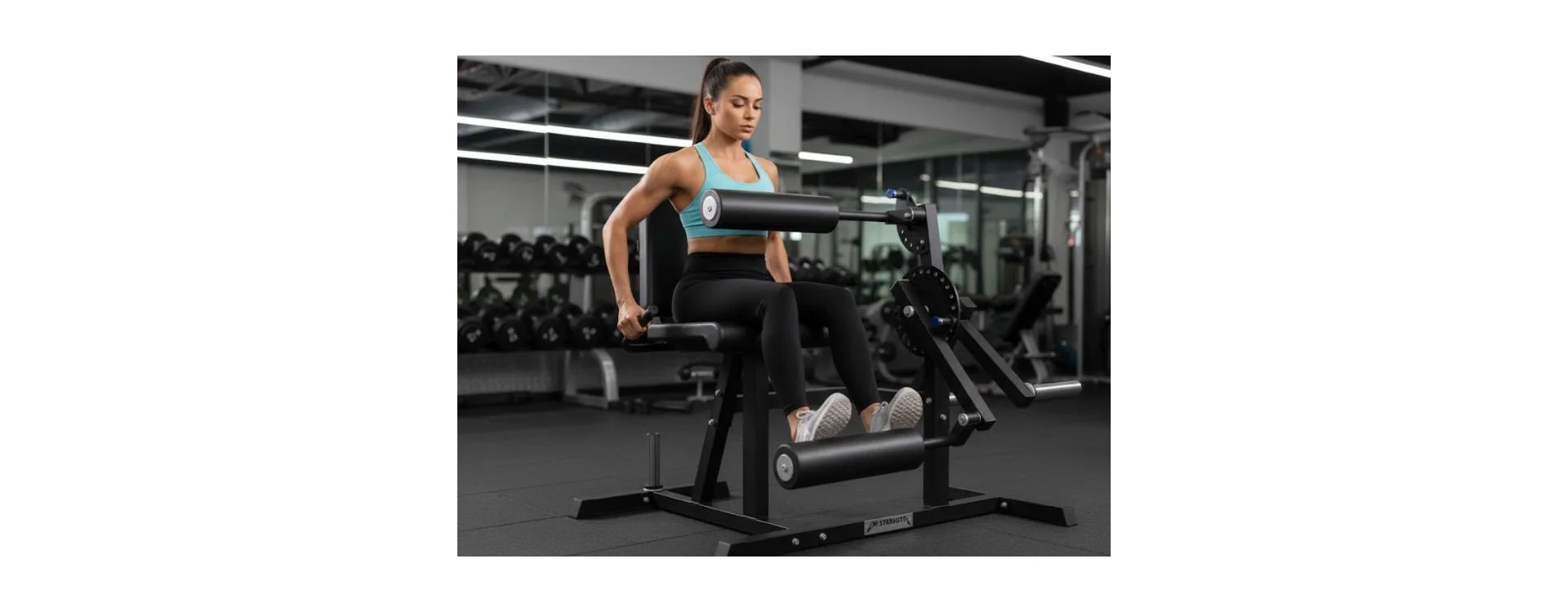
Discover the Uni Strength Leg Curl Machine
Seated or Lying Leg Curl: What's the difference?

The choice between the seated or lying version is not just a matter of comfort, but of muscle tension. The seated Leg Curl is often considered superior for muscle gain because the torso position stretches the hamstrings at the hip. Working a muscle in a stretched position is a powerful lever for hypertrophy. The lying Leg Curl, on the other hand, facilitates maximum contraction at the end of the movement. The ideal is to alternate these two variants to target the fibers from different angles and ensure complete development.
How to properly execute the movement (Technique)
Proper execution begins with a precise adjustment of the machine. The axis of rotation of the lever must be perfectly aligned with your knee joint. Place the movable pad just above your heels, on the lower calves. During the contraction phase, bring the pad towards your glutes smoothly without jerking. The return phase, or eccentric phase, should be twice as slow as the ascent to keep the muscles under constant tension. Be careful not to fully lock the knees at the bottom of the movement to preserve your joints.
The 3 mistakes to absolutely avoid during your Leg Curl
Lifting the hips off the bench
This is the most common mistake, especially in the lying Leg Curl. When the load is too heavy, the body tries to help by arching the lower back. By lifting the hips, you transfer the effort to the lower back and reduce the isolation of the hamstrings, increasing the risk of back pain.
Using inertia and momentum
Launching the load with an impulse at the start cancels the effectiveness of the exercise. If you cannot mark a short pause in the contracted position, the weight is excessive. A jerky movement unnecessarily stresses the tendons and reduces the time under tension necessary for muscle growth.
Neglecting full range of motion
Many athletes stop halfway, either due to lack of flexibility or to lift heavier. To recruit all the fibers, you must seek a full stretch at the bottom (without snapping the joint) and maximum flexion at the top. A reduced range of motion drastically limits aesthetic and functional results.
Integrating the Leg Curl into your program
The Leg Curl fits perfectly into a leg routine, whether in a specific session or in a Split. For maximum efficiency, follow these few rules:
-
Perform 3 to 4 sets of 10 to 15 repetitions to promote volume.
-
Place it at the beginning of the session for a pre-fatigue before squats, or at the end of the session to finish "tearing" the fibers.
-
Use intensification techniques like drop sets or partial repetitions at the end of the set to push the muscle to failure.
To go further in the shop: Athéna Leg Roller, Cable pulleys, Athena accessories.
The equipment for the leg curl
| Variation | Equipment | Key figure |
|---|---|---|
| Seated leg curl and leg extension | Seated leg curl and leg extension machine | dual loading axis to tune the resistance curve, 140 kg capacity, 50 mm or 28/30 mm plates |
| Leg curl and leg extension on an Athena rack | Athena leg curl / leg extension attachment | fits 60 x 60 mm racks, plates up to 120 kg, hook for a pulley cable |
| Nordic curl, no machine | Athena leg roller | leg hold-down, 260 kg capacity |
| Standing leg curl, warm-up | Resistance bands | 7 sizes, resistance from 2 to 100 kg |
Specifications taken from the product pages on 9 October 2026.
Frequently asked questions
What is the leg curl for?
To isolate and strengthen the hamstrings, and to stabilise the knee joint.
Seated or lying leg curl?
The seated version is often considered superior for muscle tension; in both cases the lever axis must be aligned with the knees.
Which mistakes should you avoid?
Lifting the hips off the bench, swinging the load with momentum and neglecting the full range of motion; 3 to 4 sets of 10 to 15 reps favour volume.