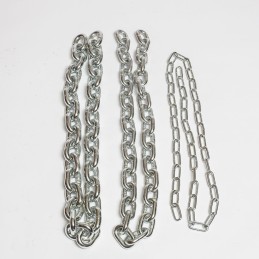
Adjustable chains, what makes the difference
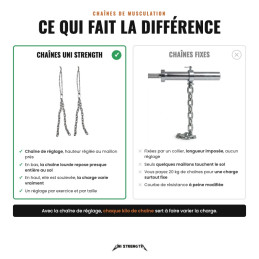
Chains attached directly to the bar have a fixed length. Only a few links touch the floor, so you pay for 20 kg of chain for a load that stays mostly fixed and a resistance curve that barely changes. With the lead chain, every kilo of chain works to vary the load.
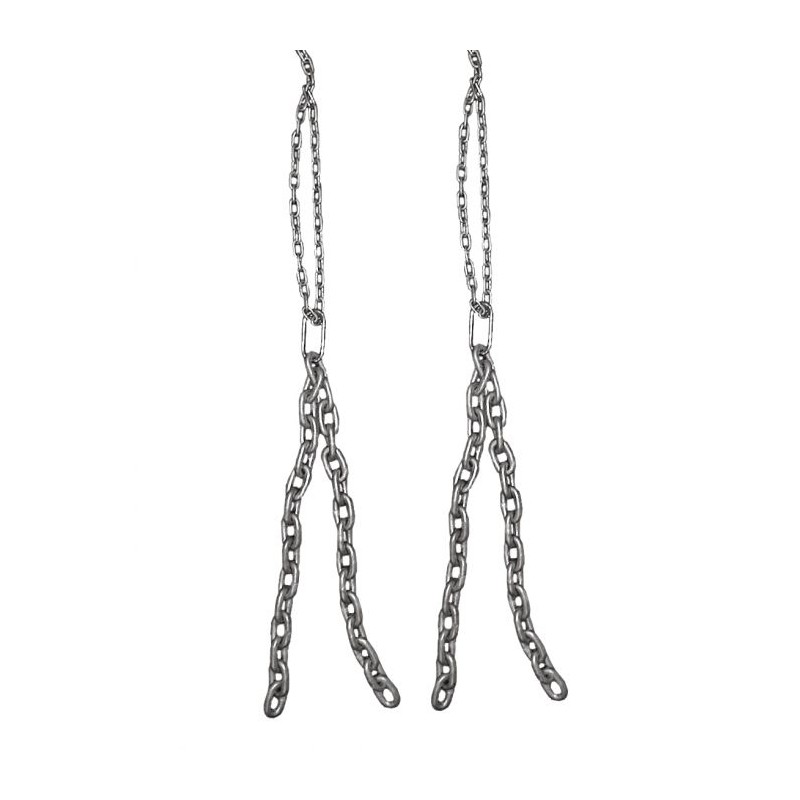
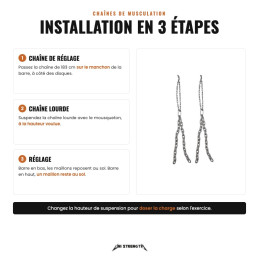
- Adjustable height. The 183 cm lead chain sets the hanging point link by link, to suit the exercise and your height.
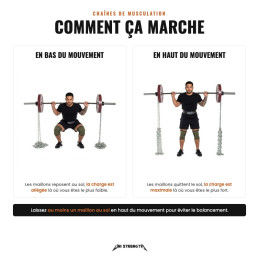
- Real load variation. At the bottom, the heavy chain rests almost entirely on the floor. At the top, it is lifted.
- Exact weight known. 2.3, 10.4 or 17.7 kg per pair, so the load can be programmed to the kilo.
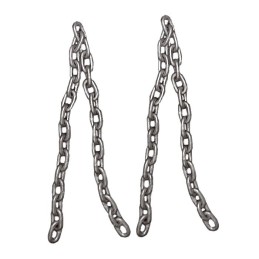
- Combinable and zinc-plated. 1.3 and 1.6 cm chains together, up to 28.1 kg per pair, in zinc-plated steel that resists corrosion.
How to set up weight training chains
1. Put the 183 cm lead chain over the bar sleeve, next to the plates. 2. Hang the heavy chain with the carabiner at the height you want. 3. Bar at the bottom, the links rest on the floor. Bar at the top, at least one link stays on the floor.
The training chains are an ideal tool for those looking to break progression plateaus by adding variable resistance to their workouts. Similar to elastic bands, they allow you to modify the resistance curve of your exercises. This means that the load varies according to the position in the movement, adapting to the force you are able to produce at different times.
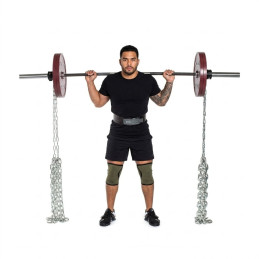
Weight training chains in the squat, a setup example
In a squat, you might be able to lift 260 kg in a quarter squat, but only 200 kg in a full squat. With chains, you can adjust the load so that it is 260 kg at the top of the movement and 200 kg at the bottom, where you are weakest. As you move down in the squat, the chains settle on the floor, lightening the load, allowing a more fluid and progressive movement.
Exercises with weight training chains
Chains can also be used for a number of assistance exercises such as:
- Extended triceps: Chains attached to handles, helping to relieve pressure on the elbows.
- Dips: Chains attached to a dips belt for variable resistance and overload at the end of the movement.
- Curls: Hold chains directly to add progressive resistance.
- Good morning: Wrap the chains around your neck to vary the resistance at each stage of the movement.
How variable resistance works
When you use chains, the resistance changes as the bar moves. At each end of the movement, more links leave or touch the ground, altering the load. For example, if you have a total of 55 kg of chains on the bar (27.5 kg on each side), the load will gradually increase as you lift the bar. At the top of the movement, the full 55 kg will be added to the bar, providing an overload at the end of the movement.
Chain specifications
- Zinc plated for corrosion resistance and durability.
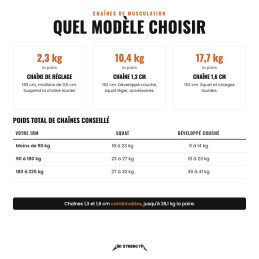
- 183 cm adjustment chains with 0.5 cm links - 2.3 kg pair.
- 152 cm chains with 1.3 cm links - pair weighing 10.4 kg.
- 152 cm chains with 1.6 cm links - pair weighing 17.7 kg.
Chains or resistance bands
Although both bands and chains change the strength curve, chains have several advantages:
- Durability: Chains are more durable; their strength does not decrease with wear.
- Stable trajectory: Unlike elastic bands, chains change the trajectory of movement very little, requiring less stability.
- Easy assessment: Chain resistance is easier to assess and programme.
- Progressiveness: They offer more progressive resistance, with extra weight at the end of the movement, which is sometimes difficult to achieve with elastic bands.
Tips for use
It is recommended to leave at least one link on the ground at the end of the movement to prevent the chains from oscillating, which could disrupt the trajectory and fluidity of the movement.
Find the full range of our plates in the weights category.
Frequently asked questions
Which weightlifting chain models are offered?
Three models sold in pairs, zinc-plated: 183 cm adjustment chains with 0.5 cm links (2.3 kg the pair), 152 cm chains with 1.3 cm links (10.4 kg the pair) and 152 cm chains with 1.6 cm links (17.7 kg the pair).
What are chains for in strength training?
To add variable resistance: the higher the bar rises, the more links leave the floor and the more the load increases. On the squat, the load is lighter at the bottom of the movement and heavier at the top, where you are strongest, which helps to break through plateaus.
What is the difference between chains and bands?
Chains are more durable (their resistance does not fade with wear), barely alter the movement path, are easier to assess and to programme, and offer a more gradual resistance with extra weight at the end of the movement.
Which exercises are chains used for?
Squat, lying triceps extensions (chains attached to handles), dips (chains attached to a dip belt), curls (chains held directly) and good morning (chains wrapped around the neck).
How should chains be used properly?
Leave at least one link on the floor at the end of the movement to stop the chains swinging and disturbing the path. With 55 kg of chains (27.5 kg per side), the whole 55 kg is added to the bar at the top of the movement.
How much chain weight should I choose?
Recommended total chain weight by 1RM. Under 90 kg, 18 to 23 kg for the squat and 9 to 14 kg for the bench press. From 90 to 180 kg, 23 to 27 kg for the squat and 18 to 23 kg for the bench press. From 180 to 225 kg, 27 to 32 kg for the squat and 36 to 41 kg for the bench press.
How do I set up chains on a barbell?
Put the lead chain over the sleeve, hang the heavy chain with the carabiner at the height you want, then adjust so the links rest on the floor at the bottom and at least one link stays on the floor at the top.
What is the lead chain for?
It sets the hanging height of the heavy chain. You choose how many links touch the floor for each exercise and your height, so the load truly varies between the bottom and the top of the lift.
Fixed chains or adjustable chains?
Chains attached directly to the bar have a fixed length. Only a few links touch the floor and the load stays mostly fixed. Adjustable chains, with a lead chain, vary the load over the whole range of motion.