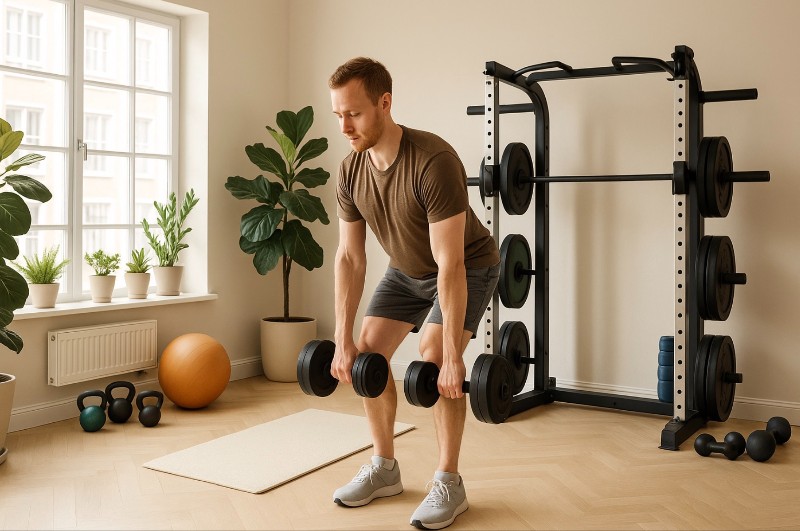
5 Mistakes to Avoid with Dumbbells
Training with dumbbells is one of the most effective ways to build strength and sculpt your body. However, poor technique can not only hinder your progress but also expose you to injuries. If you've ever experienced unexplained minor pains or felt like you're not getting the results you expected despite your efforts, this article is for you.
Proper form isn't just a minor detail: it's the very foundation of all strength training work. Let's explore the five most common mistakes with dumbbells and how to correct them to maximize your results while protecting your body.
In short
- The 5 mistakes: knees caving in on the squat, rounded back on the Romanian deadlift, momentum on the bent-over row, excessive lower back arch on the shoulder press, elbows flared to 90° on the bench press.
- Squat and Romanian deadlift: knees in line with the toes, flat back and hips pushed back.
- Row and presses: controlled movement pulling the elbows towards the hip crease, braced core, elbows at 45° on the bench press.
- Signs of poor technique: tension felt in the joints rather than the muscles, relying on momentum, pain during or after the session.
Why Technique Trumps Weight
Before diving into specific mistakes, it's essential to understand why proper form is so crucial. Many athletes think that lifting heavier automatically equals better results. This is a dangerous misconception.
Impeccable technique allows you to precisely target the intended muscles, avoid muscular compensations, and drastically reduce injury risk. When you sacrifice your form to lift heavier, you transfer tension from muscles to joints and tendons, which can lead to chronic pain and long-term injuries.
Signs that your technique isn't optimal:
- You feel tension in your joints rather than in your muscles
- You use momentum to lift the weights instead of controlled movement
- You don't feel the target muscle working during the exercise
- You experience pain or discomfort during or after training
- You're unable to maintain the same form throughout all your repetitions
Mistake #1: Dumbbell Squat - Knees Caving Inward
The dumbbell squat is a fundamental exercise for developing legs and glutes. However, it's also one of the movements where we observe the most technical errors. The most frequent mistake is letting the knees cave inward during the descent or ascent, a phenomenon called knee valgus.
This error puts excessive pressure on the knee ligaments and limits glute activation, which are the primary muscles you're trying to work. Over time, this bad habit can lead to chronic pain and significantly increase injury risk.
How to Correct This Mistake
Stand with feet shoulder-width apart or slightly wider, toes pointing slightly outward. Before descending, actively engage your glutes by imagining you're spreading the floor with your feet. Throughout the descent, keep your knees aligned with your toes, never letting them excessively push forward.
Descend until your thighs are parallel to the ground, or as low as your mobility allows while maintaining good form. Then push through your heels to rise, keeping your knees outward and squeezing your glutes at the top of the movement.
Practical tip: Use a resistance band placed just above your knees to create external resistance. This forces you to actively push your knees outward and reinforces this good motor habit.
Mistake #2: Romanian Deadlift (RDL) - Rounded Back
The Romanian deadlift is excellent for targeting hamstrings and glutes, but it requires impeccable technique to protect your spine. The most dangerous error is rounding your back during the movement, which exposes your intervertebral plates to enormous pressure.
Many athletes also round their shoulders forward, creating a hunched posture that amplifies stress on the spine. Another common mistake is bending the knees excessively, transforming the movement into a hybrid squat rather than a true hip hinge.

Correct RDL Technique
Start standing, feet hip-width apart, with a slight knee bend. Before beginning the movement, actively brace your spine by slightly tucking your chin and keeping your chest proud. Imagine a string pulling the top of your head toward the ceiling.
Initiate the movement by pushing your hips backward, as if you wanted to close a car door with your glutes. Let the dumbbells descend along your legs while maintaining a flat back and neutral gaze. You should feel an intense stretch in your hamstrings.
Descend until you feel good tension in the back of your thighs, then contract your glutes and hamstrings to return to the starting position. Throughout the movement, the dumbbells should remain very close to your legs.
Mistake #3: Bent-Over Row - Using Momentum Instead of Control
The bent-over dumbbell row is one of the best exercises for developing a powerful and balanced back. Unfortunately, it's also a movement where many athletes cheat with their technique, compromising their results and safety.
The main mistake is using momentum to yank the weights upward instead of performing a controlled, muscular movement. This usually happens when the dumbbells are too heavy or the core isn't sufficiently braced, causing the body to rock back and forth. Another classic error is shrugging the shoulders rather than pulling with the back, which primarily works the traps at the expense of the lats.
Perfecting Your Bent-Over Row
Position yourself by hinging at the hips, similar to the Romanian deadlift position. Your torso should be almost parallel to the ground, with a flat back and well-braced core. Let the dumbbells hang directly beneath your shoulders with arms extended.
When you pull, bring the dumbbells toward your hip crease, not toward your armpits. This execution angle promotes activation of the lats and mid-back rather than the traps. Keep your elbows close to your body and, at the top of the movement, squeeze your shoulder blades as if you wanted to pinch a pencil between them. Then slowly lower the weights with control.
Mental cue: Think about pulling with your elbows rather than your hands. This visualization helps transfer effort from the arms to the back muscles.
Mistake #4: Shoulder Press - Excessive Lower Back Arching
The shoulder press is fantastic for building strong and sculpted shoulders, but technique is paramount to protect your spine. The most common mistake is excessive lower back arching when the weights are overhead.
This arching usually occurs when the core isn't sufficiently braced or the dumbbells are too heavy. While it may seem harmless in the moment, it exerts considerable pressure on the lumbar vertebrae. Another frequent problem is excessive elbow flaring directly to the sides, which places the shoulder joint in a vulnerable position.
Executing a Perfect Shoulder Press
Whether seated or standing, the first priority is to brace your core. Imagine you're zipping up tight jeans. This contraction prevents your ribs from flaring and your back from arching. Start with your elbows slightly in front of your shoulders, not directly to the sides.
Push the dumbbells upward in a controlled manner, without completely locking your elbows at the top. At the top of the movement, your biceps should be next to your ears, not behind your head. This confirms that your spine remains neutral and your shoulders are in a safe and strong position.
If you struggle to raise the weights without leaning backward, reduce the load. Technique should always take precedence over ego. It's better to progress slowly with perfect form than to risk injury to lift a few extra pounds.
Mistake #5: Dumbbell Bench Press - Elbows Too Wide
The dumbbell bench press is a key exercise for developing upper body strength, particularly the pectorals, shoulders, and triceps. However, if your positioning is faulty or your control is lacking, this exercise can quickly become problematic.
The most common mistake is flaring the elbows perpendicular to the body. This position places significant strain on the shoulder joints and can make the movement uncomfortable or even painful. Many athletes also bounce the weights off their chest, especially when using heavy loads. This bouncing completely eliminates muscle tension and puts the joints at risk.
A more subtle but equally problematic error is wrist flexion backward during the press, which can cause wrist discomfort and make movement control much more difficult.
Mastering the Bench Press
Lie on a flat bench, incline bench, or on the floor, feet firmly planted, core engaged. Hold the dumbbells above your chest with straight wrists aligned above your elbows. As you lower the weights, maintain your elbows at a 45-degree angle to your torso. This position protects your shoulders while keeping focus on the pectorals.
Lower the dumbbells slowly, without bouncing, stopping just above your chest before pressing back up. Your path should be smooth and slightly arced, not in a straight line. Imagine the dumbbells moving in a gentle arc above your chest.
Most importantly, keep your wrists aligned with your forearms, without bending or letting them fall backward. Your joints should remain stacked and stable throughout the entire movement.
Summary Table of Mistakes and Corrections
| Exercise | Main Mistake | Key Correction | Target Muscle |
|---|---|---|---|
| Dumbbell Squat | Knees caving inward (valgus) | Actively push knees outward, knee-toe alignment | Quadriceps, glutes |
| Romanian Deadlift (RDL) | Rounded back, hunched shoulders | Maintain flat back, push hips backward, proud chest | Hamstrings, glutes |
| Bent-Over Row | Using momentum, shrugging shoulders | Controlled movement, pull toward hip crease with elbows | Lats, mid-back |
| Shoulder Press | Excessive lower back arching | Brace core, elbows slightly in front of shoulders, biceps near ears at top | Deltoids, triceps |
| Bench Press | Elbows at 90°, bouncing off chest | Elbows at 45°, controlled descent, wrists aligned with forearms | Pectorals, shoulders, triceps |
The Benefits of Perfect Technique
Improving your form isn't limited to avoiding injuries, though that's already a major advantage. Correct technique literally transforms the effectiveness of your workouts. When you perform a movement with impeccable form, you maximize mechanical tension on the target muscle, which is the primary stimulus for muscle growth.
Additionally, movement control develops a better neuromuscular connection. This connection between your brain and muscles allows you to truly feel the muscles working, making each repetition more productive. Over time, this body awareness improves all aspects of your training.
Concrete advantages of perfect technique:
- Reduced injury risk: Protection of joints and tendons
- Better muscle results: Precise targeting of intended muscles
- Faster progression: Ability to gradually increase loads safely
- Balanced development: Avoids muscle imbalances and compensations
- Athletic longevity: Ability to train sustainably without injury-related interruptions
- Optimal efficiency: Every repetition truly counts
- Increased confidence: Knowing you're executing movements correctly
How to Integrate These Corrections into Your Training
Now that you know the five major mistakes and their corrections, how do you put them into practice effectively? Change doesn't happen overnight, especially if you've ingrained certain bad habits for a long time.
Start by choosing one or two exercises to perfect per week. Film yourself performing the movements from different angles to precisely identify where your error lies. Temporarily reduce your loads to focus entirely on technique. It's better to lift lighter with perfect form than heavier with approximate technique.
Also integrate mobility and stabilization exercises into your routine. Limited ankle mobility can cause knees to cave during squats, while weakness in shoulder stabilizer muscles can lead to poor positioning during presses.
Checklist for safe progression:
- Film yourself regularly to analyze your technique
- Reduce loads if necessary to maintain perfect form
- Focus on muscle feeling rather than pure performance
- Integrate specific warm-ups to prepare the solicited joints
- Work on your mobility to allow complete range of motion
- Don't hesitate to ask advice from a coach or experienced athlete
- Be patient with yourself: technical mastery takes time
Conclusion: Technique as the Foundation of Your Success
Strength training is a marathon, not a sprint. Building a strong and aesthetic physique while preserving your joint health requires a thoughtful and patient approach. The five mistakes we've explored may seem technical, but their correction will radically transform your results.
Remember that proper form always takes precedence over the weight lifted. If you must choose between lifting heavy with approximate technique or lighter with perfect form, always choose the second option. Your muscles will develop better, your joints will thank you, and you'll be able to train consistently for years.
Every repetition is an opportunity to improve your technique. Approach each training session with intention and awareness. Ask yourself: do I really feel the muscle working? Is my movement controlled? Is my position safe? These simple questions will make all the difference in your long-term progression.
Investing in impeccable technique today will allow you to continue training with pleasure and efficiency in ten, twenty, or thirty years. It's perhaps the most profitable investment you can make in your fitness journey.
To go further in the shop: Dumbbells, Adjustable dumbbells, Fixed dumbbells. Also worth reading: our ranking of the best dumbbells in 2026.
The equipment to correct these mistakes
| Use | Equipment | Key figure |
|---|---|---|
| Getting the load exactly right | Adjustable dumbbells 4 to 20 kg, 100% steel | 1 kg steps, up to 65 kg with the extension kit |
| Squat, Romanian deadlift, row, shoulder press | HR-36 adjustable dumbbells, 100% steel | 4 to 36 kg per dumbbell, 2 kg steps |
| One fixed load per pair | Hexagonal rubber dumbbells | pairs from 2.5 to 70 kg, steel core |
| Dumbbell bench press, flat or incline | UF-5 Plus incline bench | backrest adjustable from 0 to 88° in 6 positions, 500 kg maximum load |
| Band above the knees for squats | Resistance bands | 7 sizes, resistance from 2 to 100 kg |
Specifications taken from the product pages on 9 October 2026.
Frequently asked questions
Why does technique matter more than load?
Clean execution targets the intended muscle, avoids compensations and reduces injury risk; sacrificing form to lift heavier shifts the tension onto joints and tendons.
What are the signs of poor technique?
Tension felt in the joints rather than the muscles, using momentum, the target muscle not working, pain during or after the session, form that cannot be held for every rep.
How do you fix knees caving in during the squat?
Feet shoulder-width apart, toes slightly out, glutes engaged as if spreading the floor, knees in line with the toes; a resistance band above the knees helps anchor the right reflex.