Guide to Training Chains
Chains are an effective tool to break plateaus and promote your progress!
Variable resistance
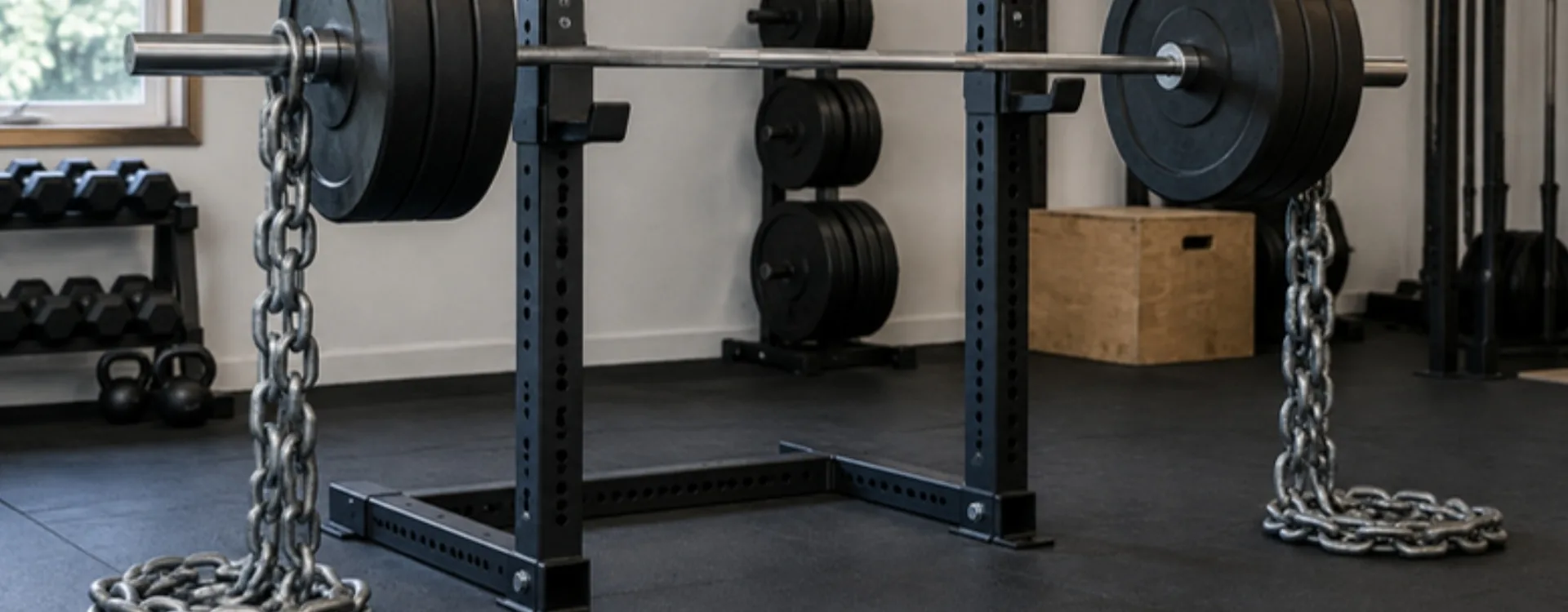
Similarly to resistance bands, if you have correctly set up the weightlifting chains, they will allow you to modify the resistance curve of the exercise, thus providing maximum muscle stimulation throughout the entire range of motion.
For example, you might be able to do a quarter squat with 260 kg, but you could only perform a full squat with 200 kg. With chains, you can make the weight at the top 260 kg, and as you squat down, more chains rest on the floor, making the load lighter.
Chains Vs. Bands
Advantages of chains:
- More progressive resistance than bands (no exceptional tension at the end of the movement)
- Modify the movement path less, less demand for stability
- Resistance easier to assess and program
- Chains: more durable, resistance does not decrease with wear
- Bands are not suitable for beginner/intermediate athletes
- Ideal for targeting a problematic part of the movement (sticking point)
Advantages of bands:
- Exponential resistance
- Requires more stability
- More easily transportable
- Lower acquisition cost
- Effective tool for speed work
Chains and bands are two different tools that are relevant in your training to overcome plateaus. Use them according to your goals and alternately
Setup
It is advisable to use the adjustment chain to optimize the height of the chains, so that all the chains rest on the ground at the bottom of the movement, leaving only a few links on the ground at the end of the movement (This will allow you to lift as much weight as possible while maintaining stability).
Therefore, we do not recommend using chains that attach directly to the bar without an adjustment chain, as this poor design diminishes the effect of progressive loads.
It is also possible to lift the entire chain at the end of the movement (leaving no links on the ground) if you want to work on your stability, but this will result in a reduction of the working load.
Measuring chain tension
The use of chains for variable resistance is simple to measure. Depending on the number of chains attached to the bar and at what height they are suspended, the chains gradually increase resistance as they are lifted.
For example, suppose you have a total of 30 kg of chains on the bar (15 kg on each side). Also assume that the chains only start to be lifted when the bar is 30 cm from the starting position, and that the total range of motion of the exercise you are performing is 60 cm.
This means that for every centimeter the bar moves above the midpoint (30 cm above the ground), the weight of the bar will gradually increase by 0.5 kg. Thus, at the top of the movement, the last links will be lifted, adding a total of 30 kg of resistance to the bar's weight.
Other uses
You can also use chains for assistance exercises:
- Lying tricep extensions (chains attached to handles): This will allow you to relieve the elbows during the stretching phase and overload the exercise during the contraction phase.
- Dips (do not put the chains around the neck, but attach them to a dip belt): This will allow you to relieve your elbows and shoulders in the low position, while overloading the triceps at the end of the movement.
- Curls: Hold the chain or use a handle.
- Good morning (wrap the chains around the neck).
- And many other exercises!
Summaries
Chains are an effective tool to progress and bring variety to your training. With proper setup and use, they allow for easily measurable variable resistance!
To go further in the shop: Training accessories, Olympic bars, Squat racks and power racks. Also worth reading: the 5 advantages of the Safety Squat Bar.
Frequently asked questions
What are chains used for in strength training?
To create variable resistance: at the bottom of the movement the chains rest on the floor and the load is lighter; as you rise they lift off and the load increases, stimulating the whole range of motion.
Chains or resistance bands?
Chains give a more progressive resistance that is easier to measure and lasts longer; bands are better for a specific sticking point and speed work. The two complement each other depending on the goal.
How do you set up chains correctly?
With an adjustment chain, so that the whole chain rests on the floor at the bottom and only a few links remain on the floor at the top. Avoid chains attached directly to the bar without adjustment.