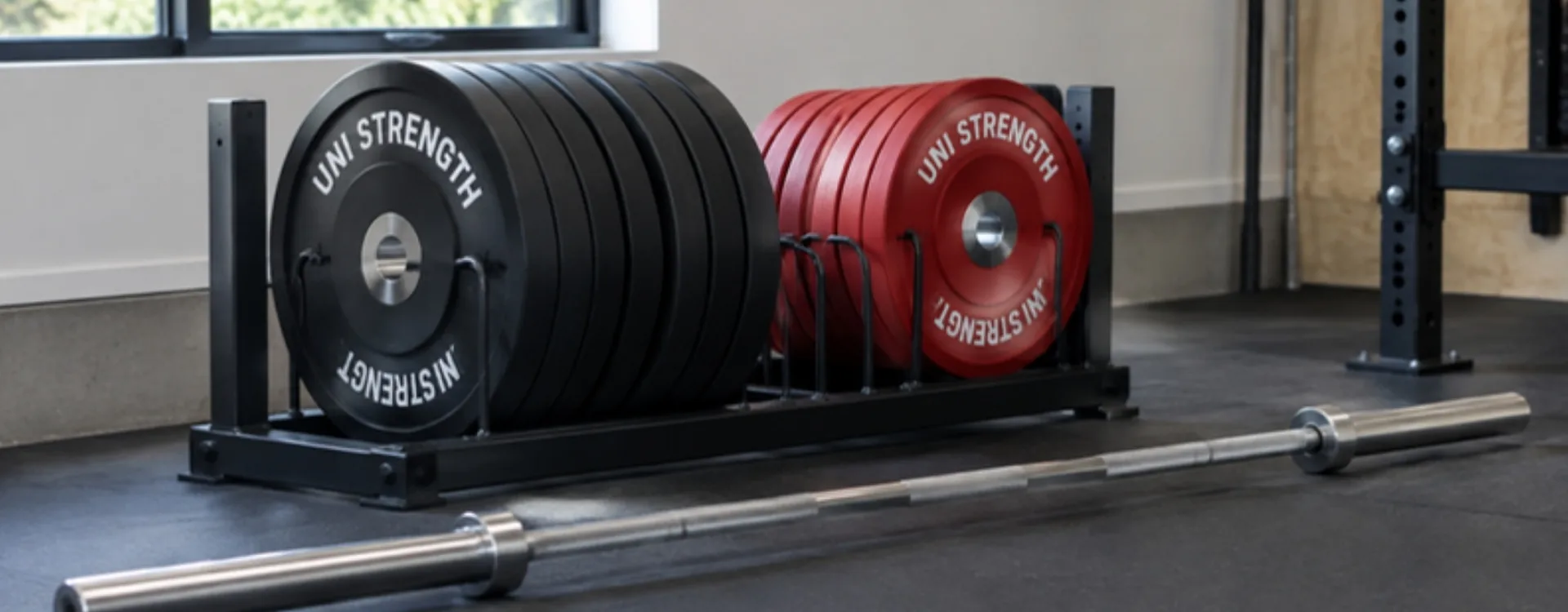
Weight Plates Buying Guide
An Olympic weight plate has a 50 mm hole; what changes from one family to the next is the weight tolerance, the diameter and whether you may drop it: calibrated (± 10 g), bumpers (rubber, 450 mm, ± 1 %), cast iron (± 2 % from 10 kg) and rubber.
Weight plates are one of the pillars of your gym. It is essential that these plates have characteristics suited to your activity to fully exploit them.
Weight Tolerance
Weight tolerance of less than 3% for 20 and 25 kg plates
Weight tolerance is essential. Indeed, some low-end weights have high tolerance. A 10% difference per weight on a pair of 20 kg plates corresponds to 2 kg, so it is possible in extreme cases to have one 18 kg plate and another 22 kg plate. In this case, there will be a 4 kg difference between the right and left sides of the bar. This problem can worsen with each pair of poorly calibrated plates placed on your bar.
Plate Thickness
Avoid plates that are too thick
Plate thickness must be considered, particularly for advanced athletes. Indeed, some bumpers made of recycled plastic (crumb) are very thick and will limit the load on the sleeves of your machines and Olympic bar (maximum 160 kg, which quickly becomes limiting for free weight leg training).
Plate thickness will also change the movement. For example: for a 240 kg deadlift with rubber bumpers, the bar will bend ("bar whip") more than with calibrated weights. Bumpers that fill the entire bar sleeve will exert greater forces than calibrated weights that stay close to the sleeves. The bar deformation will give a more progressive movement, as the 240 kg of the bar will not be felt at the start.
Diameter and Shape
450 mm diameter and round shape for deadlift athletes
A diameter less than 450 mm (IWF and IPF standard) will force you to do deficit deadlifts or set up blocks. A non-round shape, like an octagon, will be annoying for deadlifts since at each repetition the bar will move due to the weight shape.
Insert
A regular 50.4 to 50.6 mm steel insert
Insert dimension is the least known but essential factor for deadlift or Olympic movement athletes. It is important that the insert dimension is identical for each plate and closest to the bar dimension (50.4 mm). An insert that is too wide will create instability on the bar. Low-end weights have irregular inserts, too wide, or plastic ones that will be loose on the bar. It will be difficult to put the bar under tension in deadlift movements ("pulling the slack out of the bar"). This will have the effect of limiting your working load, decreasing mechanical tension, and increasing injury risk. Less annoying, irregular inserts can deteriorate the aesthetic appearance of your bar sleeve.
For bumpers, stainless steel firmly fixed in the plate is essential for durability.
Steel Weights
Cast Iron, Machined, and Calibrated
Steel plates offer excellent longevity and make more noise, the metal clank (some athletes love this old school noise, others prefer quieter weights). The advantage of cast iron weights is their attractive price (beware of price increases since 2021) and their low thickness. Their weaknesses are weight tolerance and insert dimension. Machined, we recommend these weights which offer a good compromise between price, tolerance, and thickness. These weights exist covered with plastic (we recommend Urethane for its durability), but the plate price will be significantly increased.
Calibrated steel plates, used in powerlifting competitions, have the advantage of being extremely precise (+/- 10g tolerance), very thin (you will never reach the load limit of your sleeve!). The disadvantages of these weights are the high price and difficulty handling them. These weights are very thin, have no handle, and a thin lip for gripping. We recommend these weights only for powerlifters who need to train with equipment similar to their competition. All steel plates are not suitable for weightlifting movements. They will make a steel noise and you will have to perform your deadlift on a platform arranged to protect your floor.
Bumper Plates
Versatile but beware of thickness
Bumper plates are the most versatile weights and represent a premium compared to steel weights. These weights, well suited to weightlifting practice, will significantly reduce noise and protect the floor a bit more for exercises like deadlifts.
Crumb: the cheapest bumpers that can be used outdoors. These plates have significant bounce and are very wide. Standard Olympic bar sleeves measure just under 42 cm on average, so if the 20 kg plates are 11 cm thick, it's difficult to fit more than 3 pairs of 20 kg with collars, so you remain limited to a 140-160 kg bar. The smell of the plates can be annoying, especially if they are produced from recycled tires; the use of adhesive will also release a strong odor (low-end glue has a more pronounced smell).
Rubber: The best compromise between price, performance, and versatility. Rubber and insert quality is essential for durability. Favor high-density rubber to limit thickness and bounce, and virgin rubber to limit odors. Example: a 20 kg plate with 72 mm thickness will allow fitting 5 pairs of 20 kg, one pair of 10 kg, and a collar, totaling 240 kg.
Competition and Training: The only disadvantage of these weights is the price; their weight tolerance and insert are excellent, their durability is good, and their thickness approaches steel plates. With only 55 mm thickness for 20 kg, competition plates will allow loading over 300 kg with collars.
Urethane: These weights are considered the most durable, but the price differential and grip difficulty related to the slippery coating present few advantages compared to competition bumpers.
Summary
Steel plates should be favored for people with a limited budget who lift heavy; weight tolerance and diameter are important criteria. Powerlifters will choose calibrated plates.
Bumpers are the most versatile plates; it is important to consider their thickness and insert quality to ensure good durability and not be limited by the weight on the bar.
Calibrated, bumper, cast-iron or rubber plates: which should you choose?
The four families
| UF calibrated | Bumpers | Cast iron | Rubber | |
|---|---|---|---|---|
| Tolerance | ± 10 g, IPF colour code | ± 1 % (black); ± 10 g, IWF standard (competition) | ± 2 % from 10 kg | — |
| Diameter | 450 mm on the 25 kg | 450 mm on every plate | varies | varies |
| Thickness | 22 mm (chrome) on the 25 kg | 26 to 71 mm (black), 33 mm (competition) | — | — |
| Dropping the bar | no | yes, designed for it | no | no |
| Sets | 157.5 to 459 kg | packs of 70, 100 and 150 kg | 107.5 to 187.5 kg | singles from 1.25 to 20 kg, sets of 107.5 to 187.5 kg |
| For | powerlifting, exact loading | weightlifting, CrossFit | classic strength training at the best price | protecting the floor and the bar |
When do you need bumpers?
When the bar gets dropped: snatch, clean and jerk, heavy deadlifts, CrossFit. For the bench press or the squat, where the bar never falls, cast iron or rubber is enough. Black bumpers are ± 1 %; competition bumpers, colour-coded, are ± 10 g and 33 mm thick, at the same 450 mm diameter.
When do you need calibrated plates?
To load the bar to the gram: 10 g tolerance checked against calibration weights, IPF colour code, 450 mm on the 25 kg. This is the plate of competition and competition prep. Sand-cast iron with epoxy coating is the standard version; chrome is thinner (22 mm on the 25 kg) and corrosion-resistant, with the same calibration.
How many kilos to start with?
In bumpers, 70 kg for beginners, 100 kg for regular lifters, 150 kg for heavy work. In calibrated plates, 157.5 kg for one lifter, 259 kg and more for a club platform. The Precision range (0.125 to 5 kg, ± 10 g, packs of 11.25, 17.5 and 21.25 kg) raises the bar by 250 g to 5 kg at a time.
Plate families in the Uni Strength range
| Family | Model | Key figure |
|---|---|---|
| Calibrated | UF calibrated chrome plates | 10 g tolerance per plate, 22 mm thick for the 25 kg, 50 mm hole |
| Bumpers | Bumper plates | 450 mm diameter, 1 % tolerance, 81 mm thick for the 25 kg |
| Competition bumpers | 20 kg competition bumper plate | thin enough to load up to 300 kg on a standard Olympic bar |
| Cast iron | Cast iron Olympic plates | 50 mm hole, 2 % tolerance from 10 kg, 3 % from 1.25 to 5 kg |
| Rubber | Rubber Olympic plates | 50 mm hole, 2 % tolerance from 10 kg, 3 % from 1.25 to 5 kg |
Specifications taken from the product pages on 9 October 2026.
Frequently asked questions
Do all plates fit all bars?
Yes: the whole catalogue uses the 50 mm Olympic hole, compatible with Uni Strength Olympic bars and with other brands using the same standard.
What is the difference between black and competition bumpers?
Black: ± 1 % tolerance, 26 to 71 mm thick; competition: colour-coded, ± 10 g, IWF standard, 33 mm thick; same 450 mm diameter.
Cast iron or chrome for calibrated plates?
Same calibration; epoxy-coated cast iron is the standard version, chrome is thinner and corrosion-resistant.