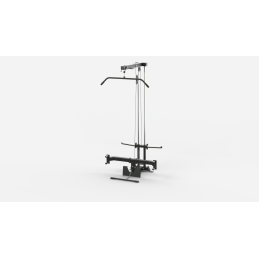
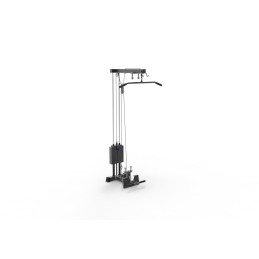
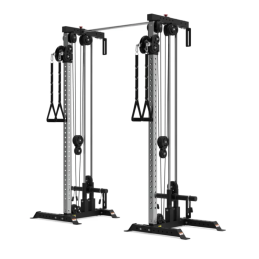
Why Choose a Training Pulley System?
Training pulley systems stand out for their ability to make movements smooth and controlled, which significantly reduces the risk of injury while maximizing exercise efficiency. Unlike dumbbells or barbells, they provide constant tension on muscles throughout the movement, thus offering optimal muscle work.
They are ideal for:
- Working specific muscle groups, such as biceps, triceps, shoulders or lats.
- Performing isolated movements with surgical precision, perfect for muscle strengthening or rehabilitation.
- Adding variation to traditional exercises, such as pulls, extensions or flyes, to break workout monotony.
Exercises to Perform with a Pulley and Muscles Worked
| Exercise |
Muscles Worked |
| Lat pulldown |
Lats, traps, biceps |
| Horizontal pull (rowing) |
Back, rear delts, forearms |
| Bicep curls |
Biceps, forearms |
| Tricep extensions |
Triceps |
| Cable flyes (chest) |
Pectorals, front delts |
| Face pulls |
Rear shoulders, traps, rhomboids |
| Cable crunches |
Abs, obliques |
| Cable abduction/adduction |
Glutes, abductors/adductors (inner and outer thigh) |
Advantages of Pulleys in Training
- Smooth and controlled movement: reduces pressure on joints, ideal for safe training.
- Maximum versatility: allows working all muscle groups with one machine (arms, shoulders, chest, abs...).
- Precisely adjustable load: promotes gradual progression, perfect for beginners or rehabilitation.
- Comfort and ergonomics: limits injury risks related to poor posture or unbalanced loads.
- Constant muscle tension: better activation thanks to continuous resistance throughout the movement range.
How to Choose a Pulley Adapted to Your Needs?
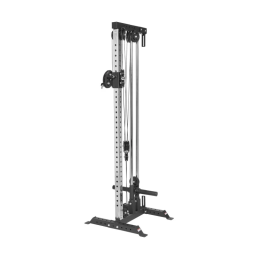
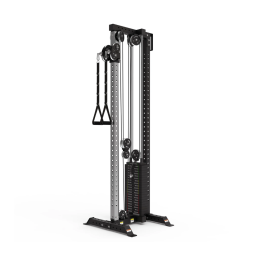
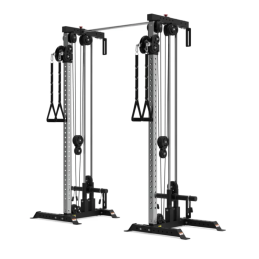
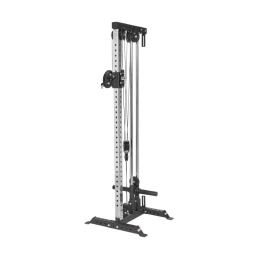
The choice of a pulley depends on your goals and space. High pulleys are ideal for vertical pulls and tricep extensions, while low pulleys suit bicep curls or abdominal pulls. If you're looking for a versatile solution, complete stations combine high, low and lateral pulleys, perfect for complete training at home or in the gym. For targeted work, dedicated back pull machines, like the lat pulldown, offer precise execution to effectively strengthen the lats. Choose a model suited to your needs and designed with robust materials for safe and durable use.

Frequently asked questions about cable machines
What is the difference between a high pulley and a low pulley?
A high pulley anchors the cable above your head, mainly for vertical pulls, triceps extensions and crunches. A low pulley places the cable at floor level for curls, rows and raises. The Uni Strength high/low systems combine both in one unit, while an adjustable pulley also offers every intermediate position.
Can a cable machine be used for rehabilitation?
Yes. The pulley is one of the most used tools in rehabilitation and sports physiotherapy. Progressive resistance, controlled movement and no crushing risk make it ideal for returning after a joint or muscle injury. Plate loading allows very fine increments (from 0.5 kg) for a progression matched to each stage of recovery.
What maximum load can a Uni Strength pulley take?
Capacity depends on the model. The CS-1 high/low pulley takes up to 250 kg thanks to its galvanised steel cables and aluminium pulleys. The Athena adjustable pulley offers a 1:1 ratio (the loaded weight equals the resistance felt), which guarantees precise work with no reduction effect.
Do I need to bolt the pulley to the floor?
Not always. Free-standing pulleys such as the Athena adjustable pulley have a base wide and heavy enough to stay stable without floor fixing, even under high loads. Rack-mounted pulley kits (CS-1 or CS-Basic) benefit from the stability of the rack itself. If your rack is not anchored, ballast sleeves or storage plates on the uprights improve overall stability.
Which pulley should a beginner choose?
For a beginner, the plate-loaded Athena adjustable pulley is the best entry point: maximum versatility with 19 height positions, plate loading keeps the initial cost down, and its minimal footprint suits small spaces. If you already own a CS-1 or CS-Basic rack, adding the high/low pulley kit is the most economical way to widen your training options without another machine.
What is the difference between plate loading and a weight stack?
Plate loading uses your existing Olympic plates: the most economical and scalable option, since you can load as much as your plates allow. A weight stack (built-in column) changes the load by moving a single pin, faster and more practical for drop sets or supersets. At Uni Strength the Athena range is available in both versions.